Saturday, March 28, 2026
No menu items!
spot_img
Home Blog Page 10

Malawi’s football clubs cry foul over inflated transfer fees

0


By Burnett Munthali

FCB Nyasa Big Bullets and Mighty Wanderers FC, two of Malawi’s top football clubs, are calling for urgent reforms in the way player transfer fees are handled.

The clubs claim that some teams are taking advantage of their interest in players, inflating prices to exorbitant levels.

Speaking to local media, officials from both clubs expressed frustration with the current system, which they say lacks transparency and fairness.

“Once a club hears that Wanderers are interested in their player, they drastically increase the price, which is surprising,” said Panganeni Ndovi, Chief Executive Officer of Mighty Wanderers FC.



Ndovi emphasized the need for clear regulations governing player transfers, particularly on how transfer fees are determined.

“We need proper regulations so that it’s not just about inflating prices simply because Wanderers want the player,” he added.

“Other countries have structured systems, and we also need to follow suit.”

Albert Chigoga, Chief Executive Officer of FCB Nyasa Big Bullets, echoed Ndovi’s sentiments, urging the Football Association of Malawi (FAM) to adopt structured transfer guidelines.

“The same player is sold at a lower price to other teams, but when Bullets show interest, the price goes up,” Chigoga said.

“Sometimes, this even delays transfers because clubs insist on excessively high fees.”

The clubs’ concerns highlight the need for FAM to take a closer look at the transfer system and introduce regulations that promote fairness and transparency.

As Ndovi pointed out, other countries have managed to establish structured systems, and Malawi should be no exception.

The calls for reform come as Malawi’s football clubs continue to navigate the challenges of the sport, from player development to financial sustainability.

With clear regulations in place, clubs like FCB Nyasa Big Bullets and Mighty Wanderers FC can focus on what matters most – promoting the beautiful game in Malawi.


Calm Amidst The Storm: The Rise of Prince Kapondamgaga (PK The Sniper)


By Sarah Banda

On Thursday evening, millions of Malawians were left glued to their TVs to watch the continuation of an inquiry into the infamous K128 billion Amaryllis Hotel sale – a contentious issue that has captured national attention and divided public opinion

Appearing before the no nonsense Public Accounts Committee of Parliament was Prince Kapondamgaga, affectionately known as PK the Sniper, the former State House Chief of Staff, who emerged as an unlikely hero amidst a swirling sea of political controversy.

The atmosphere was electric. Media personnel buzzed with anticipation, and multitudes of Malawians were all eager to witness the unfolding drama. Kapondamgaga entered the parliamentary chamber, his demeanor calm and composed – a stark contrast to the probing nature of the questions awaiting him.

Prince Kapondamgaga


As members of the panel rained down challenging inquiries, hoping to catch him off guard, Kapondamgaga responded with a steady voice and meticulously crafted arguments. His calmness was disarming; he navigated the hostile waters with a finesse that belied the tension.

Soon after the enquiry, renowned lawyer and activist James Ayuba James took note of this extraordinary display, sharing his thoughts on social media. “MCP MPs were largely absent at his appearance at the inquiry. Both Chaziya and Mkaka chose to play absent without leave, depriving the inquiry of their rehearsed English accent,” he tweeted.

James continued, “You may think that’s enough. Then, you see both Nation and Times (newspapers) writing positively about his performance at the inquiry, their articles loaded with acquittal undertones in which he is thematized and painted hero.”

Appearing before the committee is a daunting task for everyone but throughout his testimony, PK remained focused, and prepared with his explanations and as the inquiry concluded, the air was thick with a mix of skepticism and newfound respect. Kapondamgaga had not just defended himself; he had resonated with the audience, winning hearts across the nation. No wonder people have now started to refer to him as a “man of the people.”

PK’s impressive handling of the situation ultimately reinforced a broader movement for accountability in governance. His calm demeanor has become an emblem of resilience in the face of provocation. In a political landscape often defined by chaos and mistrust, Kapondamgaga emerged, shining as a beacon of hope. He has also demonstrated that integrity, perseverance, and the courage to speak truth to power could indeed alter the course of history.

Governance and Economic experts faults HRDC for contradiction on the role of MOF over Amaryllis Hotel sale

0


By Linda Kwanjana

Economic expert , scholar and Public policy analyst, Dr Ben Dzolowere has faulted Human Rights Defenders Coalition (HRDC) for contradicting themselves on the role of Ministry of Finance ,economic Planning and Decentralization on the Amaryllis Hotel deal.

Dr Ben Dzolowere says HRDC has been saying the Public Pension fund Trust operates autonomously while the same committee drags Ministry of Finance into the issues.

According to the laws of Malawi, Pension which I will site, below, Ministry of Finance is never involved and should never get involved. So we wonder why this HRDC kept  on contradicting itself during their press conference.

HRDC Presser


Accorsing to Dzolowere, Public Pension fund Trust is an autonomous entity with own board of trustees, management, bank accounts.

He says , the Fund’s resources are managed by independent Fund Managers and that Fund’s investments and related decisions are done through the Board of Trustees and independent investment managers.

He says , according to section 60 of the Pension Act  2023, Fund rules of the pension fund do not permit a trustee to be subject to any direction or order by any other person in exercise of the trustee’s power in relation to the fund.

According  to the laws of Malawi, any person who improperly or unduly seeks to influence a trustee in the performance of the functions of the trustee, commits an offence and shall, on conviction, be liable to a fine of K100 million or to imprisonment of ten years.

In this case,  the ministry of finance was not involved in the decision making and payment of the Amaryllis hotel and there is no evidence to that effect.

According to Dzolowere , who has been followiing this issue , RBM governor also said the same during the interview with the enquiry team.

FGRF Sparks New Wave of Economic Hope with K100 Million Injection

0


By Rahim Abdul

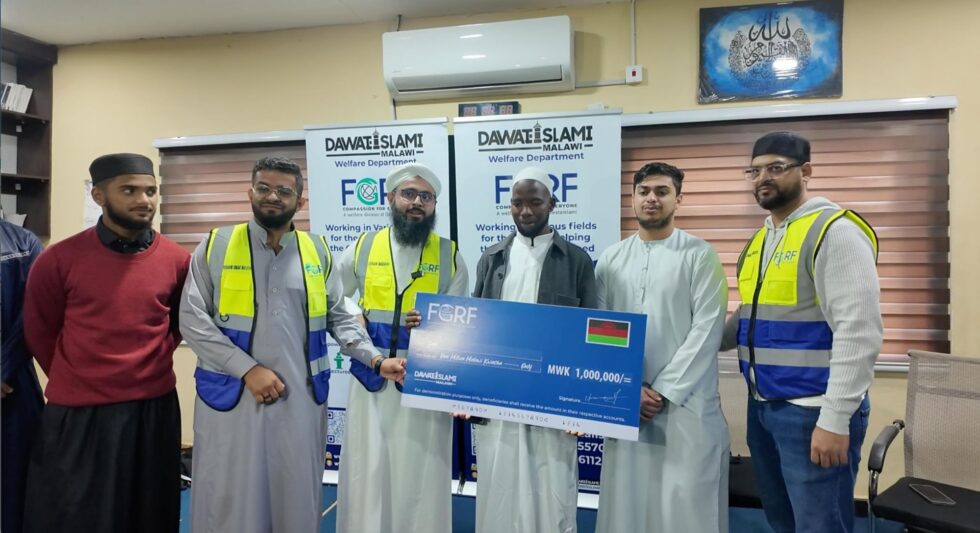
A fresh chapter of economic transformation is unfolding across Malawi as Faizan Global Relief Foundation (FGRF) rolls out a bold initiative aimed at turning vulnerable households into self reliant entrepreneurs, starting with a powerful K100 million cash distribution to 100 families.

Launched in Blantyre, the programme is not just about handing out money it is about planting seeds of long-term financial independence. Each selected household has received K1 million, a lifeline designed to ignite small businesses and restore dignity through productivity.

FGRF Africa head Usman Madani described the initiative as a shift from dependency to empowerment, emphasizing that beneficiaries are being equipped with business management skills to ensure their ventures thrive beyond the initial support.


“This is not charity, it is a partnership for progress,” Madani said, underscoring the organisation’s vision of building sustainable livelihoods that ripple through entire communities.

To strengthen accountability and financial discipline, all beneficiaries have been assisted in opening bank accounts, marking a significant step toward formal financial inclusion. Monitoring teams will track progress every two months, ensuring that the funds are translating into tangible growth.

Stakeholders have rallied behind the initiative, urging recipients to seize the opportunity with seriousness and foresight. Business leader Hanif Osman of OG Issa Group called for discipline and strategic investment, warning that success will depend on wise decision making.

Echoing similar sentiments, Abdul Munaf Siku of Siku Group and Abdul Latif highlighted the importance of honesty, hard work and proper record keeping as pillars of sustainable business growth.

For beneficiaries like Ismail Amidu from Kambulaje Village in Machinga, the programme is already a game changer. A small scale restaurateur, Amidu says the funding will allow him to expand his operations and move closer to financial independence.

Beyond this initiative, FGRF has made a remarkable humanitarian impact during the Ramadan period, reaching over 30,000 households with food assistance valued at more than K1 billion.

Districts such as Nsanje, Thyolo, Salima and Mangochi each recorded up to 4,000 households supported, while others including Mulanje, Chiradzulu and Zomba also benefited significantly.

In total, the organisation has injected over K1 billion into communities nationwide, combining immediate relief with long term empowerment strategies.

FGRF Director of Public Relations and Communications, Ibrahim Omar Mataya, reaffirmed the organisation’s commitment to uplifting lives, calling on more partners and well wishers to join hands in expanding the impact.

As Malawi continues to grapple with economic challenges, initiatives like this are rewriting the narrative proving that with the right support, ordinary families can rise, rebuild, and lead their own journey toward prosperity.

The bitter taste of victory: Unpacking the controversy surrounding the African Cup of Nations

By Burnett Munthali

The African Cup of Nations has once again been marred by controversy, with the recent final between Senegal and Morocco leaving many fans scratching their heads.

The match, which saw Morocco declared winners after a lengthy delay, has sparked outrage among football enthusiasts across the continent.

One fan, Mabasa Amu Obedience, summed up the sentiment, saying “Morocco are winners on paper, but Senegal are winners on grass.”

This statement highlights the perception that Morocco’s victory was tainted by the unusual circumstances surrounding the match.


The decision to award Morocco the win after a two-month delay has raised questions about the integrity of the tournament.

As one fan, Haileab Habtemariam, put it, “How do I explain to my grandkids in 2050 that once upon a time there was a country called Morocco who don’t regard themselves as Africans but won African Cup of Nations without winning on the pitch in year 2026?”

This statement speaks to the broader issue of Morocco’s identity and its relationship with the rest of Africa.

The fact that Morocco has won the tournament without actually winning on the pitch has led many to wonder if the competition has become more about politics than football.

As one fan quipped, “From now onwards, any nation hosting any tournament must be declared a winner or else we go to the boardroom.”

This tongue-in-cheek suggestion highlights the perception that the outcome of the tournament was predetermined.

Another fan, Driss Ragdy, simply stated, “Not all players left the field,” implying that Morocco’s victory was not just a sporting victory, but a statement of national pride.

The controversy has also sparked debate about the role of referees in football, with some arguing that their decisions should be final and others calling for greater accountability.

As Burnett Munthali noted, “Here is my personal opinion from the many experiences of football with reference to the sections being referred to in this context also in consideration that the referee’s decision is always final.”

However, in this case, it seems that the referee’s decision was not the only factor at play.

In conclusion, the African Cup of Nations has been tainted by controversy, and it’s time for African football to take a hard look at itself.

The continent deserves better than a tournament marred by politics and questionable refereeing decisions.

It’s time for a change, and it’s time for African football to put the interests of the game above all else.

*Personal opinion*

As a football fan, I’m deeply disappointed by the outcome of the African Cup of Nations. The controversy surrounding the match has left a bitter taste in my mouth, and I’m forced to wonder if the tournament is more about winning than about the beautiful game. The fact that Morocco can be declared winners without actually winning on the pitch is a travesty, and it’s a slap in the face to every football fan on the continent. It’s time for African football to clean up its act and put the interests of the game first.