
One of the country’s popular financial institutions, Ecobank Malawi has on Tuesday unveiled Save as You Spend Account, which allows customers to automatically save a percentage of their spending transactions.
According to the bank’s head of consumer banking Sophie Kalambule, the account is designed to help customers build up their savings while they spend on everyday needs.
“Customers can choose to save between one percent and 10 percent of their spending transactions, which will be transferred from their current account to their Save As You Spend Account,” she says.
Kalambule
Kalambule says the product is part of Ecobank Malawi’s commitment to promoting a saving culture and assist customers to achieve their financial goals.
She adds: “This is a simple and convenient way for our customers to save money while they spend.
“This is a unique and innovative savings account that automatically debits up to 10 percent of every transaction you make; hence, help our customers save effortlessly as they spend on their daily needs.”
Kalambule highlights that the account, with zero monthly fees, will enable customers to enjoy the benefits of saving such as earning interests, securing their future and accessing credit.
Ecobank Malawi is part of the Ecobank Transnational Incorporated, the parent company of the Ecobank Group that operates in 35 African countries.
A newly released Deloitte audit report has put recent past ruling Democratic Progressive Party (DPP) and its leadership on a tight corner following the plunder of money few months before they were booted out from Government
According to the report, between January 1, 2019 and June 30, 2020, illicit and dubious transactions were made at the Reserve Bank of Malawi through the hands and command of Reserve Bank Governor Dalitso Kabambe.
The audit found that K2.2 billion went out for “building maintenance, rentals, school fees allowances, recall of diplomats” but there are no supporting documents for these transactions. In short, this amount was stolen and Kabambe made a barefooted claim of these expenses.
Kabambe, masterminded of dubious transactions?
According to the document, K4.1 billion was paid to the Pensions and Gratuity Account without an approved funding instruction from government using FDH Bank while K6.5 billion went to FDH Bank in December 2018 and December 2020, which auditors found suspicious.
The audit further revealed that K3.9 billion costs payable to FDH Bank were not disclosed to the board for approval while USD$769 million was disproportionally channelled through FDH Bank.
The report has further revealed that K2.8 billion was paid to various law firms, but auditors did not trace any supporting documents while K27 billion was paid to retiring top managers, who in turn provided K7 billion to the then governing DPP in whose interest Kabambe has, at the material times, always worked.
The audit has found that Mulli Brothers Limited (MBL) was irregularly issued with letters of credit to supply fertilizer to the Government.
According to the audit , one company, Mitra, was awarded two contracts of K1 billion and K757 million contrary to RBM policy. Mitra was also irregularly paid 60% upfront.
According to the report K9.7 billion was siphoned in January 2020 through dubious purchase of overpriced materials for the Prisons Department worth US$18 million from the United Arab Emirates (UAE).
Over the years, I have observed that Malawians tend to avoid engaging in candid discussions about prominent figures in society, often out of a sense of deep respect or to steer clear of potential conflicts and controversies. Saulos Chilima’s eligibility to contest in the 2025 presidential elections after serving two consecutive terms as vice president is undoubtedly a matter of great significance for Malawi’s political landscape.
This issue deserves a candid discussion, regardless of the personal likability of Chilima, as it concerns the fundamental principles of democracy and governance in the country. First and foremost, it is essential to clarify that the decision regarding Chilima’s eligibility should be based on the law, as is the case in any democratic nation and not based on personality. The Malawian Constitution is the supreme law of the land, and its provisions should guide the interpretation of eligibility for any political office, including the presidency.
The legal context surrounding this issue, as highlighted by the Supreme Court of Appeal in the Bakili Muluzi vs. The Electoral Commission case in 2009, indicates that the presidency encompasses both the President and the vice presidents. This interpretation is consistent with the spirit of the Constitution, which seeks to prevent any individual from holding the presidency for an extended period, as it would be contrary to the principles of term limits and rotation of power. The Malawi Constitution establishes positions for both First Vice President and Second Vice President, and it is evident that these offices are included in the constitutional provisions regarding term limits.
If the two-term limit applied exclusively to the President, it could create a situation where an individual could serve as Second Vice President for two consecutive terms and then transition to First Vice President for another two consecutive terms before eventually assuming the office of the President for another two terms. This scenario would effectively defeat the entire purpose of limiting presidential terms, as the benefits and powers of the President and the Vice President positions are substantially similar.
It is clear, therefore, that the intention of the Malawian Constitution is to ensure that no individual holds a prominent executive position for more than two consecutive terms, whether as President, First Vice President or Second Vice President. This interpretation is not only legally sound but also aligns with the principles of democratic governance, ensuring a fair and equitable distribution of power and leadership opportunities.
In light of this legal framework and the spirit of the Constitution, Saulos Chilima’s eligibility to contest in the 2025 presidential elections must be examined within the context of these provisions. Chilima has served two consecutive terms. The first was from 2014 to 2019 when he paired with Arthur Peter Mutharika under the Democratic Progressive Party ticket and from 2020 to 2025 in the Tonse Alliance government. After serving two consecutive terms as Vice President, it would be constitutionally consistent for the UTM leader to be ineligible to run for the presidency in 2025.
However, it is crucial to emphasise that any discussion on this matter should remain objective and within the bounds of the law. The Malawian people, their leaders, and the judiciary should ensure that constitutional principles are upheld, providing a fair and just political environment where leadership transitions occur as intended by the Constitution. It is important to leave out emotions and personalities in such discourse. The willingness to engage in open and candid discussions on such matters is essential for the continued strengthening of Malawi’s democracy and the rule of law.
Just to agree with Prof. Kamchedzera, Chilimas political future hangs in the balance. His situation needs to be interpreted by the constitutional court through a presidential referral and as far as 2025 eligibility is concerned, it is only President Lazarus Chakwera who can do that referral.
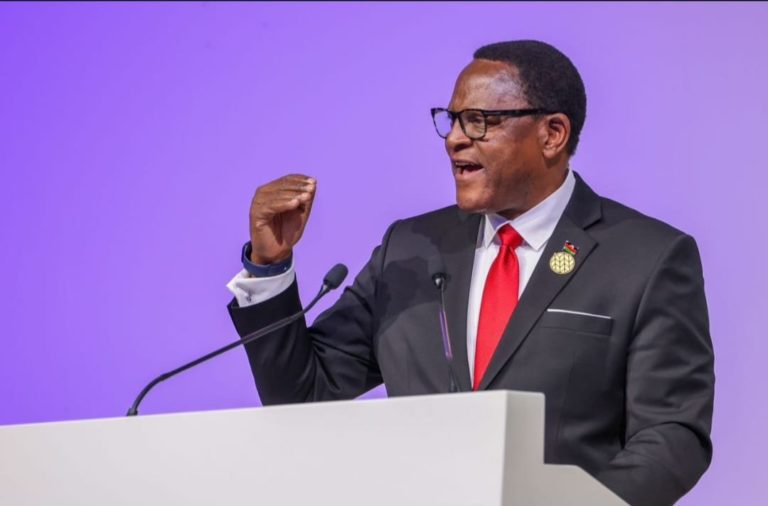
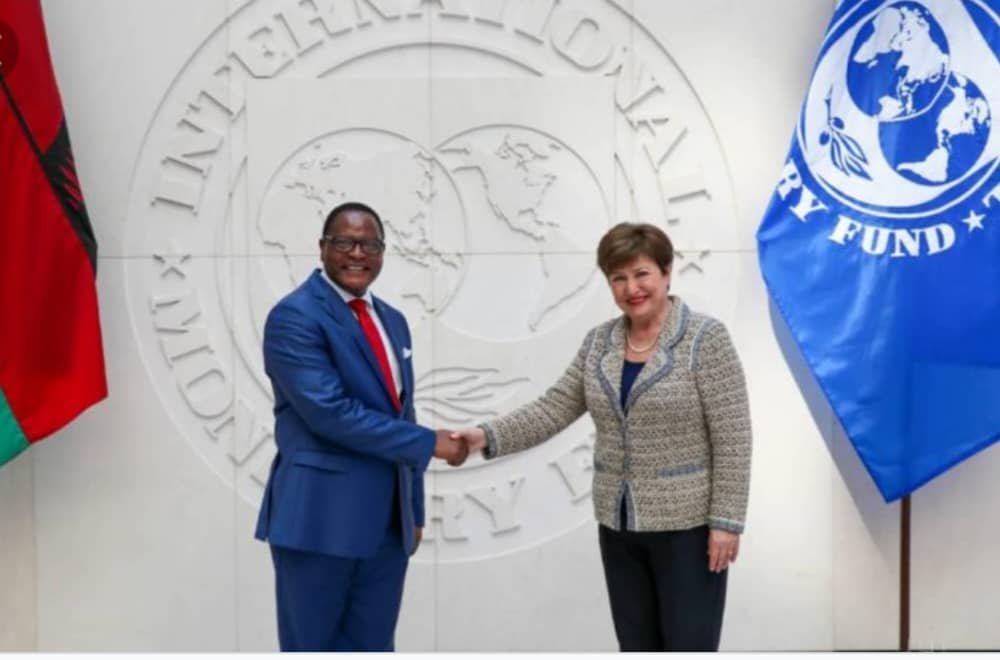
Malawi State President Dr Lazarus McCarthy Chakwera has made a strong appeal to the youths to take pride in their country.
President Chakwera was speaking in Lilongwe during the launch of the National Youth Policy.
“Make sure that youth programmes encourage young people to take pride in their country and what it produces, because they are citizens of a great country, and it is unjust to give them a false perception that Malawian ideas and products are inferior,” he said.
Chakwera urged stakeholders in Malawi’s development to use this policy as a guiding compass for safeguarding the rights and welfare of the youth.
The President commended the US Government for the support and efforts to develop the policy.
“When it comes to youth development work in Malawi, we count on the support of true friends like the USA to keep us going when the going gets tough. I also want to thank the Heads of other Missions who are here present, for I know that all of you are doing so much in Malawi that benefits our youth,” he said.
The president said the Government cherish support not only because it is a demonstration of friendship, but also because it is indispensable to addressing the challenges that youth face, challenges that are at once many, unique, complex, and varied.
The president said nearly a quarter of Malawi’s population lives in urban areas, others in peri-urban areas, and still others in rural areas, and it is critical that programmes be responsive to the different challenges youth face in different contexts of the economy.
Chakwera urged the youths to be responsible since they form larger population of the country.
Yona Mlotha, the Southern Region Youth Director of the Democratic Progressive Party (DPP), has issued a compelling call to fellow party members, urging them to promptly address internal differences and promote checks and balances within the current administration.
Mlotha made this plea during a political rally held at Chimbiri Primary School ground in Phalombe, where discussions centered on the demarcation of a new constituency.
He expressed apprehension about the current administration’s challenges in effective governance, emphasizing the need for a formidable opposition.
Mlotha stated, “I implore my fellow DPP members to unite and tackle the issues within our party. This way, we can establish a robust opposition capable of scrutinizing and addressing the challenges within the current regime.”
In the course of the rally, Bertha Nachuma, the Director of Women in the Southern Region, encouraged residents in the newly demarcated Phalombe South constituency to register in significant numbers to ensure their eligibility for voting in support of Professor Arthur Peter Mutharika and the party’s chosen Member of Parliament in the 2025 elections.
She also advised prospective Shadow Members of Parliament planning to contest in the area to adhere to the party’s constitution before commencing their campaigns, with special recognition of Tiaone Hendere, who has expressed interest in running for Member of Parliament in 2025.
Previously recognized as Phalombe South, the constituency has been subdivided into Phalombe-Machemba and Phalombe South. Bertha clarified that despite this division, Mary Mpanga remains a constituent until 2025.
Notable figures present at the rally included Member of Parliament for Machinga South East, Fyness Magonjwa; Member of Parliament for Mulanje-Bale, Victor Musowa; and Member of Parliament for Zomba-Malosa, Grace Kwelepeta.