Monday, April 6, 2026
No menu items!
spot_img
Home Blog Page 83

MLS finalises draft rules to operationalise judicial reforms

0


By Chisomo Phiri

The Malawi Law Society (MLS) says it has completed drafting key regulations and supporting instruments aimed at enabling the full operationalisation of the recently enacted Judicial Reform Acts.

The drafted instruments include proposed regulations, procedures for the Independent Complaints Commission of the Judiciary (ICCJ), impeachment procedures, and a Code of Conduct for judicial officers.



The Judicial Reform Acts comprise the Constitutional (Amendment) Act, 2025; the Judicial Service Administration Act, 2025; and the Courts (Amendment) Act, 2025, all of which were passed by the National Assembly on December 20, 2024.

However, on January 24, 2025, Former President Lazarus Chakwera assented to only two of the three laws,the Constitutional (Amendment) Act, 2025 and the Judicial Service Administration Act, 2025,leaving out the Courts (Amendment) Act, 2025.

On Monday,the judicial reform stakeholders  gathered in Lilongwe for an engagement workshop to discuss, review, and refine the draft documents before they are formally presented to government.

Those attended the workshop include representatives from the MLS, the Law Commission, the Malawi Human Rights Commission (MHRC), Youth and Society (YAS), the Centre for Democracy and Economic Development Initiatives (CDEDI), and the Centre for Human Rights Education, Advice and Assistance (CHREAA).

In an interview with journalists,MLS Chief Executive Officer (CEO ) Chrispin Ngunde said the drafted instruments are intended to fast-track implementation of the reforms by providing a solid foundation for formal rule-making.

“Our aim is to submit these draft instruments to the Ministry of Justice to trigger formal consultations and guide the development of official rules and regulations required to operationalise the Acts,” said Ngunde.

Mwanamveka blames rising debt,donor exit for slow economic growth

0

By Chisomo Phiri

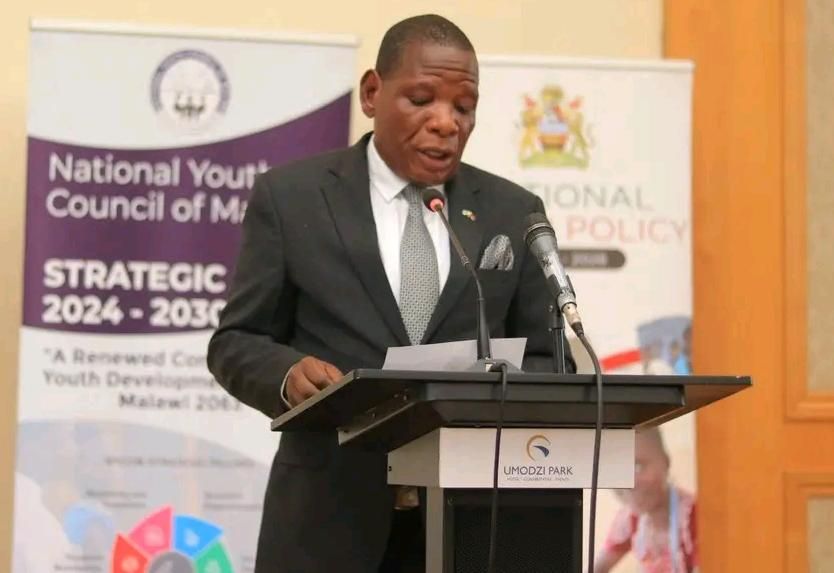
Minister of Finance, Economic Planning and Decentralisation Joseph Mwanamveka has attributed Malawi’s sluggish economic growth to rising public debt, reduced donor support, and increased government expenditure, warning that the pressures continue to constrain fiscal space.

The minister made the remarks during a pre-budget consultation meeting with youths in Lilongwe on Monday, where he acknowledged that unemployment remains a major challenge, particularly among young people.

Mwanamveka


Mwanamveka said Malawi’s public debt has risen to K22.6 trillion, with domestic debt accounting for 65 percent and external debt 35 percent.

He further disclosed that government is engaging development partners in discussions aimed at restructuring the country’s debt to ease the economic burden.

The minister said government remains committed to addressing youth unemployment through targeted empowerment initiatives and inclusive economic policies.

On her part, National Youth Network(NYN) Chairperson Salome Kadanzi called on government to increase funding towards youth empowerment programmes, including the Youth Innovation Fund, citing high demand and limited access to the resources.

PIL donates K400 Million fuel for food relief efforts

0

By Linda Kwanjana

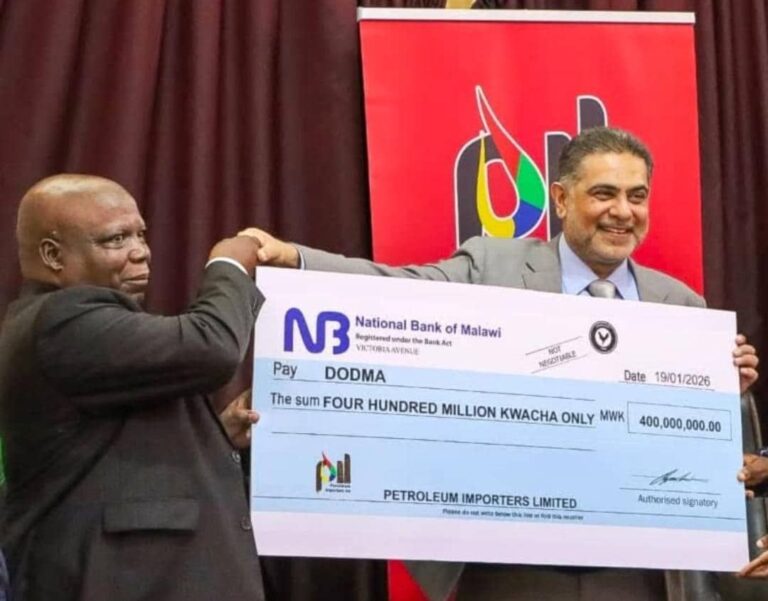
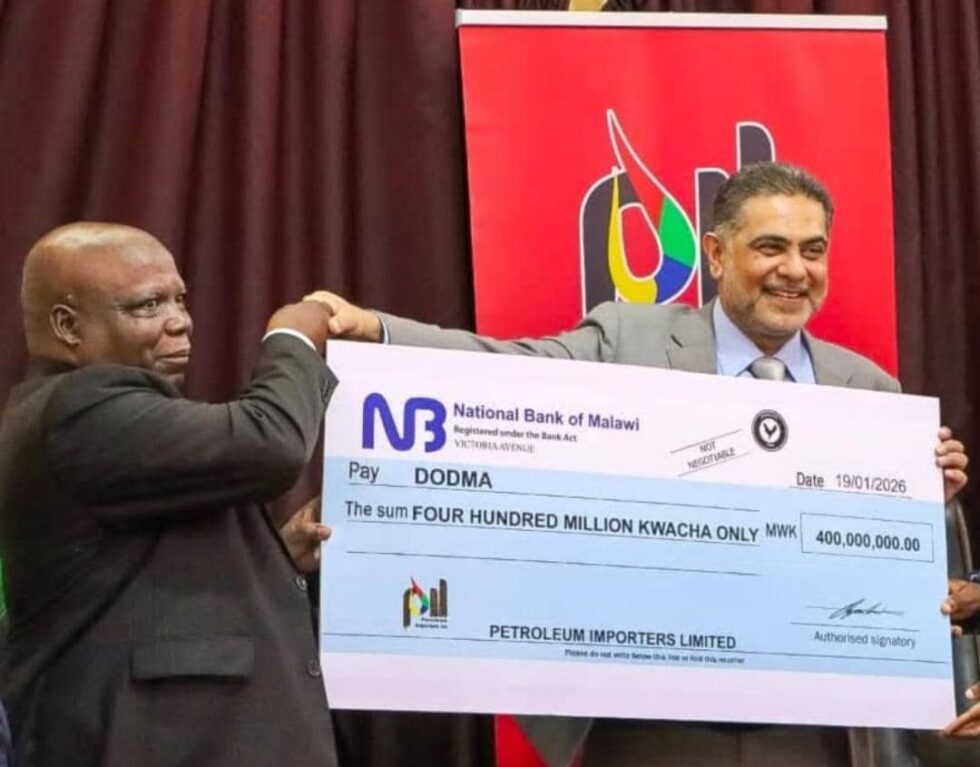
Petroleum Importers Limited (PIL), has stepped in to support government efforts to address food insecurity by donating fuel worth K400 million to the Office of the President and Cabinet (OPC) for the Lean Season Food Response Programme.

The donation is intended to support the transportation and distribution of relief food to hunger-affected households across the country.


The support comes at a time when government, through the Department of Disaster Management Affairs (DoDMA), continues to implement the National Lean Season Food Insecurity Response Plan, which focuses on addressing immediate, life-saving needs while also replenishing national food stocks.

Speaking during the handover ceremony, PIL Vice Chairperson Zubeir Bhana said the fuel contribution was made in response to the government’s declaration of a state of disaster in several districts following severe food shortages experienced last year.

“We wish to affirm our solidarity with the people of Malawi. This country is our home, and when it is in distress, we have a responsibility to act,” said Bhana.

He said the fuel will enhance the government’s ability to reach vulnerable populations, including communities in hard-to-reach areas, ensuring the timely delivery of humanitarian assistance.

“This fuel will enable the transportation of essential food supplies to affected communities. It is our contribution to keeping relief efforts moving and hope alive,” he explained.

He urged fellow private sector players, development partners, and well-wishers to partner with the government in responding to the emergency.

Receiving the donation, Chief Secretary to the President and Cabinet , Dr Justin Saidi, commended PIL for the timely support, saying the private sector has demonstrated strong commitment to complementing government efforts in responding to hunger.

“ We thank Petroleum Importers Limited for the generous and timely contribution towards the food insecurity response programme. This donation will greatly facilitate the efficient movement and distribution of humanitarian food to food-insecure households across the country,” said Saidi.

He added that the support from a local private sector player is a strong demonstration of togetherness, solidarity, and shared responsibility in achieving national aspirations such as food security and poverty reduction, as outlined in Malawi 2063.

The Response Plan requires an estimated MK209.4 billion to address all needs across the prioritized clusters out of which MK138 billion has been mobilized from government and partners, with the remaining MK71 billion still to be mobilized.

PIL is a consortium of four oil marketing companies namely Puma Energy, TotalEnergies, Vivo Energy and Petroda

MERA hikes fuel prices by over 41%

0

By Chisomo Phiri

The Malawi Energy Regulatory Authority (MERA) has announced a sharp increase in fuel prices, with both petrol and diesel rising by over 41 percent, effective January 20, 2026.

In a press statement signed by MERA Board Chairperson Lucas Kondowe, the authority says the adjustment follows the reinstatement of the Automatic Pricing Mechanism (APM), under which fuel prices are reviewed whenever movements in key pricing parameters exceed a ±5 percent trigger band.


According to MERA, the APM had been abandoned over the past three years in favour of a fixed pricing regime.

However, the authority says the fixed system proved commercially unsustainable, leading to significant losses for fuel importers and suppliers.

“These losses resulted in the inability to import adequate petroleum products and failure to remit critical levies such as the Road Levy to the Road Fund Administration and the Rural Electrification Levy to the Malawi Rural Electrification Programme (MAREP) Fund,” reads the statement.

MERA notes that the situation contributed to the deterioration of road infrastructure nationwide and delayed the implementation of key rural electrification projects.

The regulator further says artificially low fuel prices created arbitrage opportunities for smugglers, leading to the loss of scarce foreign exchange as Malawi effectively subsidised fuel consumption in neighbouring countries.

This, according to MERA, also resulted in the depletion of the country’s Strategic Fuel Reserves.

Following a review for January 2026, the authority says the landed cost of both petrol and diesel exceeded the ±5 percent trigger threshold under the APM, necessitating an upward price adjustment to ensure continued fuel importation.

Under the new pricing structure, the pump price of petrol has increased from K3,499 per litre to K4,965 per litre, representing a 41.90 percent rise.

Diesel has gone up from K3,500 per litre to K4,945 per litre, an increase of 41.29 percent.

MERA has since warned that, by law, all fuel retailers must sell petroleum products at prices not exceeding the approved maximum pump prices.

Kambanje criticises fuel price hike

0

By Chisomo Phiri

Human rights advocate Edward Kambanje has criticised the recent fuel price hike, arguing that the government has failed to shield citizens from economic shocks and warning that the move will worsen the cost of living.


In an interview with 247 Malawi News, Kambanje said government leadership is about absorbing shocks during difficult times rather than transferring the full burden to ordinary citizens.

“Government business is about absorbing shocks when necessary, not shifting the entire burden onto citizens,” said Kambanje.

Kambanje


He called for the restructuring of Malawi’s fuel pricing mechanism, saying it should strike a balance between market realities and social protection, as demonstrated by successful middle-income countries.

Kambanje acknowledged that automatic fuel pricing is not inherently flawed, describing it as a policy tool.

However, he warned that when applied without safeguards, it causes unnecessary hardship.

“Automatic pricing is not inherently wrong; it is a tool. But when applied without cushioning, it becomes automatic suffering,” he said.

The human rights advocate noted that fuel price increases have a direct and widespread impact on the economy, effectively devaluing the purchasing power of citizens as the prices of goods and services rise.

“A fuel price increase has a domino effect. Everything becomes more expensive, and in this case, the risks outweigh the benefits,” he said.

Kambanje also linked fuel price instability to the continued depreciation of the Malawi kwacha, particularly on the parallel market.

He pointed out that while the official exchange rate presents a different picture, the kwacha is reportedly trading at around K240 to one South African rand on the parallel market.

“If fuel prices are to decrease, the kwacha must stabilise first. The variance between the official exchange rate and the parallel market rate is simply too wide,” he said.

The human rights advocate concluded by urging the government to take decisive action to protect Malawians from the rising cost of living.

“The government can and should protect its people,” he said.

The Malawi Energy Regulatory Authority (MERA) on Tuesday morning announced a sharp increase in fuel prices, with both petrol and diesel rising by over 41 percent, effective January 20, 2026.

MERA Board Chairperson Lucas Kondowe,said the adjustment follows the reinstatement of the Automatic Pricing Mechanism (APM), under which fuel prices are reviewed whenever movements in key pricing parameters exceed a ±5 percent trigger band.

He said the APM had been abandoned over the past three years in favour of a fixed pricing regime.

Under the new pricing structure, the pump price of petrol has increased from K3,499 per litre to K4,965 per litre, representing a 41.90 percent rise.

Diesel has gone up from K3,500 per litre to K4,945 per litre, an increase of 41.29 percent.