Friday, April 10, 2026
No menu items!
spot_img
Home Blog Page 91

MERA hikes fuel prices by over 41%

0

By Chisomo Phiri

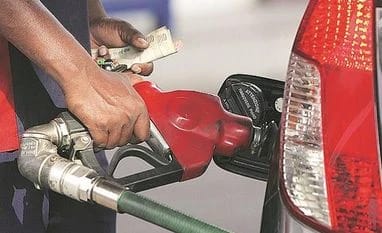
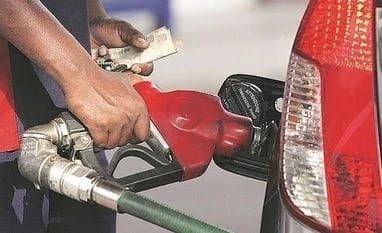
The Malawi Energy Regulatory Authority (MERA) has announced a sharp increase in fuel prices, with both petrol and diesel rising by over 41 percent, effective January 20, 2026.

In a press statement signed by MERA Board Chairperson Lucas Kondowe, the authority says the adjustment follows the reinstatement of the Automatic Pricing Mechanism (APM), under which fuel prices are reviewed whenever movements in key pricing parameters exceed a ±5 percent trigger band.


According to MERA, the APM had been abandoned over the past three years in favour of a fixed pricing regime.

However, the authority says the fixed system proved commercially unsustainable, leading to significant losses for fuel importers and suppliers.

“These losses resulted in the inability to import adequate petroleum products and failure to remit critical levies such as the Road Levy to the Road Fund Administration and the Rural Electrification Levy to the Malawi Rural Electrification Programme (MAREP) Fund,” reads the statement.

MERA notes that the situation contributed to the deterioration of road infrastructure nationwide and delayed the implementation of key rural electrification projects.

The regulator further says artificially low fuel prices created arbitrage opportunities for smugglers, leading to the loss of scarce foreign exchange as Malawi effectively subsidised fuel consumption in neighbouring countries.

This, according to MERA, also resulted in the depletion of the country’s Strategic Fuel Reserves.

Following a review for January 2026, the authority says the landed cost of both petrol and diesel exceeded the ±5 percent trigger threshold under the APM, necessitating an upward price adjustment to ensure continued fuel importation.

Under the new pricing structure, the pump price of petrol has increased from K3,499 per litre to K4,965 per litre, representing a 41.90 percent rise.

Diesel has gone up from K3,500 per litre to K4,945 per litre, an increase of 41.29 percent.

MERA has since warned that, by law, all fuel retailers must sell petroleum products at prices not exceeding the approved maximum pump prices.


Kambanje criticises fuel price hike

0

By Chisomo Phiri

Human rights advocate Edward Kambanje has criticised the recent fuel price hike, arguing that the government has failed to shield citizens from economic shocks and warning that the move will worsen the cost of living.


In an interview with 247 Malawi News, Kambanje said government leadership is about absorbing shocks during difficult times rather than transferring the full burden to ordinary citizens.

“Government business is about absorbing shocks when necessary, not shifting the entire burden onto citizens,” said Kambanje.

Kambanje


He called for the restructuring of Malawi’s fuel pricing mechanism, saying it should strike a balance between market realities and social protection, as demonstrated by successful middle-income countries.

Kambanje acknowledged that automatic fuel pricing is not inherently flawed, describing it as a policy tool.

However, he warned that when applied without safeguards, it causes unnecessary hardship.

“Automatic pricing is not inherently wrong; it is a tool. But when applied without cushioning, it becomes automatic suffering,” he said.

The human rights advocate noted that fuel price increases have a direct and widespread impact on the economy, effectively devaluing the purchasing power of citizens as the prices of goods and services rise.

“A fuel price increase has a domino effect. Everything becomes more expensive, and in this case, the risks outweigh the benefits,” he said.

Kambanje also linked fuel price instability to the continued depreciation of the Malawi kwacha, particularly on the parallel market.

He pointed out that while the official exchange rate presents a different picture, the kwacha is reportedly trading at around K240 to one South African rand on the parallel market.

“If fuel prices are to decrease, the kwacha must stabilise first. The variance between the official exchange rate and the parallel market rate is simply too wide,” he said.

The human rights advocate concluded by urging the government to take decisive action to protect Malawians from the rising cost of living.

“The government can and should protect its people,” he said.

The Malawi Energy Regulatory Authority (MERA) on Tuesday morning announced a sharp increase in fuel prices, with both petrol and diesel rising by over 41 percent, effective January 20, 2026.

MERA Board Chairperson Lucas Kondowe,said the adjustment follows the reinstatement of the Automatic Pricing Mechanism (APM), under which fuel prices are reviewed whenever movements in key pricing parameters exceed a ±5 percent trigger band.

He said the APM had been abandoned over the past three years in favour of a fixed pricing regime.

Under the new pricing structure, the pump price of petrol has increased from K3,499 per litre to K4,965 per litre, representing a 41.90 percent rise.

Diesel has gone up from K3,500 per litre to K4,945 per litre, an increase of 41.29 percent.

Malawi Eyes Regional Solution to Costly Medical Referrals

0


By Rahim Abdul

Malawi could soon reduce its reliance on expensive overseas medical referrals as government moves to strengthen health cooperation within the region, with Tanzania emerging as a key partner in specialised healthcare delivery.

Health Minister Madalitso Baloyi says the country is considering a bilateral agreement that would allow Malawian patients in need of specialised treatment to receive care in Tanzania, a move expected to ease pressure on both government finances and struggling families.

Speaking during a tour of Benjamin Mkapa Hospital in Tanzania, Baloyi revealed that nearly 1,900 Malawians are currently waiting to be referred for specialised treatment abroad, most of them destined for far off countries such as India at high cost.

She noted that accessing advanced medical services in Tanzania would not only shorten travel distances for patients but also significantly cut referral expenses, allowing government to redirect resources to other critical areas of the health sector.


Beyond patient referrals, the proposed partnership is also expected to deepen collaboration between the two countries through joint training programmes, medical research initiatives and exchange of health professionals.

Baloyi expressed confidence that Tanzania’s fast-growing healthcare infrastructure, anchored by facilities such as Benjamin Mkapa Hospital, can help bridge Malawi’s gap in specialised medical services while long term local capacity is being developed.

Tanzania’s Minister of Health, Mohammed Mchengerwa, welcomed the initiative, describing it as a practical and sustainable approach to regional health cooperation that benefits both countries.

If concluded, the agreement is expected to bring specialised healthcare closer to Malawians, reduce referral backlogs and mark a major shift towards regional solutions in addressing shared health challenges.

Two ESCOM Employees Die in Tragic Line of Duty Incident in Lilongwe

0


By Rahim Abdul

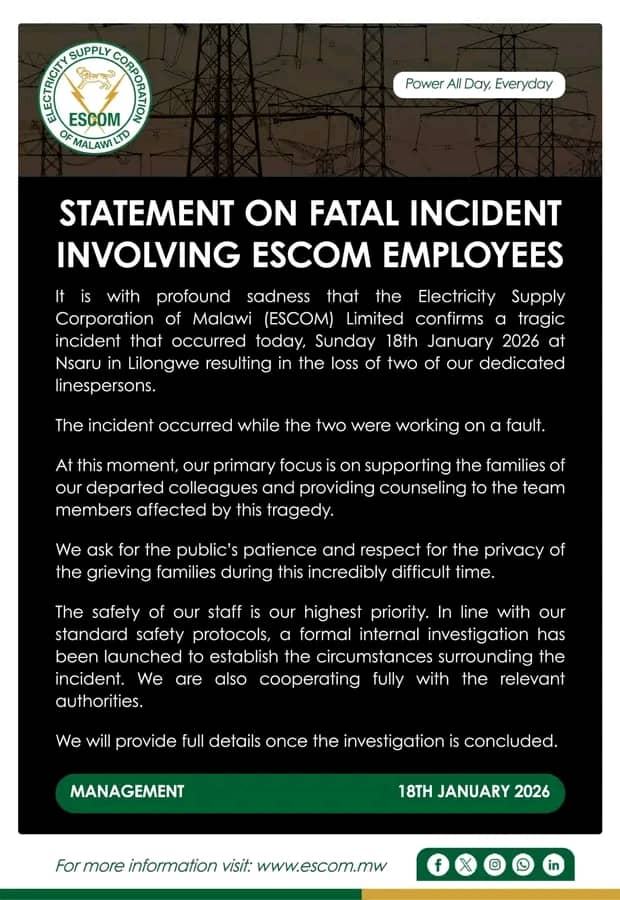
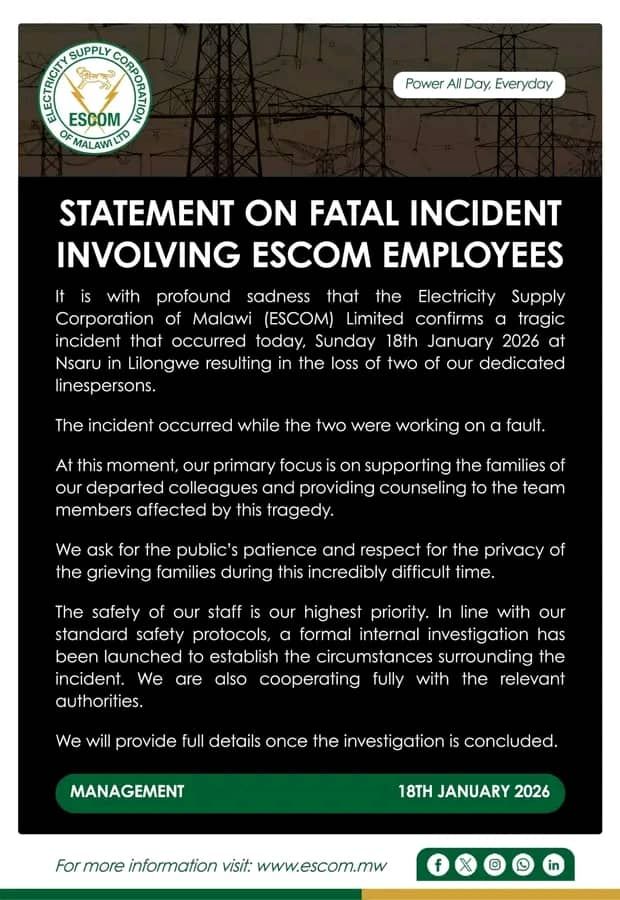
The Electricity Supply Corporation of Malawi (ESCOM) has confirmed the death of two of its employees following a tragic incident that occurred on Sunday, January 18, 2026, at Nsaru in Lilongwe.

In a statement released by the corporation, ESCOM said the two were experienced linespersons who lost their lives while carrying out fault repair works on the power network.

The incident has sent shockwaves across the utility company and the nation at large.

“It is with profound sadness that ESCOM Limited confirms a tragic incident that occurred today resulting in the loss of two of our dedicated linespersons,” reads part of the statement signed by management.


According to the statement, the incident happened as the two employees were attending to a reported fault, a routine task that forms part of efforts to maintain stable electricity supply across the country. Further details surrounding the exact circumstances have not yet been disclosed.

ESCOM said its immediate priority is to support the bereaved families, adding that counselling services are also being provided to colleagues and team members affected by the tragedy.

The power utility has appealed to the public to exercise patience and respect the privacy of the grieving families during what it described as an “incredibly difficult time.”

“The safety of our staff is our highest priority,” ESCOM said, noting that a formal internal investigation has been launched in line with standard safety protocols to establish what led to the fatal incident.

The corporation also confirmed that it is fully cooperating with relevant authorities as investigations continue. ESCOM said full details will be made public once the inquiry is concluded.

The deaths come as a painful reminder of the risks faced daily by power utility workers who often operate under hazardous conditions to keep electricity flowing to homes, businesses and essential services.

Meanwhile, messages of condolence have begun pouring in from members of the public and various institutions, with many describing the fallen workers as heroes who died in the line of duty.

Police arrest 5 men for robberies, recover stolen items in Lilongwe

0


By Rahim Abdul

Lilongwe Police has arrested four men suspected to be members of a notorious criminal syndicate in connection with a series of robberies that occurred in Area 1, Falls Estate in Lilongwe, where foreign nationals were targeted.

The suspects have been identified as Lano Banda,aged 27, James Banda, 32 years old, Gregory Makonokaya, 41years old, all operating from Bangwe and Ndirande townships in Blantyre, and Alfred Banda, aged 39, of Mgona location in the capital city.

Police have also arrested Steven Lackson, 25 years old, an IT technician based at Devil Street in Lilongwe, who was allegedly buying stolen property from the suspects and forwarding it to Blantyre for resale.


On November 18, 2025 during night time, the suspects attacked four Nigerian nationals who were residing in the same house and stole four mobile phones, HP laptop, a wristwatch and K6.1 million in cash. Police have since recovered the laptop and a cellphone.

In another incident, on November 26, 2025 at around 01:00 hours, the suspects, while armed with panga knives, attacked six Central Poultry Limited employees of Indian origin who were within the same compound.

The suspects stole three laptops, a cellphone, and cash amounting to one million kwacha. Two laptops and one mobile phone have been recovered.

Further, on November 29, 2025 the suspects attacked a Pakistani national and four other housemates, all Central Poultry Limited employees. During the attack, one victim sustained a fractured left arm.
The suspects went away with two cellphones and K695,000 in cash, among others.

Following the incidents, Lilongwe Police detectives gathered intelligence which linked the suspects to the robberies, along with two other accomplices who are currently at large.

The investigations led detectives to Blantyre, where Lano Banda, James Banda and Gregory Makonokaya were arrested. Alfred Banda was later arrested at Bwandiro in the capital city.

The suspects will be taken to court soon to answer multiple counts of robbery and unlawful wounding, while investigations continue to apprehend the remaining suspects.

Lano Banda comes from Kheleng’ende Village, Traditional Authority Nsabwe in Thyolo, James Banda hails from Msukwa Village, Tradition Authority Nsamala in Machinga district, Gregory Makonokaya is from Mitawa Village, Tradition Authority Mulumbe, Zomba, Alfred Banda comes from Chimwamkango Village, Tradition Authority A Mkanda,  Mchinji and Steven Lackson is from Kumatenga Village, Tradition Authority  Chauma in Dedza District.