


By Staff Reporter
On Saturday, 4 October 2025, Justice Dr. Jane Mayemu Ansah, SC, JA (Retired) was sworn in as Malawi’s First Vice President at Kamuzu Stadium in Blantyre, alongside President Professor Arthur Peter Mutharika.
Her inauguration marked a historic moment as she became only the second woman to hold the country’s second-highest office, and the first to do so under a Democratic Progressive Party administration since 2020.
Dr. Ansah entered frontline politics with a record already etched in Malawi’s governance history, having served as the nation’s first female Attorney General from 2006 to 2011 and later as a Justice of Appeal of the Supreme Court of Appeal.
The optics of her swearing-in, projected institutional continuity and constitutional order at a time when Malawians were demanding accountability from a new government.
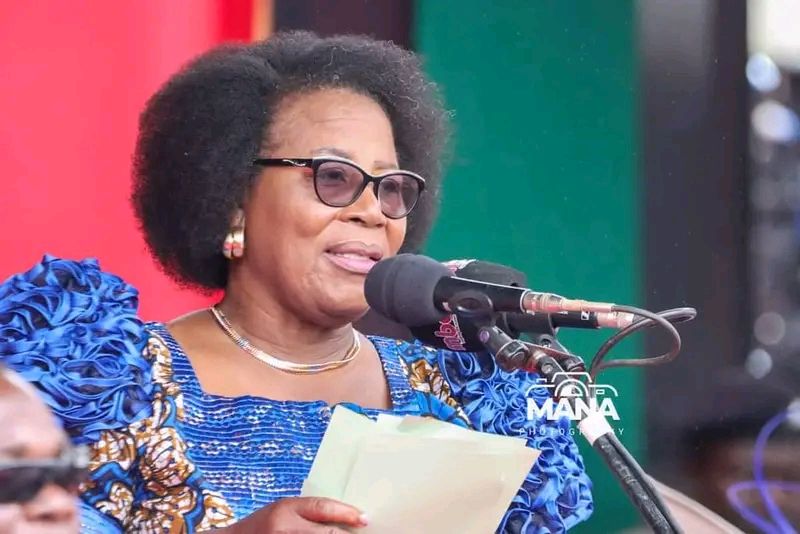
Within hours of taking office, she signaled a leadership style that blends legal precision with pastoral presence, attending a prayer service at Christ Citadel International Church in Chirimba on 5 October and delivering the sermon herself.
That first Sunday set the tone for a month that would be defined less by ceremonial visibility and more by operational intent.
Her 70th birthday on 11 October was commemorated with a public thanksgiving at Christ Citadel International Church in Lilongwe, drawing senior officials, diplomats, and faith leaders into a rare convergence of state and civil society.
The event reinforced her dual identity as jurist and pastor, a combination that resonates strongly in Malawi’s civic culture.
By 13 October, she had formally assumed executive responsibilities at Capital Hill, briefing staff and pledging transparent governance from the Office of the Vice President.
The real policy signal came on 17 October, when she convened human resource personnel from multiple ministries to begin an audit of Ministries, Departments, and Agencies.
Guided by Secretary to the Vice President Charles Kalemba, she framed the exercise around cutting redundant roles and maximizing resource use, a direct challenge to a bloated civil service.
Her legal background was evident in the language of performance tracking and structural alignment, suggesting a shift from political rhetoric to administrative discipline.
Internationally, the timing of her intervention mattered because Malawi was already entering a crisis phase.
On 30 October, speaking on Africa Day for Food and Nutrition Security, she issued a national directive in response to the Malawi Vulnerability Assessment Committee report.
The report had projected that over 4 million Malawians would face food shortages from October 2025 onward, prompting President Mutharika to declare a State of Disaster.
Dr. Ansah’s office took immediate control of the Department of Disaster Management Affairs and finalized the rollout of the National Lean Season Food Insecurity Response Programme, targeting 11 of the worst-affected districts.
She coupled emergency action with a longer-term agricultural message, urging councils to adopt climate-smart methods less dependent on erratic rainfall.
This pairing of immediate relief with structural adaptation reflects an understanding that Malawi’s food insecurity is cyclical, not episodic.
By the end of her first month, three governance pillars had crystallized under her leadership: disaster oversight, public service efficiency, and climate-resilient agriculture.
For an international audience, her early tenure reads as a deliberate attempt to restore credibility to the vice presidency, an office often criticized for ambiguity in Malawi’s political system.
She is leveraging her judicial reputation to audit the state, her pastoral profile to maintain social legitimacy, and her executive mandate to respond to a humanitarian emergency.
Whether that formula translates into durable reform will depend on her ability to navigate cabinet politics, fiscal constraints, and the expectations of a public that has seen many promises before.
Yet October 2025 suggests a vice president who is not waiting to grow into the role.
She is defining it, quickly, and on her own terms.