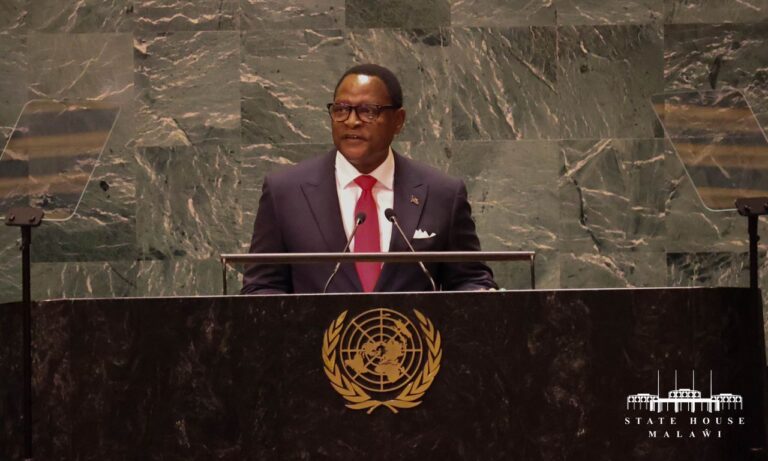
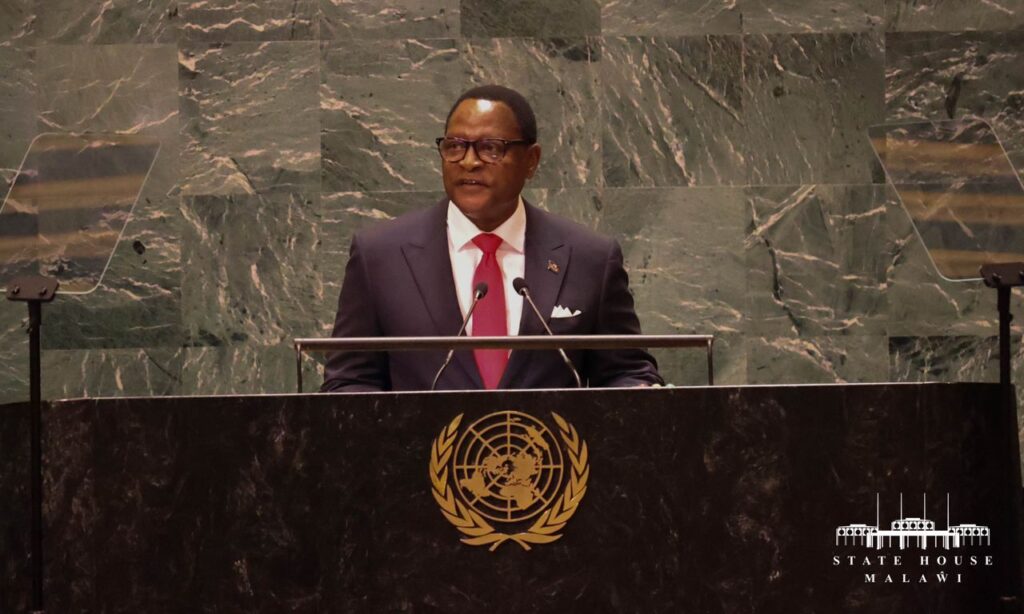
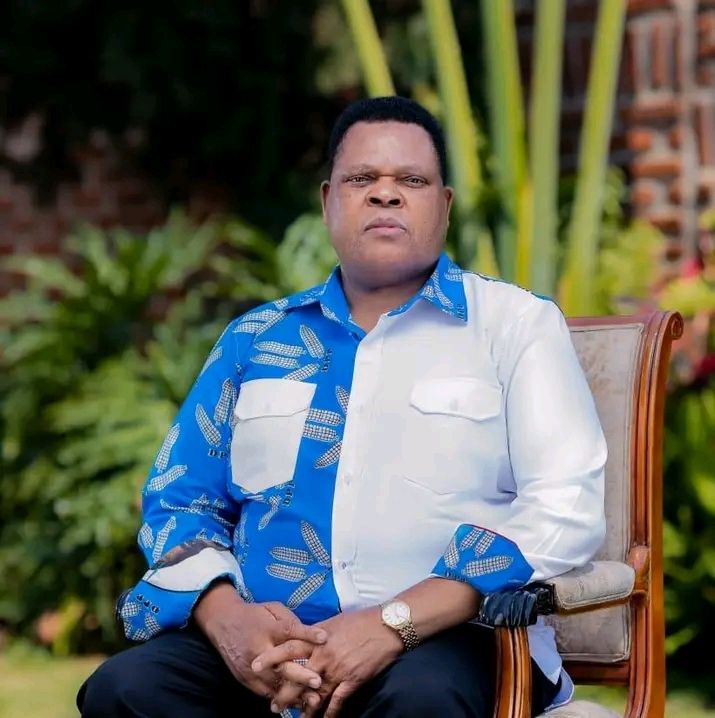
Malawi leader Dr Lazarus McCarthy Chakwera on Thursday addressed the United Nations General Assembly in New York where among other things the president called for the United Nations General Assembly to give Africa a voice to veto important global decisions.
In his address, Chakwera expressed displeasure with the arrangement where such seats have only been offered to Western countries.
The President in this regard demanded real democracy to flourish in the UN family.
Chakwera addressing UN
“But if we are serious about cooperation, then we must act with urgency in fixing and reforming the United Nations and other multilateral institutions, and one fix that we from African demand is for the United Nations to embrace democracy in the Security Council by giving Africa two permanent seats with veto power,” he said.
The President said he was happy to note that some leaders like Joe Biden are in support of the reforms.
“When I first made this call in my inaugural address in this chamber, I was delighted to hear President Biden also announce that the United States is in favour of this reform. Similarly, when I met President Xi Jinping of China three weeks ago, I was delighted to hear that he, too, is in favour of a stronger representation of the interests of developing countries in the Security Council. So, Mr. President, the time to fix this is now,” he said.
Chakwera said there is a need for this abnormality to be fixed need in order to strengthen voice on the issues that matter to African countries.
“In the four years that I have been President, I have declared a state of natural disaster every year because of climate change impacts that we can not solve without multilateral cooperation,” he said.
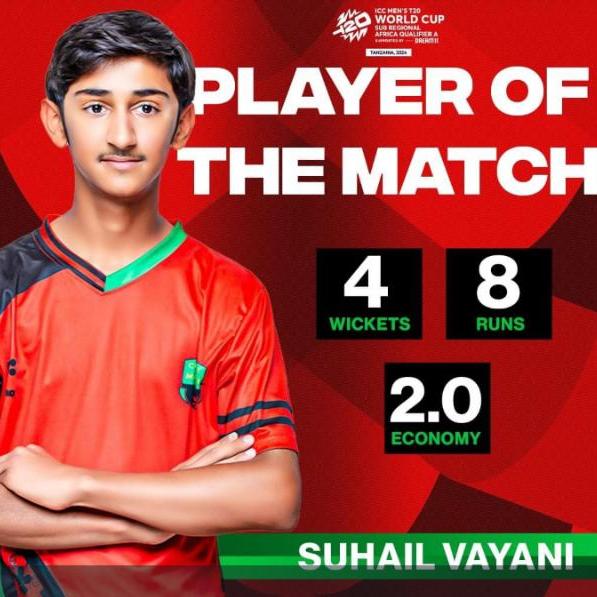
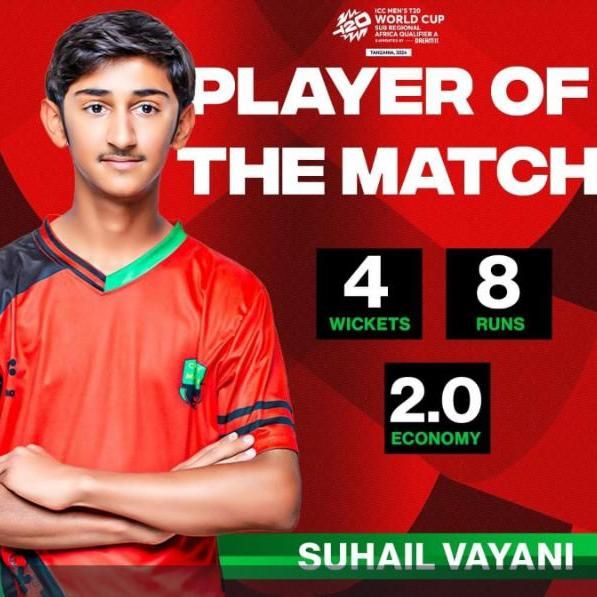
In a thrilling cricket match against Mali, Malawi’s rising star Suhail stole the show, claiming four crucial wickets to secure the Man of the Match award. The electrifying performance at the Blantyre Sports Club propelled Malawi to a convincing victory, cementing their position in the ICC Africa Cup qualifiers.
Suhail’s mesmerizing spell of 10 overs yielded 4 wickets for just 23 runs, leaving the Mali batting lineup reeling. His victims included the dangerous Amadou Traore, who threatened to unleash chaos with his aggressive batting. Suhail’s clever variations and pinpoint accuracy proved too much for the Mali batsmen, as they struggled to find their footing.
“I focused on maintaining pressure and varying my pace to keep them guessing,” Suhail explained in a post-match interview. “The wickets were a bonus, but the team’s win is what truly matters.”
Malawi’s captain, Moazzam Baig, praised Suhail’s game-changing performance. “Suhail’s spell was the turning point. He bowled with precision and intelligence, and his wickets broke Mali’s momentum.
The Mali team, opting to bat first, found themselves in trouble early on. Suhail struck in his second over, dismissing Traore LBW, and then removed the middle order’s backbone, claiming the wickets of Soumaïla Cissé and Issa Traore.
Malawi’s chase began nervously, but opener Kondwani Phiri’s 32 and middle-order batsman Amadou Jallow’s unbeaten 43 guided the team to a comfortable 5-wicket victory.
This triumph marks Malawi’s third consecutive win in the ICC Africa Cup qualifiers, solidifying their second-place standing in the group. With Suhail’s form and the team’s growing confidence, Malawi’s chances of qualifying for the main event look brighter than ever.
“Suhail’s performance is a testament to the team’s hard work and dedication,” said Yusuf Mwale, President of the Malawi Cricket Federation. “We’re proud to have him represent Malawi, and we look forward to more exciting performances.”
As the cricket world takes notice of Suhail’s emergence, fans in Malawi are ecstatic about the team’s prospects.
In a tragic incident late last night, several officials from the University of Malawi were involved in a serious road accident in Dedza. The accident, which occurred around midnight, saw the vehicle they were traveling in overturn three times. The group was returning from Karonga, where they had gone to attend the burial of a student who recently made headlines in the news.
The accident has left four key figures injured, including university officials and the Student Union president. The officials involved in the accident are Mr. Lamba, Mr. Manda, Mr. Dagoulas, and Mr. Thanks Elia, the Student Union president. The injured are currently receiving treatment at Kamuzu Central Hospital in Lilongwe.
The accident occurred as they were making their way back after paying their respects at the burial of the student, whose untimely death had attracted significant media attention in recent weeks. The mood during the journey was reportedly solemn, given the nature of their mission, but the accident added further tragedy to an already difficult situation for the university community.
It is unclear what caused the vehicle to overturn, but eyewitness reports suggest that poor road conditions and the late hour could have played a role. Authorities in Dedza are investigating the accident, and further details are expected as the situation unfolds.
The injured individuals are said to be in stable condition, though they are receiving critical care at Kamuzu Central Hospital. Mr. Thanks Elia, as the Student Union president, has been a vocal leader on campus and his involvement in the accident has shocked many students who look up to him. University officials, including Mr. Lamba, Mr. Manda, and Mr. Dagoulas, play critical roles in the institution’s administration and their involvement in the accident has caused concern among both staff and students.
The University of Malawi community is reeling from the double blow of losing one of its students and the subsequent accident involving senior figures. Many students and staff members have expressed their solidarity with the injured, sending messages of support and prayers for their speedy recovery.
As the news spreads, Malawians are reminded of the dangers that exist on the country’s roads, particularly during long journeys late at night. The accident in Dedza adds to the growing list of road incidents that have raised concerns about road safety across the country.
University officials are expected to release an official statement regarding the accident and the health status of those involved in the coming days. For now, the focus remains on ensuring the well-being of the injured and providing support to the affected families.
This accident serves as a painful reminder of the unpredictable nature of life and the importance of road safety, especially for those traveling long distances under difficult conditions.
_Burnett Munthali is a political analyst and journalist, reporting on current events in Malawi._
In a recent post on his official Facebook page, Malawi’s Minister of Local Government, Richard Chimwendo Banda, stirred conversation by commenting on political and developmental matters. His post, written in a mix of Chichewa and English, reflects the dynamic and often heated nature of the country’s political discourse. His words carry strong sentiments about Malawi’s political trajectory under President Dr. Lazarus Chakwera.
Chimwendo Banda’s message began with the provocative statement, “Atipha ndi chitukuko Dr Lazarus Chakwera,” which can be loosely translated as “Development under Dr. Lazarus Chakwera will overwhelm us.” This statement could be seen as a mix of both sarcasm and confidence in the developmental agenda that the president has championed since taking office in 2020.
As the post continues, Chimwendo Banda addresses a personal matter, expressing, “This is Malawi and not India,” highlighting the context of local governance and identity. He contrasts Malawi with other nations, possibly in response to ongoing debates about Malawi’s developmental pace compared to other countries. His reference to India might have been a metaphorical comparison, urging Malawians to appreciate their unique journey rather than drawing parallels with nations that have taken different developmental paths.
He further writes, “nde ngati ndinaphonya Chithuzi,” suggesting that he may have missed a particular image or point. This phrase hints at the fact that he might have overlooked or misunderstood something in the ongoing discussions, but maintains a tone of resilience. Chimwendo Banda is known for his fiery and unapologetic political rhetoric, and this phrase could be an acknowledgment that not all criticisms are understood or addressed in their full context.
In a direct address to a fellow individual, he says, “zinthu izi zikufana wanva iwe my dear sister Gitta.” It appears that Chimwendo Banda is engaging with a specific individual, possibly a political colleague or critic, referring to how events or situations may seem similar or aligned with past occurrences. This line conveys his familiarity and openness in addressing individuals within his political circle.
Finally, his statement, “asiye awo asova,” translates to “let them be, they will deal with it.” This indicates a dismissal of critics or those who disagree with his views, a typical stance among politicians who are determined to push their agenda despite opposition.
Chimwendo Banda’s use of social media to voice his opinions has become part of the broader landscape of political communication in Malawi. By engaging directly with the public on platforms like Facebook, he fosters both support and criticism in real-time, as citizens react to his statements. His style is often unfiltered, allowing for raw and honest exchanges, which can stir both admiration and controversy.
However, his post also highlights a deeper question about how Malawi navigates its path toward development under the leadership of President Chakwera. Chimwendo Banda’s words may reflect the frustrations and triumphs felt by many Malawians as they look to their leaders for progress amidst challenges.
In a political climate where every word can be dissected and analyzed, Minister Richard Chimwendo Banda’s Facebook post serves as a reminder that social media has become a powerful tool for politicians to communicate directly with their audience. His bold approach may continue to ignite conversations about Malawi’s future, leadership, and development.
Only time will tell how these discussions evolve, but one thing is clear: the political conversation in Malawi remains as vibrant and unpredictable as ever.
_Burnett Munthali is a political analyst and journalist, contributing to discussions on Malawian politics and governance._
We’ve all been there – that awkward moment when our brain and tongue don’t quite sync, and we blurt out something we didn’t mean to say. It’s embarrassing, but it happens to the best of us. Even public figures, who are expected to be composed and articulate, can fall victim to a slip of the tongue.
In Malawi, we’ve seen our fair share of slips. Who can forget Titus Mvalo’s gaffe when he addressed President Lazarus Chakwera as “your honour the Vice President,Dr Lazarus chakwera? Mvalo quickly apologized, but the damage was done. Uladi Mussa, who defected from the DPP to MCP, had a similar moment during an interview with Brian Banda. He urged people to support Professor Bingu wa Mutharika, then Peter Mutharika, before finally correcting himself to say Lazarus Chakwera.
Mukhito
More recently, DPP Secretary General Peter Mukhito made a startling statement, claiming that people from all political regions had agreed to vote for Peter Mutharika to lead the Malawi Congress Party. These slips, while amusing, can have serious consequences, damaging reputations and eroding trust.
But what exactly is a slip of the tongue? Research suggests that it’s a common phenomenon, where our brains and tongues don’t quite coordinate. There are eight types of slips, including anticipation, perseveration, exchange, blend, shift, substitution, addition, and deletion.
In the case of Titus Mvalo, his slip was likely a substitution – replacing the intended word “President” with “Vice President”.Uladi Mussa’s mistake, on the other hand, was an example of perseveration, where he repeated a previous thought (supporting Professor Bingu wa Mutharika) before correcting himself.
While slips of the tongue can be embarrassing, they also offer a glimpse into our thought processes. Sigmund Freud, the famous psychologist, believed that slips revealed our unconscious thoughts and desires. Perhaps Mvalo’s slip revealed a lingering doubt about Chakwera’s presidency?
Peter Mukhito’s Slip of the Tongue: A Freudian Perspective
Peter Mukhito’s recent statement, where he said people from all political regions had agreed to vote for Peter Mutharika to lead the Malawi Congress Party (MCP), can be seen as a revealing glimpse into his unconscious thoughts. From a Freudian psychoanalytic perspective, Mukhito’s slip may indicate residual loyalty or admiration for Peter Mutharika, despite being the DPP’s Secretary General. This unconscious bias could be rooted in past experiences or associations, demonstrating how the subconscious mind can influence our words and actions.
Cognitive Overload and Mental Fatigue
Mukhito’s slip of the tongue can also be attributed to cognitive overload and mental fatigue. As a prominent figure, he likely handles numerous tasks and responsibilities, leading to mental exhaustion. When the brain is overwhelmed, it can retrieve incorrect information or mix up similar concepts, resulting in verbal mistakes. This explanation highlights the importance of self-care and stress management in maintaining mental clarity.
The Linguistics of Lexical Blending
From a linguistic perspective, Mukhito’s mistake can be classified as a classic example of lexical blending. This phenomenon occurs when two similar concepts or words are blended together, resulting in an incorrect statement. In this case, Mukhito may have unintentionally combined his knowledge of Peter Mutharika’s leadership and the MCP, illustrating how language processing can sometimes lead to errors.
Social Identity Theory and Groupthink
Mukhito’s slip may also be influenced by social psychological factors, particularly social identity theory. His statement could reflect his own social identity or group affiliation, revealing an unconscious bias towards Peter Mutharika or the DPP. Additionally, groupthink may play a role, where Mukhito inadvertently adopts and repeats the party’s dominant views, even if they contradict his current role. This highlights the complex interplay between individual identity and group dynamics.
Neurological Factors and Cognitive Decline
Research suggests that slips of the tongue can be related to neurological factors, such as disruptions in the brain’s language processing centers. Age and cognitive decline can also increase the likelihood of verbal mistakes. While Mukhito’s age and cognitive abilities are unknown, this explanation underscores the importance of considering neurological factors in understanding slips of the tongue.
Peter Mukhito’s slip of the tongue offers a fascinating case study for understanding the complex interplay between psychological, linguistic, and neurological factors. By examining this incident through various lenses, we gain insight into the intricacies of human communication and cognition.
In conclusion, slips of the tongue are an inevitable part of human communication. Even the most composed individuals can fall prey to a stray word or phrase. By understanding the psychology behind these slips, we can become more empathetic and forgiving.
As Malawians, we should learn to laugh at ourselves and others when we make these mistakes. After all, it’s a reminder that we’re all human.