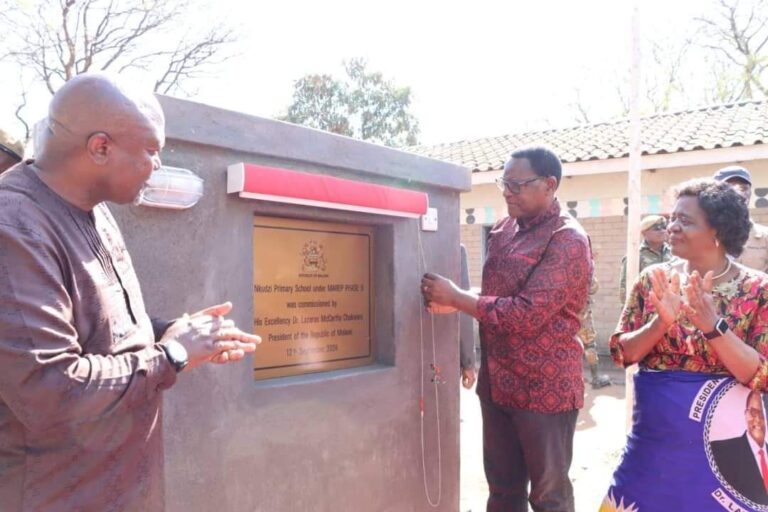
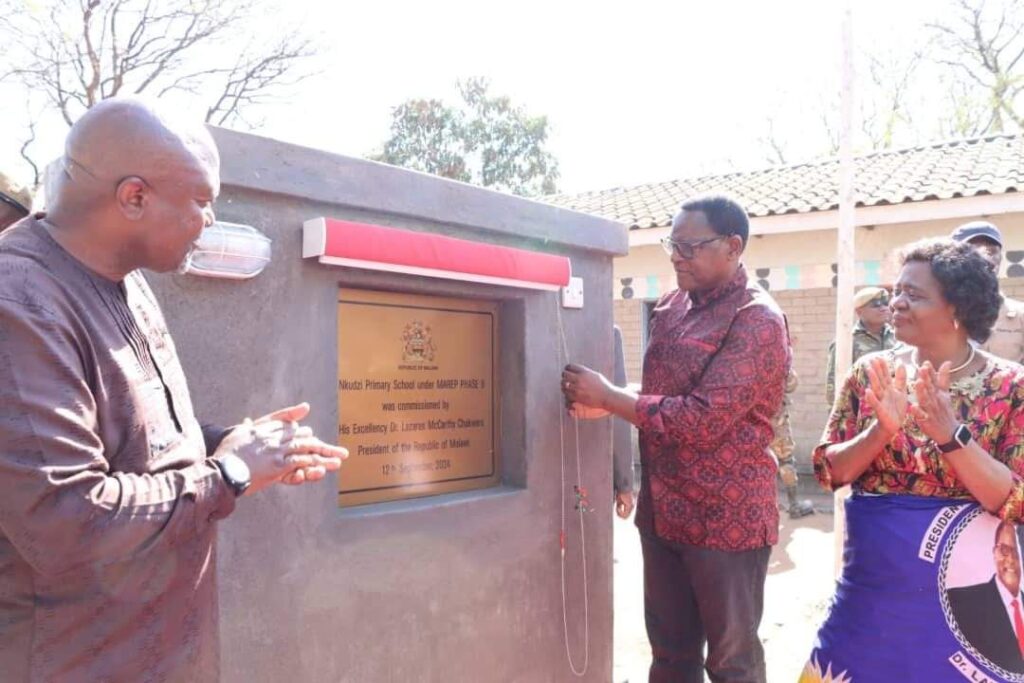
Malawi leader president Dr Lazarus McCarthy Chakwera has inaugurated Malawi Rural Electrification Programme phase 9 in the area of Group village headman Dzilipaine Traditional Authority Maseya in Chikwawa.
Addressing the gathering at the Nkudzi full primary school, President Chakwera said he was impressed to witness the commissioning of MAREP 9.
The president said he wants equal distribution of development projects without looking at regional boundaries.
Minister of Energy Ibrahim Matola commended Dr Lazarus Chakwera for lighting up Nkudzi Primary school.
Matola said people will be able to improve their social and economic lives.
The Malawi Government has been implementing Malawi Rural Electrification Programme (MAREP) with an aim of increasing access to electricity for the rural and peri-urban areas in order to transform the rural economies and reduce poverty amongst the rural masses and contribute to Government’s agenda on poverty reduction.
The programme started in the 1980s with Electricity Supply Corporation of Malawi (ESCOM) Ltd as the implementing entity. The program was implemented through own financing and donor funding. Following the commercialization of ESCOM, the Malawi Government took over the
Marep 9 is funded through a rural electrification levy in the petroleum pump price build-up and other financing windows.
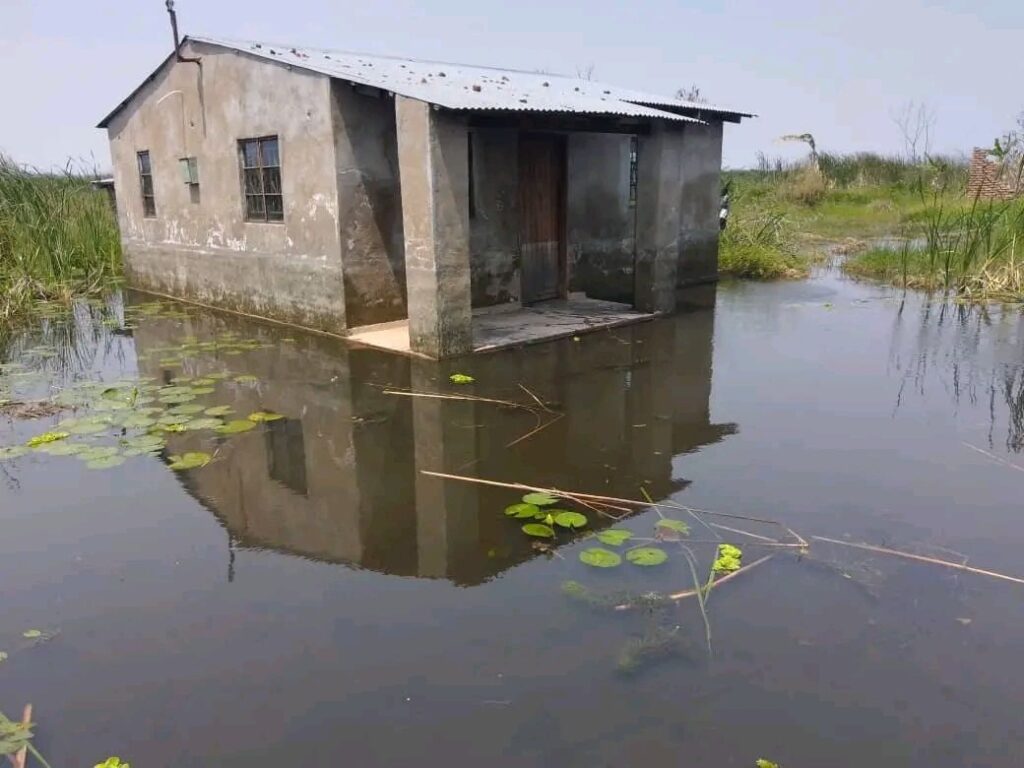
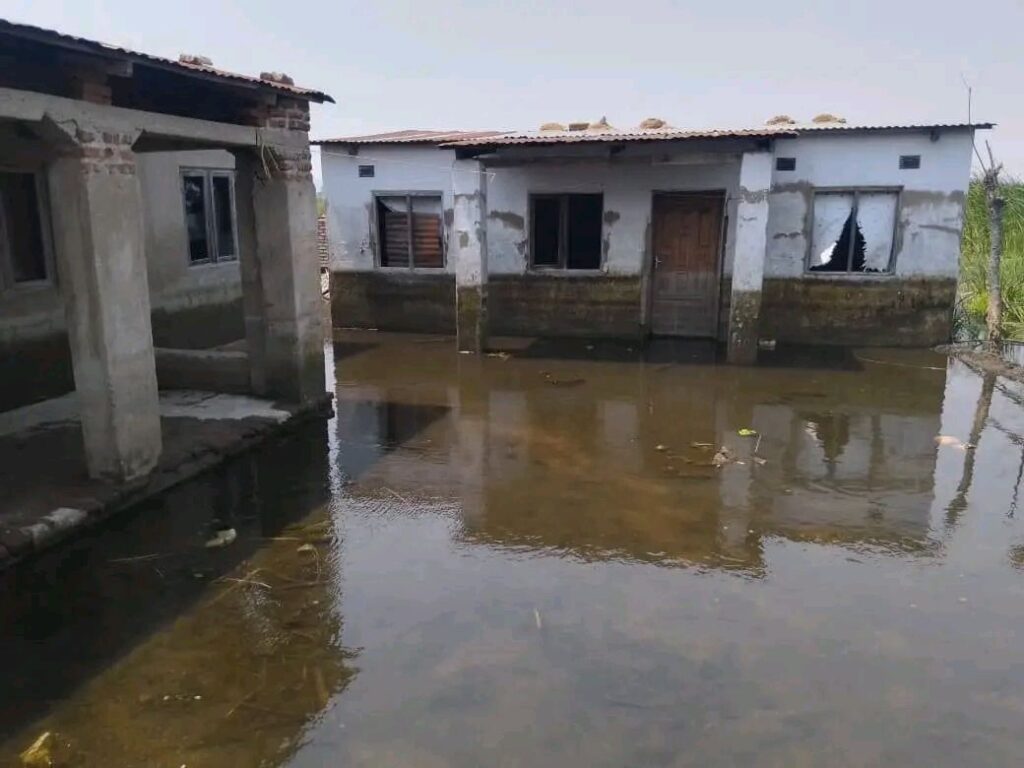
The National Water Resources Authority (NWRA) has warned Malawians living near lakeshores and riverbanks to brace for flash floods during this year’s rainy season.
NWRA Chief Executive Officer (CEO) Dwight Kambuku made the announcement during a media tour, visiting communities impacted by rising water levels in Lake Malawi on Tuesday.
Kambuku said that between October this year and November next year, water levels are expected to increase significantly, with projections showing the lake could reach 475.22 meters above sea level by December 1, 2025.
Kambuku
He advised residents in flood-prone areas to relocate ahead of the upcoming rainy season.
On his part part,Mangochi Municipal Council CEO Ernest Kadzokoya echoed the warning, stressing that certain flood-affected areas remain dangerous.
He urged people not to return to these locations, as the situation is expected to persist until next year.
Currently, 26 households displaced by flash floods are sheltering at Ngalamo camp in Mangochi.
President Dr. Lazarus Chakwera has reaffirmed his commitment to revitalizing the rail transportation networks, which were neglected by previous administrations.
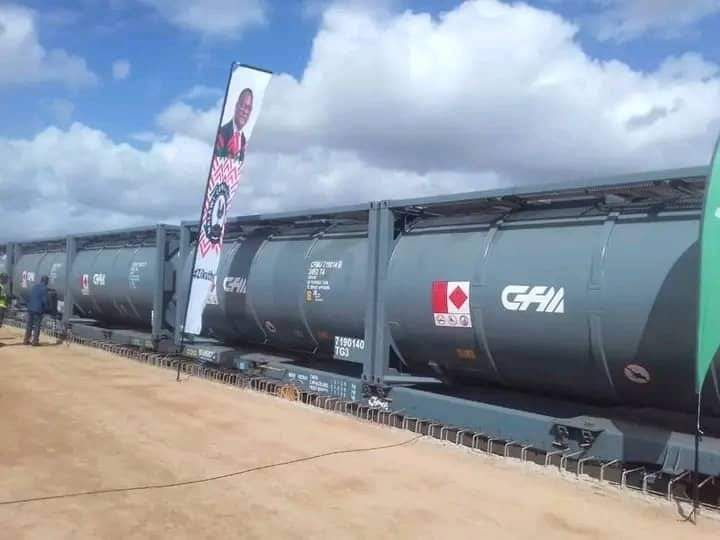
Chakwera was speaking on Wednesday at Marka Border Railway Station in Nsanje,when he received the fuel train carrying 1.2 million liters of petroleum products from Beira, Mozambique.
The Malawi leader emphasized that the resumption of railway services will significantly enhance the socio-economic development of Malawi.
He said:”Many people doubted my administration’s ability to revamp the railway line, but today, I am proud to see it functional.”
The president noted that the train’s arrival in Lilongwe last month marked the end of a 21-year suspension of fuel transportation services.
Chakwera assured the nation that his administration is committed to implementing long-lasting development projects, asking communities to be patient.
On his part,Minister of Transport Jacob Hara hailed the train’s arrival as a milestone in transport infrastructure development, highlighting its positive impact on rural masses through reduced goods prices.
Board Chairperson for National Oil Company of Malawi (NOCMA),Colleen Zamba, welcomed the train’s arrival, citing the benefits of cheaper railway transport in reducing fuel importation costs.
Traditional Authority(T/A) Ndamera praised the current administration for its commitment to development projects across all regions.
The re-operationalisation of the Marka-Beira railway line, a crucial transportation link between Malawi and the Indian Ocean, has raised hopes of significantly reducing the time it takes to haul fuel into the country. This development is expected to have wide-reaching benefits for the landlocked nation, improving not only the fuel supply chain but also boosting economic growth and trade.
The Marka-Beira railway line connects Malawi to the port city of Beira in Mozambique, a vital gateway for the country’s imports and exports. The railway had been dormant for several years due to infrastructural damage and political instability in the region. However, its recent rehabilitation and reopening signal a strategic step towards enhancing Malawi’s transport infrastructure.
For a country that heavily relies on road transport to import essential goods like fuel, the re-operationalisation of the railway presents a faster, more efficient, and cost-effective alternative. Historically, fuel haulage into Malawi has been plagued by delays, which often contribute to fuel shortages and rising costs in the country.
With the railway back in operation, the time taken to import fuel from Beira to Malawi is expected to drop significantly. This is due to the railway’s ability to move large quantities of fuel in shorter periods compared to the traditional road haulage system, which is slower and susceptible to traffic congestion, bad road conditions, and border delays.
Energy experts anticipate that fuel transportation costs will also be lowered, as rail is generally cheaper than road transport for bulk goods. This reduction in cost could lead to lower fuel prices in the country, which would be a welcome relief for businesses and consumers alike, especially in an economy that has been grappling with rising fuel prices.
The reopening of the Marka-Beira railway line holds numerous benefits beyond fuel transportation. For Malawi, this railway connection to the Indian Ocean presents an opportunity to increase trade volumes, as the route provides quicker access to international markets. Agricultural exports, which form a significant part of Malawi’s economy, stand to benefit greatly from faster and more reliable transportation.
The railway is also expected to reduce the wear and tear on Malawi’s roads, which are often burdened by heavy truck traffic carrying fuel and other goods. By alleviating pressure on road infrastructure, the railway will allow for longer-lasting roads and reduced maintenance costs.
In addition, the improved fuel supply chain could spur development in Malawi’s industrial sector. Reliable and consistent fuel availability is critical for manufacturing, transport, and energy generation, all of which are key drivers of economic growth.
The re-operationalisation of the railway line is also a testament to improved regional cooperation between Malawi and Mozambique. The railway represents a vital part of the Southern African Development Community’s (SADC) regional infrastructure development agenda, which seeks to promote cross-border trade and regional integration.
Mozambique’s Beira Port is one of the most important transit points for several Southern African countries, including Zimbabwe, Zambia, and the Democratic Republic of Congo (DRC). The railway’s reopening enhances Beira’s capacity as a regional trade hub, further cementing its strategic importance.
The reopening of the Marka-Beira railway line has set high expectations for a faster and more efficient fuel haulage system in Malawi. This long-awaited development is not only expected to reduce fuel transportation time but also lower costs, enhance trade, and relieve pressure on the country’s road infrastructure. If properly managed, the re-operationalisation of the railway could be a game-changer for Malawi’s economy, providing a crucial link to international markets and fostering regional integration. As Malawi looks to capitalize on this development, the country’s economic future appears brighter with improved transport logistics now in place.
In a rapidly changing agricultural landscape, Malawi’s Minister of Agriculture, Sam Kawale, has called on farmers across the country to embrace digitalization as a key component of modern farming. Speaking at an agricultural innovation summit, Kawale emphasized that the future of farming in Malawi depends on the adoption of digital tools and technologies that can enhance productivity, improve market access, and ensure food security.
Kawale highlighted that traditional farming methods, while still valuable, are increasingly being complemented by technological advancements that have the potential to transform the agricultural sector. He noted that the global agricultural industry is moving towards smart farming practices, which use digital tools to optimize crop management, soil health, and weather predictions.
Kawale
“Digitalization is no longer a luxury; it is a necessity. If our farmers do not embrace these innovations, we risk being left behind in an era where agriculture is becoming more competitive and knowledge-driven,” Kawale said.
He stressed that adopting digital platforms can provide farmers with real-time information on weather conditions, market prices, and farming techniques, helping them make informed decisions that can increase crop yields and reduce losses.
Kawale outlined several benefits of digitalization for Malawi’s farmers, including access to online agricultural services, data-driven decision-making, and better connectivity with suppliers and markets. Digital tools can help smallholder farmers—who make up the majority of Malawi’s farming population—improve efficiency by using precision farming techniques that maximize the use of inputs such as water, fertilizers, and pesticides.
Moreover, digital platforms can empower farmers by providing them with better access to credit and financing options. Farmers who are connected to digital networks can build digital credit profiles, making it easier for financial institutions to assess their creditworthiness and provide them with loans.
“Access to finance has long been a challenge for our farmers, but through digital platforms, we can bridge this gap. Farmers can now connect with financial institutions directly, making the process faster and more transparent,” Kawale added.
However, Kawale acknowledged that the digital transformation of Malawi’s agricultural sector will not be without challenges. He pointed out that many farmers, particularly those in rural areas, still lack access to reliable internet services and mobile technology. To address this, the government is working on improving the country’s digital infrastructure and expanding access to mobile networks in underserved areas.
Kawale urged stakeholders in both the public and private sectors to collaborate in bridging the digital divide, ensuring that farmers have access to affordable smartphones, internet connectivity, and digital literacy training. He noted that education and awareness campaigns will be crucial in helping farmers understand how to use digital tools effectively.
“We must ensure that no farmer is left behind in this digital revolution. It is our responsibility as a government to provide the necessary infrastructure, but we also need the support of technology companies, mobile service providers, and agricultural organizations to make this vision a reality,” he said.
In addition to improving productivity and access to markets, Kawale emphasized that digitalization can also play a key role in promoting sustainable farming practices. By using data to monitor soil health, water usage, and crop conditions, farmers can adopt more sustainable farming methods that reduce environmental impact and mitigate the effects of climate change.
“Digital tools allow us to practice agriculture that is both productive and sustainable. We can grow more food while using fewer resources, ensuring that future generations can also benefit from a healthy agricultural sector,” Kawale stated.
He pointed to successful examples of digital farming initiatives in neighboring countries, where farmers have seen significant improvements in yields and profitability by using mobile apps to manage their farms and connect with buyers.
Minister of Agriculture Sam Kawale’s call for Malawi’s farmers to embrace digitalization underscores the importance of technology in shaping the future of farming. As Malawi faces challenges such as climate change, food insecurity, and limited access to markets, digital tools offer a pathway to modernize agriculture and ensure that farmers can compete on a global scale.
By adopting digital solutions, Malawi’s farmers have the potential to improve their livelihoods, access new opportunities, and contribute to the nation’s food security. However, for this vision to be realized, the government, private sector, and other stakeholders must work together to address the challenges of connectivity, digital literacy, and infrastructure development. With these efforts, Malawi’s agricultural sector could be on the cusp of a digital transformation that benefits both farmers and the nation as a whole.