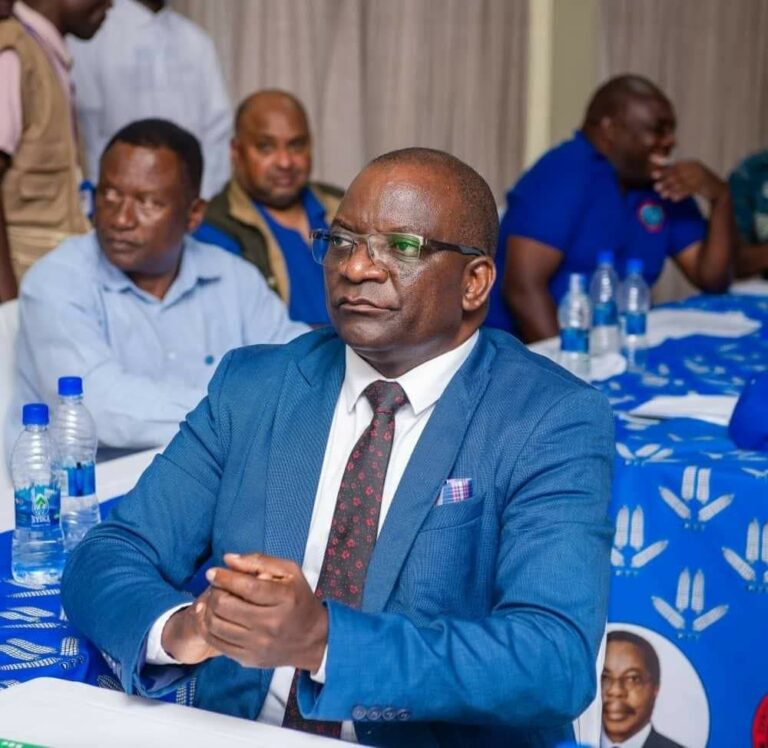
Firebrand politician and activist Jessie Kabwila, recently reappointed as the Publicity Secretary of the Malawi Congress Party (MCP) at the party’s convention in Lilongwe, has made a bold statement about the party’s prospects for the 2025 general election. After spending over five years in political obscurity, Kabwila, who has been warmly welcomed back into the MCP fold, is now poised to play a significant role in the party’s electoral strategy.
In a passionate address following her reinstatement, Kabwila emphasized that the MCP’s success in the upcoming elections will hinge on its track record of delivery. She argued that the party’s ability to meet the expectations of the Malawian people, rather than mere promises, will be the key to securing victory.
Kabwila
“I am here to assure you that the MCP will not only compete but will win the 2025 general election based on our record of delivery,” Kabwila declared. “The party has been working hard on the ground, and we are ready to show the people of Malawi that our commitment to their needs is unwavering. We have learned from the past, and we are more determined than ever to fulfill our promises.”
Kabwila’s return to the MCP marks a significant moment for the party, as her influence and experience are seen as vital assets in the run-up to the next general election. Her reappointment follows a period of reconciliation, during which she was reintegrated into the party with a renewed sense of purpose.
During the convention, Kabwila expressed gratitude for the support and forgiveness extended to her, acknowledging the challenges she faced during her time away. She praised the MCP leadership for their openness and commitment to unity, which she believes will strengthen the party’s position in the coming election.
As the MCP gears up for the 2025 general election, Kabwila’s renewed enthusiasm and strategic vision are expected to play a crucial role in shaping the party’s campaign. Her focus on delivering tangible results rather than empty promises reflects a broader strategy aimed at reconnecting with voters and addressing their pressing concerns.
With Kabwila’s vocal support and active involvement, the MCP is poised to leverage its achievements and address its challenges as it seeks to win the confidence of Malawians in the next election.
As Malawi’s political scene heats up in the run-up to the 2025 elections, a significant development has emerged. The Democratic Progressive Party (DPP) has successfully invited three major opposition parties AFORD, UTM, and UDF to its convention this weekend at the COMESA Hall in Blantyre. This move marks a notable shift in the political landscape as parties prepare for a crucial electoral contest.
This article aims to explore the implications of AFORD, UTM, and UDF’s acceptance of the DPP’s invitation and the strategic considerations behind this development. With the 50+1 voting threshold looming as a major challenge, these dynamics are set to influence the political strategies and alliances leading up to the 2025 elections.
According to sources from Malawi Voice, AFORD, UTM, and UDF have confirmed their participation in the DPP convention. Each party will send high-powered delegations, led by their party presidents, signaling a serious engagement with the DPP’s initiative. This joint appearance is expected to provide a platform for discussions on potential collaborations and strategic alliances.
Political analysts view the DPP’s move as a “tactical approach” in light of the approaching elections. The 50+1 threshold, which requires a presidential candidate to secure more than 50% of the vote to win outright, is a significant challenge for any single party. By inviting key opposition parties, the DPP aims to solidify alliances that could help them address this challenge effectively.
The attendance of AFORD, UTM, and UDF at the DPP convention suggests a possible shift in Malawi’s political alliances. The discussions and negotiations at the convention could set the stage for strategic partnerships and electoral strategies. This maneuver could impact the balance of power and influence the outcome of the 2025 elections.
In conclusion , as Malawi’s political landscape evolves, the DPP’s convention will be a critical event to watch. The potential alliances and strategies discussed could shape the trajectory of the 2025 elections. Stay tuned for further updates as the political narrative continues to develop and the stakes for the upcoming election become clearer.
More updates to follow. The unfolding political dynamics will be closely monitored as new developments arise. The approach to 2025 promises to be a defining period for Malawian politics, with potential shifts in alliances and strategies likely to play a crucial role in the electoral outcome.
The recent critique of the DPP’s convention approach by Lyson Sibande has sparked a heated debate on the party’s intentions.
Sibande argues that the DPP’s decision to allocate positions based on regional affiliations promotes regionalism and tribalism, rather than merit and personal aspirations.
However, a closer examination of the party’s motivations reveals a more nuanced approach, aimed at ensuring equal representation and preventing the dominance of a single tribe in senior positions.
Namalomba
The DPP’s approach is not about promoting regionalism, but rather about creating a more inclusive and representative party structure.
By allocating positions based on regional affiliations, the party seeks to prevent a situation where senior positions are held by individuals from a single tribe, as is the case with the MCP.
The recent MCP convention, where all senior and strategic positions were held by individuals from the Chewa tribe, is a stark reminder of the dangers of tribal dominance in politics.
In contrast, the DPP’s approach ensures that each region has a fair share of positions, preventing any one tribe from monopolizing power.
This approach is not about restricting opportunities based on geography, but rather about creating a level playing field where individuals from all regions can compete for positions based on their merit and aspirations.
Furthermore, the DPP’s approach is not communistic, as Sibande suggests.
Rather, it is a pragmatic response to the realities of Malawian politics, where tribal affiliations often play a significant role.
By acknowledging and addressing these realities, the DPP is taking a step towards creating a more inclusive and representative party structure.
The DPP’s convention approach is not about promoting regionalism or tribalism, but rather about creating a more inclusive and representative party structure.
By ensuring equal representation and preventing tribal dominance, the party is taking a step towards creating a more equitable and just political system.
One of the main criticisms leveled against the DPP is their decision to allocate positions based on regional affiliations.
Critics argue that this approach may limit the opportunities for individuals to compete for positions based on their merit and aspirations.
However, it is important to note that the DPP’s convention approach does not restrict individuals from competing for positions based on their merit.
In fact, it allows for individuals from all regions to participate in the political process and contribute their skills and expertise to the party.
Moreover, by ensuring that each region has a fair share of positions in the party, the DPP is promoting diversity and inclusivity within its ranks.
This approach allows for a wide range of perspectives and experiences to be represented in decision-making processes.
Diversity in political parties is essential to ensure that all voices are heard and considered when making important policy decisions.
By implementing regional quotas, the DPP is working towards creating a more inclusive and representative party structure.
It is worth noting that the DPP’s approach is not unique to Malawian politics.
Many political parties around the world have regional quotas or affirmative action policies in place to ensure diverse representation within their organizations.
In countries with diverse populations like Malawi, it is crucial for political parties to reflect the various regions and tribes that make up the population.
By implementing regional quotas, the DPP is recognizing and valuing the contributions of individuals from all backgrounds.
Critics of the DPP’s convention approach often accuse the party of promoting tribalism and nepotism.
However, it is important to acknowledge that the DPP’s approach is a strategic decision to prevent the concentration of power within a single tribe and promote a more equitable distribution of positions within the party.
By prioritizing inclusivity and diversity, the DPP is setting a positive example for other political organizations to follow.
In a country as diverse as Malawi, it is crucial for political parties to foster a sense of unity and shared purpose among their members.
By ensuring that all regions have a voice in the party’s decision-making processes, the DPP is working towards creating a more harmonious and inclusive society.
The party’s commitment to regional quotas should be seen as a positive step towards addressing historical inequalities and promoting social cohesion.
Ultimately, the DPP’s convention approach should be understood as a well-intentioned effort to promote inclusivity and prevent tribal dominance within the party.
By prioritizing inclusivity and diversity, the party is laying the foundation for a more prosperous and united future for all Malawians.
The DPP’s commitment to regional quotas is a reflection of their dedication to creating a more equitable and representative political system in Malawi.
In conclusion the DPP’s convention approach is not about imposing restrictions on individuals based on their tribe or region.
Instead, it is about creating a fair and transparent process for selecting party leaders and representatives that takes into account the diversity of the Malawian population.
By implementing regional quotas, the DPP is taking a proactive stance towards building a more unified and diverse party structure that can effectively represent the interests of all Malawians.
The Senior Resident Magistrate’s Court in Balaka has convicted and sentenced a 43-year-old man, Jonas Buleya, to 18 years imprisonment with hard labour after he pleaded guilty to a charge of having sexual intercourse with a child contrary to Section 138 of the Penal Code.
The court through state prosecutor Superintendent Bodwin Msukwa heard that the convict, Jonas Buleya, committed the offence on May 14, 2024 at Nkaluluka Village in Balaka District, where he had unlawful sexual intercourse with a 14-year-old girl.
The court further heard that the convict committed the offence when the girl’s mother was out for other errands and he took advantage of the situation and went into the girl’s house where he had unlawful sexual intercourse with her. The convict noted that the girl’s mother was away.
The convict later threaten the girl not to reveal the ordeal to anyone and if she dared to report, she would be killed but the girl reported the matter to her sister as well as to her mother on the following day.
Appearing before court, the convict pleaded not guilty to a charge of having sexual intercourse with a child. This prompted the state to parade five witnesses who proved the case beyond reasonable doubt and he was later convicted accordingly.
In mitigation, the convict asked the court for leniency, saying he has family obligations and that he also looks after orphans.
However, in his submission, state prosecutor Superintendent Bodwin Msukwa pleaded with the court for a stiff punishment, citing that the offence committed is serious in nature and that the planned to commit the offence as he was supervising the movement of the victim’s parents and relations.
Presiding over the case, Senior Resident Magistrate Joshua Nkhono quashed the mitigation factors and sentenced the convict to 18 years imprisonment with hard labour as a detterent to other would-be offenders.
The convict, Jonas Buleya, comes from Nkaluluka Village in Traditional Authority Nsamala in Balaka District.
The Democratic Progressive Party (DPP) Secretary General Dr. Clement Mwale has quashed social media rumours with action as he has submitted his nomination papers in his bid to return the position of Secretary General at the forthcoming elective convention of the former ruling party.
Earlier On rumours started on Social Media that Mwale was ready to dump the party over what was called favouritism for Peter Mukhito, who is also vying for the same position. It was rumoured that the party hierarchy wanted Mukhito for the role and that they wanted Mwale to go back to his Deputy Secretary General role
Dr. Mwale, who is one of the senior members of the DPP, has refuted rumours making rounds on social media that he has ditched the former ruling party, saying he remains a loyal member of the DPP.
He has added that ditching the former ruling party has never come to his mind.
DPP is expected to hold its elective convention between 17th and 18th August in Blantyre where over 100 people are expected to compete on various positions.