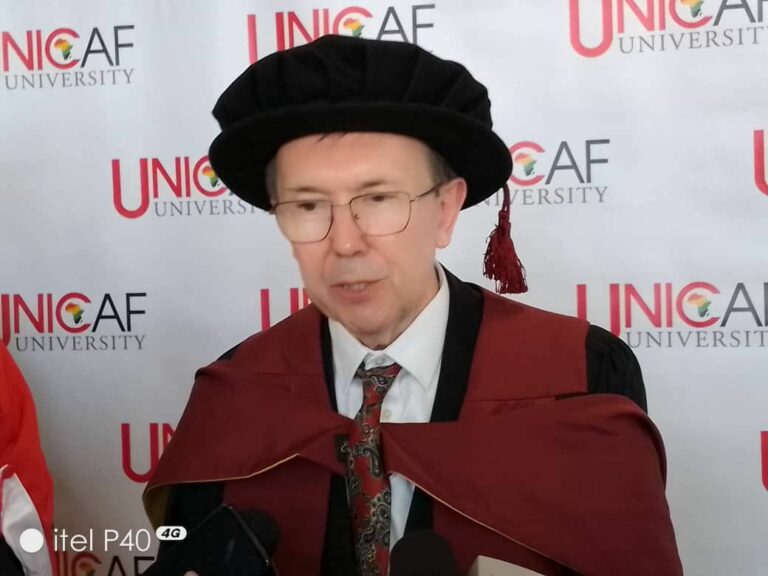
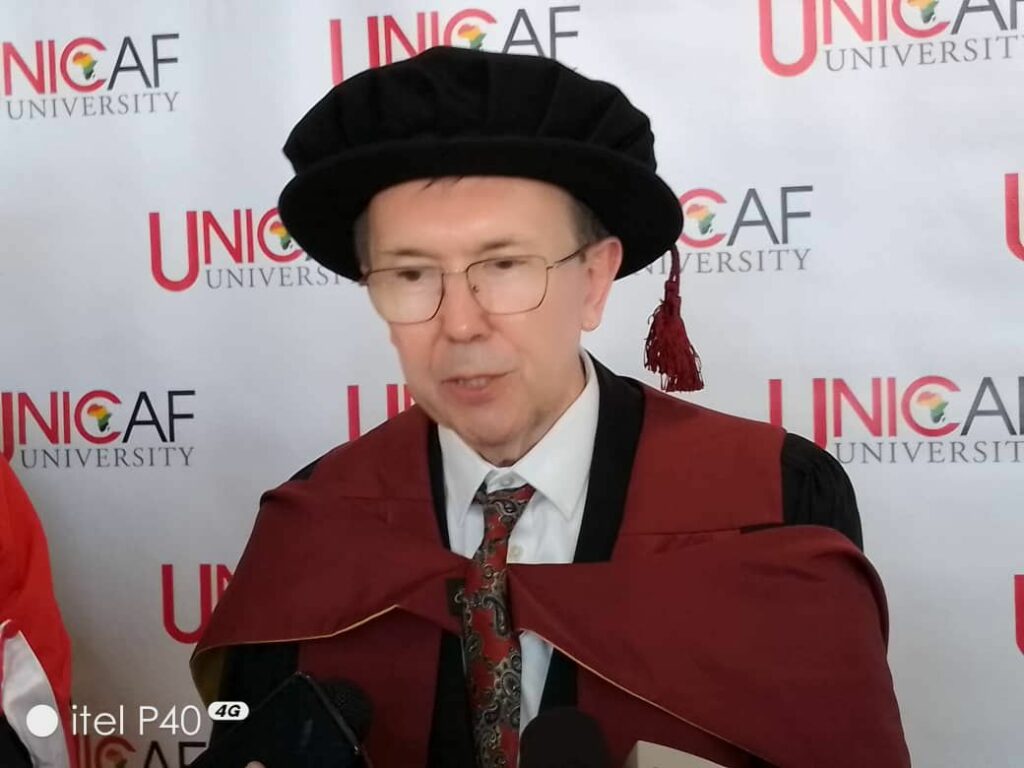
Unicaf University on Friday graduated 502 students with Bachelor’s, Masters and Doctorate degrees. Among them were 134 Malawians and the rest were from different countries.
Speaking during the graduation ceremony in Lilongwe, Deputy Minister of Education Nancy Chaoola Mdooko commended Unicaf for their contribution in promoting online higher education in Malawi.
In his sentiments Unicaf University’s Vice Chancellor in Malawi Dr Robert Ridley said their university is proud of their contribution to education in Malawi . He reiterated that the University will proceed to contribute in the promotion of research through science, knowledge and learning for betterment of the society.
Ridley – we will continue to contribute in higher education in Malawi
On his part, one of the graduates Shadreck Kalitera who graduated with Masters in Business Administration Finance hailed the university saying it is internationally recognized and that brings liberty to work elsewhere across the global.
Unicaf University is an international institution that offers online studies globally.
Once, their only chant was ‘A’choke! A’choke!’ (she must go! She must go!), but they now threatened “Total War” against government and that included anyone proxy to it.
After the 2019 annulled elections, there was tension in most parts of Malawi.
From nowhere, unrest erupted. There was no known leader, no office, and no one to control it as some opposition party supporters terrorized the cities.
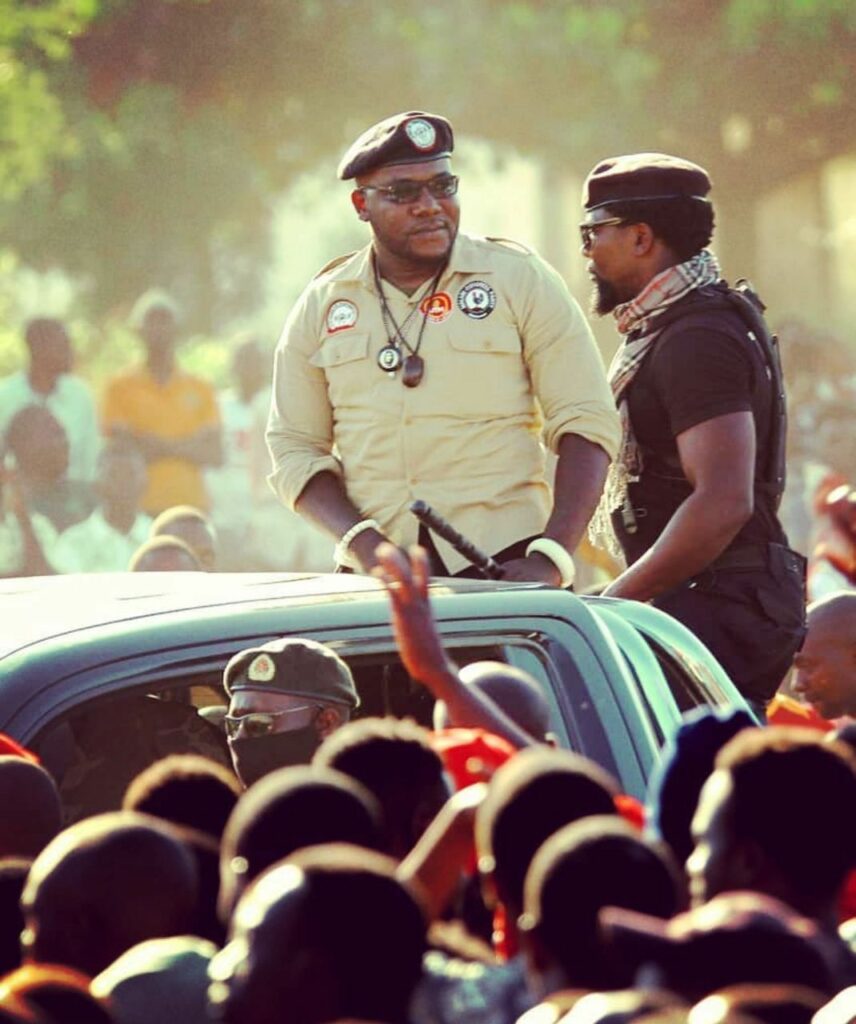
One of the places where rioting erupted was Nsundwe, a community that sprawls 25-kilometers outside the capital city, Lilongwe,where some notorious citizens turned themselves into soldiers of fortune under the cult monickered “Msundwe Barracks,”violently demanding electoral justice.
A line of blue-vans, also full of riot police that for long had been staple of violent confrontation across the country, arrived in the area.
Rowdy boys started hurling stones at them. And teargas and stun bullets rattled all day,untill they pulled back.
But the vans dumped one in the middle of rioting mob. He was pronounced dead at Kamuzu Central Hospital.
People lacked a feeling of security to their democracy after the mismanaged elections under the watch of Jane Ansah, the then Malawi Electoral Commission Chairperson.
And a bullet could not stop them demanding her resignation for having mismanaged the elections.
More deadly clashes escalated in most part of the country. Peace were broken. There was more violence and the country became tense.
The following day,a fiery statement was issued,reverberated across radio, television, and social media platforms.
“Jane Ansah must resign! We’re prepared to make the ultimate sacrifice for the people of Malawi. We’re not intimidated. We cannot trust you, Ansah, with our votes.”
This ruffled voice belonged to Timothy Pagonachi Mtambo,chairperson of the Human Right Defenders Coalition(HRDC).
A leader, whom many believed, spoke.
For Fidelis Kumwenda,57, who had experienced earlier riots at the dawn of multiparty system, the emergence of a believable leader in a state of near anarchy, heaved a huge sigh of relief.
At least, there was somebody authorities could talk to,“Without Mtambo, there was going to be total chaos in the country.”
Kumwenda’s mind swirls with memories of the riots on 6 May 1992. Riots over pay went off in parts around Ginnery Corner in Blantyre which escalated to other places nationally.
There was no leader, it was total chaos. Property was destroyed and about 38 people lost their lives nationally.
During the 1992 riots, the then president, Hastings Kamuzu Banda quickly constituted a Presidential Committee on Dialogue which was going to speak for the government side, and the churches provided leadership on the other side—where they had Public Affairs Committee (PAC).
As now the two groups could talk, relative calm was restored.
Aside from the much publicized arrests, petrol bomb targeting his house—and being shot at, they were other run-ins with authorities that showed he is a “daredevil.”
For me, patriotism and integrity is why his name remains legendary for activism throughout the country and beyond.
However ,people don’t understand how he gained a foothold in activism.
There are some,who say it was when he signed up with Center for Human Rights and Rehabilitation before he eventually became the founding chairperson of the HRDC in 2017.
A funny one is that of the mystical belief which centers on allegations of being traditional leader in his village,Chitipa.
Which is also backed by how he survived six bullets in an attempted assassination.
If you saw him speak, clenching his fist while carrying a stick to his right hand, coupled with a corpulent ring on his left hand, you could gullibly believe he had mystical powers.
In April,2020,Mtambo announced his resignation from HRDC—forming a political movement which he named; The Citizens For Transformation-People Power Movement (CFT) through which he helped in advertising the Tonse Alliances promises that were a pie-in-the-sky.
Worse still, what followed later— was his appointment as minister of the newly established Ministry of Civic Education and National Unity—before he was dismissed in 2022.
The immediate reactions from citizens were anger, not analysis.
But is anger enough to judge Mtambo’s decision? Was it wrong for Mtambo as an activist to join politics?
Well, the answer is no.
Activism in Malawi did not start with Mtambo. History is replet with examples of activists who turned politicians.
As early as 1912 Levi Ziliro Mumba and his team of North Nyasa Native Association lobbied for the good working condition for educated Africans.
Later,activits of other associations merged to form a political revolution which was called Nyasaland African Congress which is now Malawi Congress Party.
Timothy Mtambo
The group,at first,was led by Levi Mumba,before Kamuzu Banda who took it into independence in 1964.
Henry Chipembere,Yatuta Chisiza,Kanyama Chiume, Orton Chirwa became ministers in the Kamuzu Banda regime.
Activits became politicians and never discarded their hat as activists. They took activism inside government. Later,when they faced resistance inside,they pulled out and relaunched the fight,now against Kamuzu.
Earlier than that,John Chlembwe also protested against the Thangata and conscription in the British Army.
He later attempted to take over government by force. An activist became politician.
Since 1980, Malawi has produced many activists that include Bakili Elson Muluzi,Kamlepo Kalua, Chakufwa Chihana and many others who later became politicians.
The solace for people should have been found in this background, that despite joining politics, Mtambo would continue fighting like Kanyama and Chisiza. Taking activism inside the government.
As I was writing this encomium, Mtambo had given an interview to Nation Publication’s political index section, published a few months ago, explaining how he was a a revolutionary daredevil inside government.
Well,this is just me and some quick stupid thoughts on Timothy Pagonachi Mtambo birthday.
Skeffa Chimoto has declared his intention to represent the Malawi Congress Party (MCP) in the Nkhotakota South parliamentary elections. In a recent interview with Times 360 Malawi, Chimoto shared that local residents approached him with strong encouragement to run for office.
Initially hesitant, Chimoto ultimately chose to enter the race after thorough reflection. “The pressure came from our own community. Although I was initially reluctant, I realized that, after much consideration and understanding why so many people wanted me to run, it was the right decision,” Chimoto explained.
Skeffa
Should he win, Chimoto aims to address the key issues facing his constituency and drive significant improvements in the region.
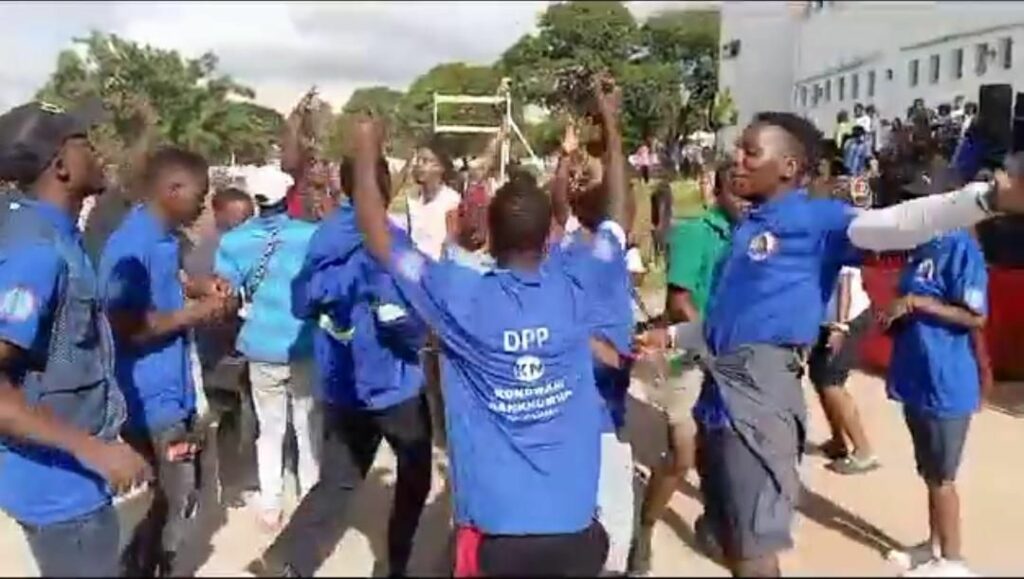
Student leaders of the Democratic Progressive Party (DPP) wings in public universities have petitioned the party to revise its laws and grant them voting rights ahead of the party’s convention this month.
In a letter dated August 9, 2024, signed by several leaders, including Micah Nthere of the Malawi University of Business and Applied Sciences (MUBAS), the students demand recognition of their role in the party’s democratic process.
Reads the letter in part:”We are not just spectators or hand clappers; we are active participants in the party’s growth and development.
“Our involvement in the decision-making process is crucial to ensuring that the party’s leadership reflects our aspirations and interests.”
Meanwhile,DPP spokesperson Shadrick Namalomba has acknowledged the students’ request, saying it is merited and will be considered.
The development comes as the DPP prepares to hold its convention from August 17 to 18 in Blantyre.
In an effort to address the lack of development in Senior Chief Chikumbu’s area in Mulanje, the community has launched a fundraising campaign to construct a community hall.
Elton Magombo, Secretary of the Area Development Committee (ADC), explained that the community had been waiting for assistance from the council and politicians who had made pledges, but nothing has materialized to date.
“As a result, the community members have taken matters into their own hands, with each member contributing K1,000 towards the project,” Magombo said.
He noted that contributions will be collected gradually, as many community members are struggling financially and are finding it difficult to meet even basic needs like food.
“We understand that not everyone can afford to contribute money, so some farmers are pledging to donate pigeon peas and other resources,” he added.
Magombo also shared that a committee has been established to manage the finances, ensuring transparency and accountability throughout the process.
“We have opened a special account where the collected funds are being deposited,” he explained.
Magombo emphasized that their efforts are in line with the 2063 goals, which encourage communities to develop their areas using locally available resources as a step toward achieving self-reliance.
“We are appealing to anyone who can contribute in any way toward the construction of this much-needed community hall. With collective effort, we can build a magnificent facility,” he added.
Kenneth Mumma, Executive Director of Children of Hope Organisation (COHO), commended the community’s initiative and called on other organizations in the district to support the project.
“Since we have an ongoing project to construct CBCCs in the area, we will negotiate with donors to assist in this construction, as the hall will serve the community, facilitate various meetings, and act as a tool for fundraising,” Mumma said.
The American Firelight Foundation and Mudzi are supporting Children of Hope Organisation, which has been actively involved in community development in Traditional Authority Chikumbu in Mulanje District since 2007. The organization focuses on Early Childhood Development through the construction of CBCCs, offering soft loans to parents and caregivers, providing livestock to families, and other initiatives.