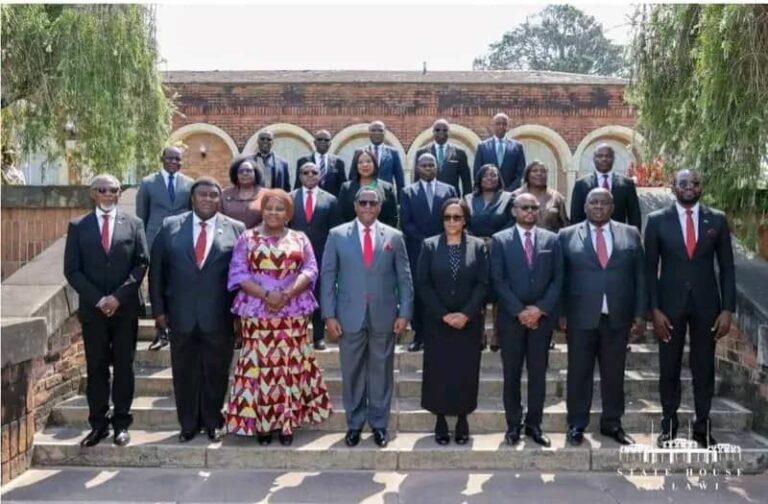
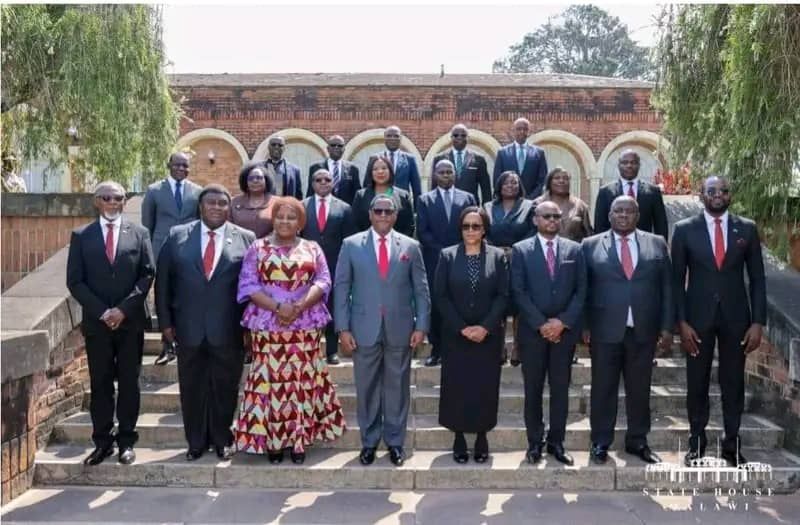
On Wednesday, July 31, 2024, President Lazarus Chakwera convened a crucial meeting with all Malawi Electoral Commissioners at the Mzuzu State Lodge. The meeting was led by the Chairperson of the Malawi Electoral Commission (MEC), Justice Annabel Mtalimanja.
Accompanying President Chakwera were nearly all senior cabinet ministers and key strategists from the ruling Malawi Congress Party (MCP). The prominent figures included Justice Minister Titus Mvalo, Homeland Security Minister Ken Zikhale Ng’oma, Health Minister Khumbize Kandodo Chiponda, Local Government Minister Richard Chimwendo Banda, and Information Minister Moses Kunkuyu.
Chakwera and MEC members
The discussion is significant as Malawi prepares for its General Elections scheduled for September 2025, highlighting the administration’s commitment to ensuring a well-organized electoral process.
A group of students who were dismissed from the Kamuzu University of Health Sciences (KUHeS) have written to President Lazarus Chakwera, seeking his intervention in their case.
The students, 36 in number, claim they were unfairly treated and are seeking justice.
According to the students’ president, Only Mopiha, and general secretary, Mathews Alfred, the dismissals were a result of “systematic academic withdrawal of students and bullying by some faculty members.”
They allege that the university introduced new examination rules and regulations without informing them, leading to their failure to meet the required grades.
The students claim they have tried to petition parliament on the matter but have not received any response.
Meanwhile, Presidential Press Secretary Anthony Kasunda has asked for time to investigate the matter, while KUHeS registrar Christopher Namagowa says they are waiting for the appointment of a new college council to handle the issue.
A total of 76 students were withdrawn from the university between 2017 and 2022 for various academic reasons.
The National Registration Bureau (NRB) has categorically denied reports that it is registering underage people ahead of the 2025 elections.
Speaking at a press briefing on Wednesday in Lilongwe,Principal Secretary at NRB,Mphatso Sambo, dismissed the claims, describing them as baseless.
He stated that the Bureau has only been issuing birth certificates to minors, not registering them to vote.
Sambo emphasized that the NRB has registered over 15 million people in the country, and the process has been transparent and rigorous.
NRB officials
“We have registered over 15 million people in this country, and I can assure you that the process has been transparent and rigorous,” he said.
He warned that anyone spreading false information about the NRB’s operations would face legal consequences.
“We will not hesitate to take legal action against anyone who spreads false information about our operations,” he said.
Sambo also addressed a recent threat by interns to down tools, stating that the matter had been resolved through discussions.
However, he revealed that the letter purportedly signed by the interns was forged, and an investigation would be conducted.
“The letter was forged, and we will investigate this matter further,” he said.
Simply put, NRB is the only government department in Malawi mandated to register all births, deaths, marriages, citizens and non-citizens of 16 years and above for the issuance of respective identification documents such as certificates and identity cards (IDs).
In order to implement this mandate, NRB has 28 District Registration Offices (at every District Commissioner’s Office), Three City Registration Offices (Blantyre, Lilongwe and Mzuzu), and 33 functional Post Offices across Malawi.
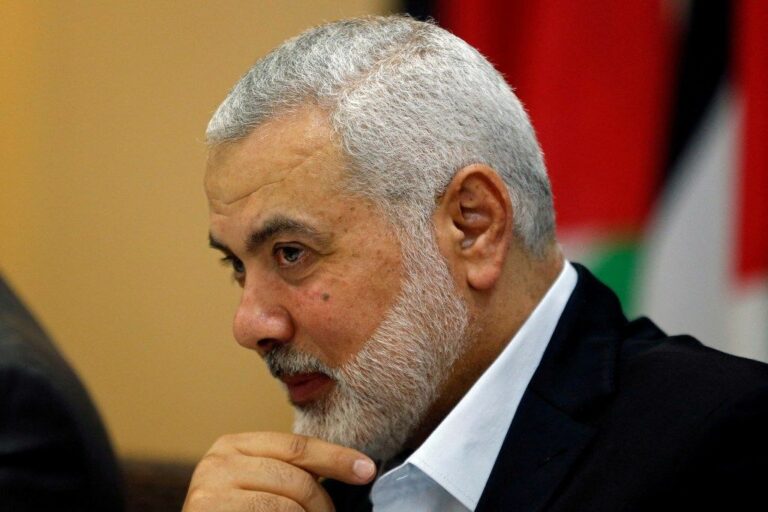
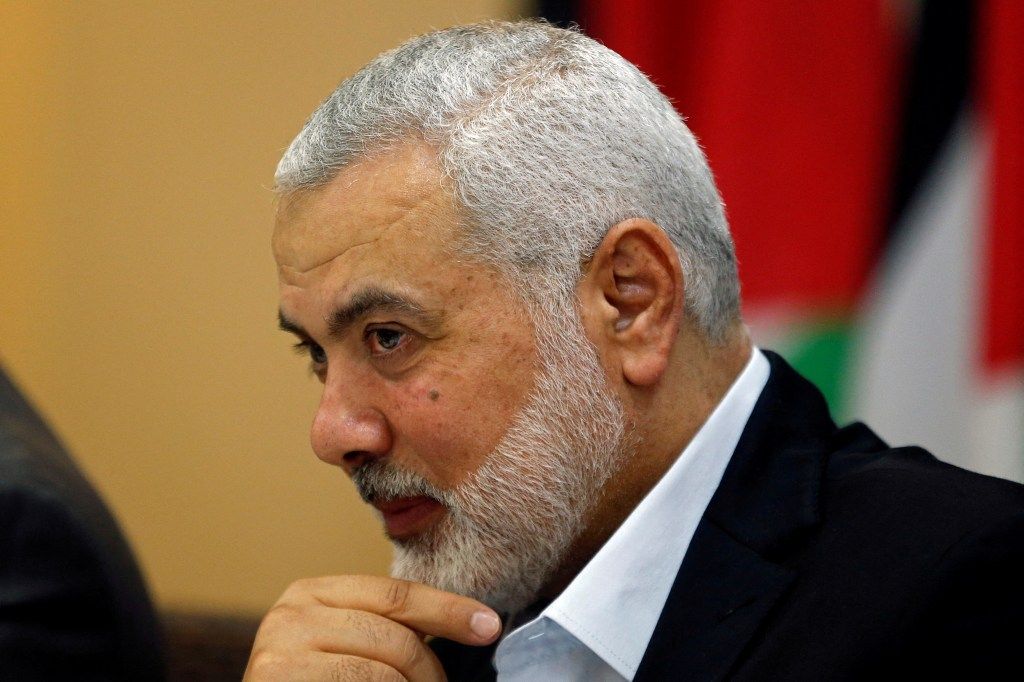
Iranian President Masoud Pezeshkian has vowed that Israel will “regret” the “cowardly” killing of Hamas political leader Ismail Haniyeh, who died in an airstrike in Tehran on July 30, 2024. The strike occurred while Haniyeh was attending Pezeshkian’s presidential inauguration ceremony.
Pezeshkian declared that Iran would “defend its territorial integrity, honour, pride, and dignity” in response to the incident. Israel has not confirmed responsibility for the attack on Haniyeh, who had been based in Qatar before his death.
Ismail Haniyeh
The killing follows an Israeli airstrike in Beirut that targeted Hezbollah’s top military commander. This commander was implicated in a recent attack on Israel that resulted in the deaths of 12 children. Both Hamas and Hezbollah receive significant support from Iran, and their armed wings have been involved in ongoing conflicts with Israel.
In reaction to the heightened tensions, U.S. Defense Secretary Lloyd Austin stated that Washington would work to ease the situation but reiterated that the U.S. would defend Israel if attacked. Currently, Israel is engaged in active conflicts with Hamas in Gaza and is experiencing exchanges of fire with Hezbollah from Lebanon.
The situation remains volatile, with significant implications for regional stability and international diplomatic efforts.
Political defections, such as Vera Kamtukule’s recent shift from the United Transformation Movement (UTM) to the Malawi Congress Party (MCP), are a common occurrence in political landscapes worldwide. These shifts can significantly influence party dynamics and electoral outcomes. Analyzing the impact of such defections involves several key considerations:
Firstly, defections can alter the balance of power within parties, introduce new strategic alignments, or exacerbate internal conflicts.
Vera Kamtukule
Parties may recalibrate their strategies to incorporate or counteract the effects of defections, influencing campaign focus and messaging.
Secondly, defectors might bring new perspectives, resources, or voter bases, potentially strengthening the receiving party.
The effectiveness of a defector often depends on their previous influence and their ability to mobilize support within their new party.
Thirdly, defectors might be seen as opportunistic or untrustworthy, which could tarnish the image of both the defector and the receiving party.
If the defector lacks a strong political base or constituency, their move might not translate into significant electoral gains.
Fourthly, they can forge new alliances and strengthen party coalitions.
Defections often attract media attention, which can boost a party’s visibility.
They may lead to dissatisfaction among existing party members or supporters.
The receiving party may face skepticism regarding the defector’s motives and loyalty.
Fifthly, what are the underlying reasons for the defection? Is it driven by personal gain, ideological alignment, or strategic interests?
How will the defection affect the party’s chances in upcoming elections? Will it attract new voters or alienate existing ones?
How effectively will the receiving party integrate the defector and address any internal concerns?
Sixthly, the way media reports on defections can shape public perception, highlighting either the strategic benefits or ethical concerns.
Public reactions often reflect broader concerns about political integrity and the motivations behind such moves.
In the case of Vera Kamtukule, her defection from UTM to MCP poses questions about her potential influence and the strategic adjustments MCP will need to make. The true impact of her move will become evident as both parties navigate the political landscape and respond to public and media reactions. Understanding these dynamics will be crucial for assessing the overall significance of political defections in shaping electoral outcomes and party strategies.