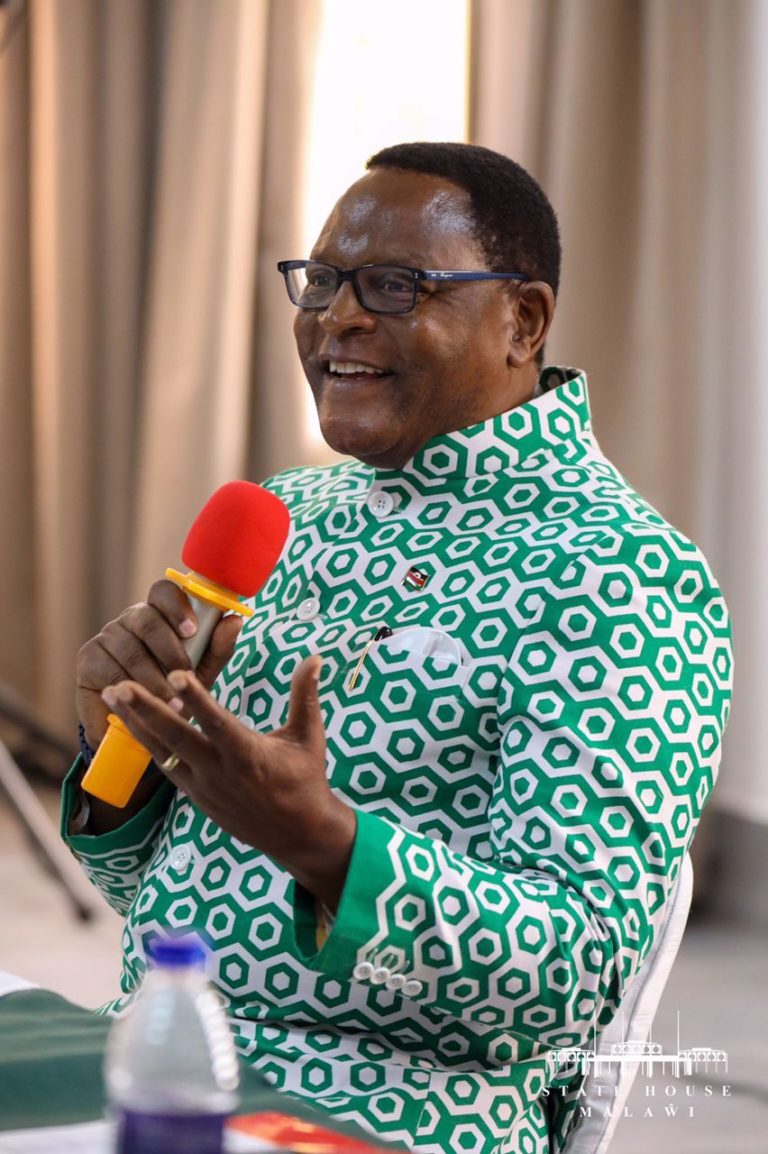
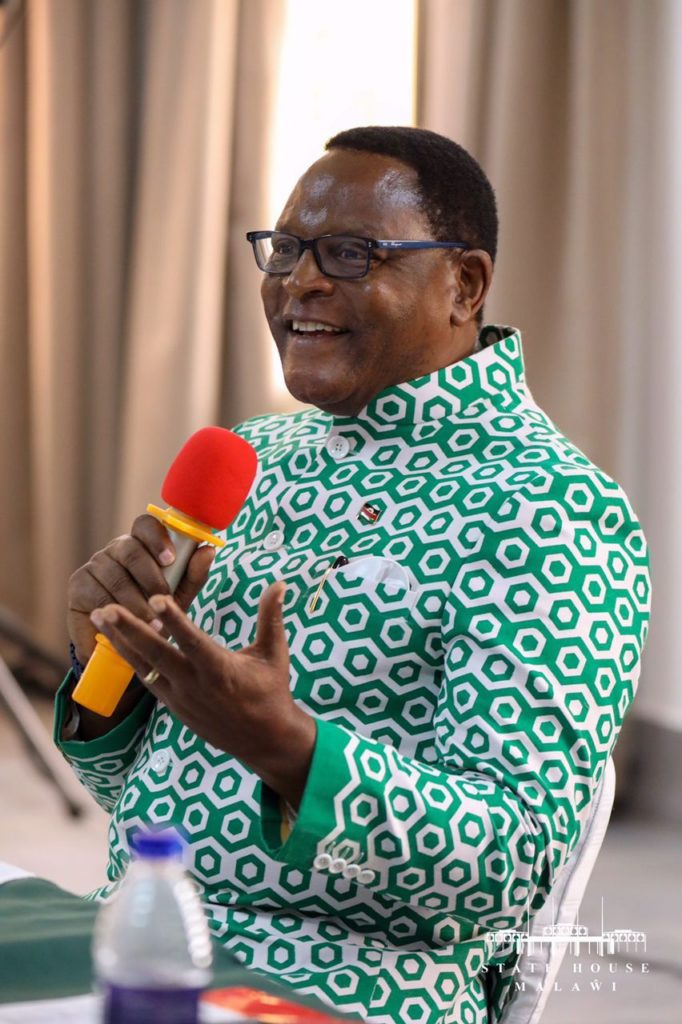
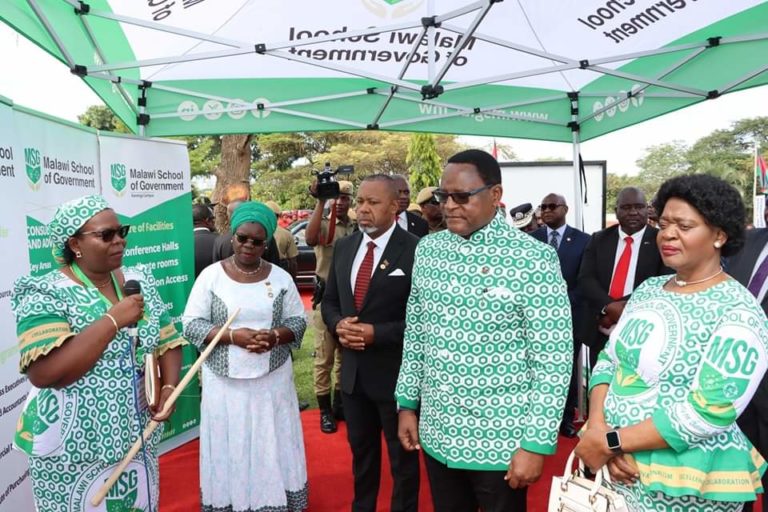
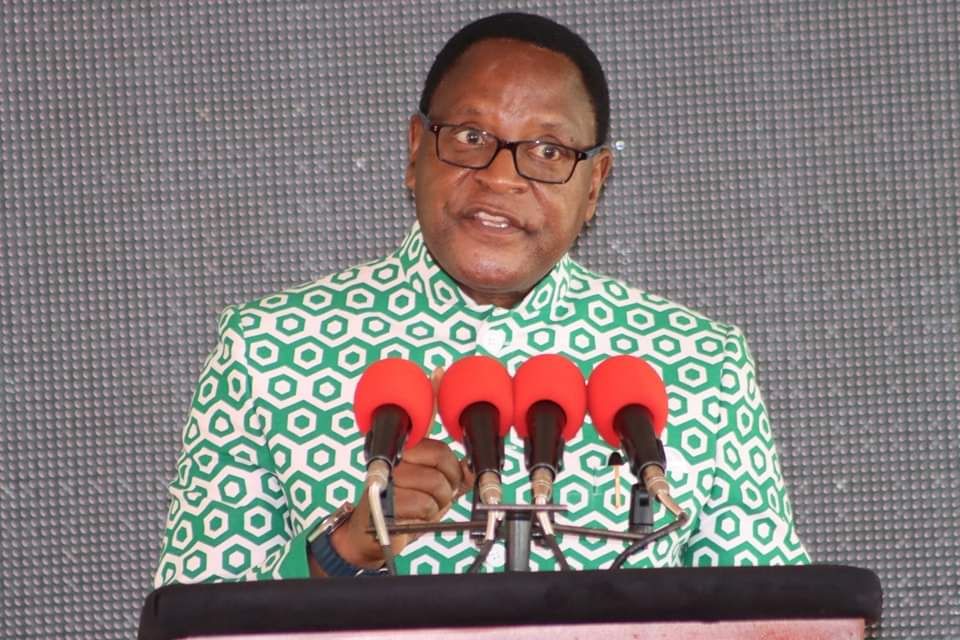
President Dr. Lazarus McCarthy Chakwera says Malawil School of Government (MSG) is the right dose to rid off chaos in the delivery of service in the civil service.
Speaking when launched MSG Campus at Kanengo in Lilongwe on Wednesday, Chakwera explained that the school will help in eradicating laxity, incompetence as well indecisiveness among civil servants.
He said his administration is determined to resurrect the civil service to make it professional service to serve Malawians better.
President Chakwera
“We have put in place programs that will enable civil servants to be ethical in their decision making,” he said.
Describing MSG as a knowledge bank, Secretary to the President and Cabinet (SPC) Colleen Zamba said the school is important for top notch public service delivery.
She assured the president that her office will provide all the necessary support to the school to make it realize it’s full potential.
MSG Governing Council Chairperson Prof. Byson Dzimbiri the institution is now ready to train a more professional and determined civil service.
MSG Director General Prof. Asiyatu Chiweza said the school will help to re energize the civil service.
President Dr Lazarus Chakwera has issued a directive for the compulsory training of all civil servants to enhance efficiency and ensure effective quality service delivery for Malawian citizens.
He made this announcement today during the official launch of Malawi School of Government at Kanengo campus in Lilongwe.
Chakwera noted the prevalent disorganisation, poor coordination among departments, and inefficiencies within the civil service system upon assuming office.
“Recognising the importance of addressing these challenges, we deemed it necessary to establish the Malawi School of Government to provide essential training for civil servants,” he said.
Highlighting the significance of Public Sector Reforms, Chakwera emphasised the pivotal role of civil servants and directed the Secretary to the President and Cabinet, along with District Commissioners, to ensure the mandatory participation of untrained civil servants in the institution’s training programmes.
Secretary to the President and Cabinet (SPC), Colleen Zamba, underscored the essential nature of training for civil servants, describing the civil service as the nerve centre of Malawi’s economic growth.
“The vitality of our system hinges on continuous training. It is imperative to equip civil servants with the necessary skills to enhance efficiency and productivity,” Zamba stated.
Professor Asiyati Lorraine Chiweza, Director General of the Malawi School of Government, highlighted the institution’s role in professional development.
The merger of the Staff Development Institute and the Malawi Institute of Management into the Malawi School of Government aims to enhance the performance of public service by offering diverse programs tailored to better serve Malawians.
The launch ceremony marks a significant milestone for the Malawi School of Government, signalling a new era in the provision of professional training, consultancy, research, and advisory services for both the public and private sectors.
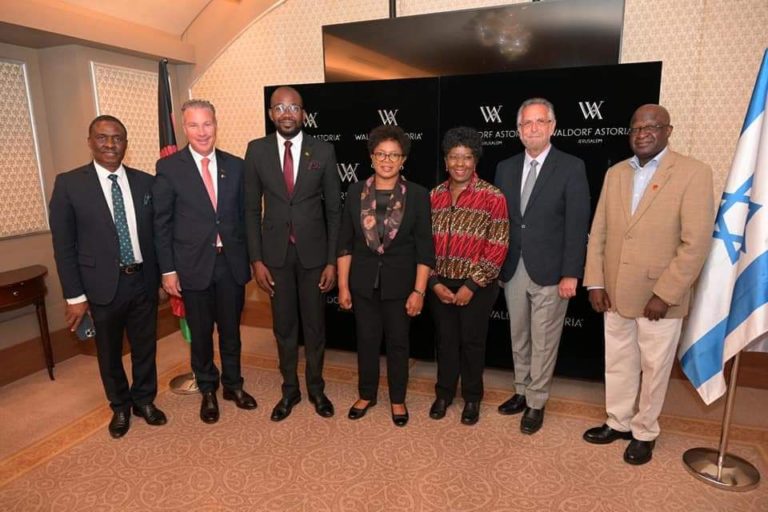
The Malawi delegation has arrived in Jerusalem today where among other things they will sign a Memorandum of Understanding (MoU) with the Israel Government on Malawi Labour Export to that country.
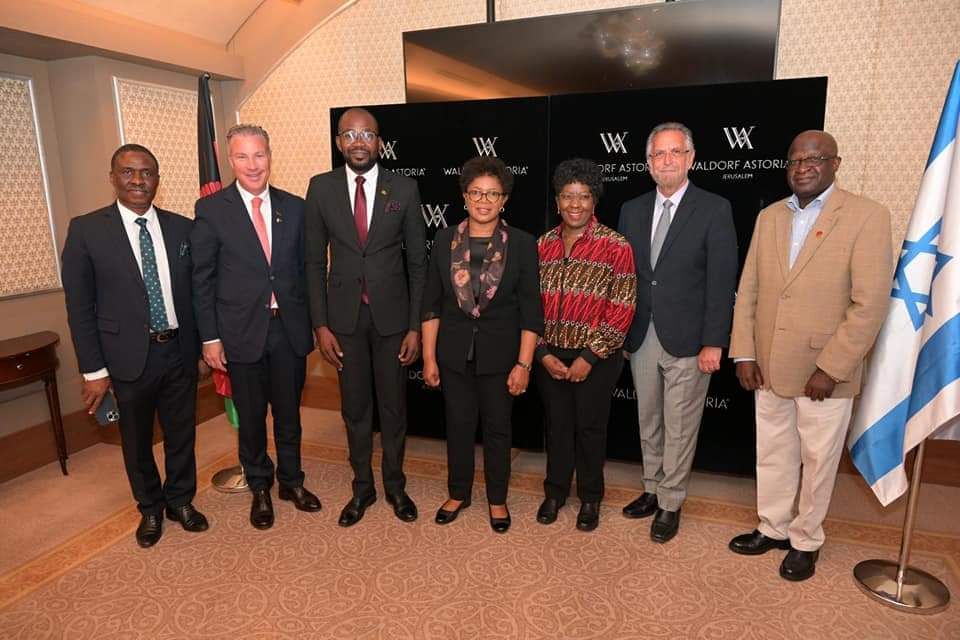
The delegation, which is led by Minister of Foreign Affairs, Nancy Tembo, met with Israel’s Director of International Interreligious Affairs, Rabbi David Rosen today at the Waldorf Astoria Hotel. Rabbi Rosen briefed the Malawi Delegation on the history of Israel State.
The Malawi delegation
Before signing the Labour Export MoU, on Thursday, 18th April in Jerusalem, the Malawi Delegation will visit farms at the Kibbutz, North Oz and Kibbutz Shfaim in Tel Aviv. While there ,they will also meet Malawian employees working at the farms.
While in Jerusalem, the Minister of Foreign Affairs will offficially open the embassy in Tel Aviv.
The Minister of Labour, Agness Nyalonje and Minister of Information and Digitalisation, Moses Kunkuyu Kalongashawa are among the Malawi Delegation.
Music followers in the country have expressed excitement following the return of renowned gospel musician Dunstan Kapitapita who has released his brand new music video titled ‘Chigonjetso’ after a 13-year-break from the music scene.
Kapitapita announced his return in the music industry a couple of days ago, saying his fans should anticipate some more projects in the near future.
“I am glad to be back with my first video project after a very long time. I believe that the song will inspire ,bless as well as remind you the goodness of our Lord Jesus Christ,” said Kapitapita in an interview.
Kapitapita
Meanwhile music fans have been reacting to Dunstan Kapitapita’s new song with many commending the artist for not loosing touch.
One music fanatic Peter Longwe said he was excited with the coming back of the artist.
“Really missed this voice in the scene for so long … beautiful to have him back.”
“The guy is blessed with golden voice,” said another music fanatic Bester Nelson.
Jumany Munama says Dunstan Kapitapita is a rare talent and that he was also excited to have him back on the music scene.
He said, “15 years we have been missing his voice then boom just hearing it once all the memories are back. Some people touch souls when singing.”
Dunstan Kapitapita came in the limelight some years back when he teamed up with Gift Phiri in popular songs like Ndikufuna Yesu, Ndidzakhala nanu, Ndaomboledwa, Tilondole Yesu and Diso Langa
He also joined forces with Anne Mutumbi in ‘Imfa ya Vic Marley’ a tribute to the late reggae dancehall musician Vic Marley who passed on tragically on 24 May in 2005.
Kapitapita released his first solo album titled ‘Ndidzayenda ndi Yesu’ in 2012 and since then, the singer has not been active on the music scene.
Here is the link to Dunstan Kapitapita’s new song ‘Chigonjetso’ https://youtu.be/BdnxZ1dGI4c?si=hZwHdw-edbboEDDG
In a recent social media post, activist P.T.N. Miyamba shared his thoughts on why he believes a federal system of governance is crucial for the development and economic growth of Malawi.
His passionate plea for change has sparked a conversation about the current state of governance in the country and the need for a shift towards a more equitable and transparent system.
Miyamba’s advocacy for federalism stems from his belief that it offers a more fair and balanced approach to allocating resources for development.
Miyamba
In a federal system, regions are given the autonomy to prioritize and plan for their own development, rather than relying on a central government that may show bias towards certain regions.
This can help prevent corruption and ensure that all areas of the country receive the necessary funds for growth.
The activist also highlights the drawbacks of Malawi’s current unitary system, which he describes as corrupt and prone to favoritism towards certain regions based on tribal affiliations.
He points to the historical influence of different tribes on the country’s governance, noting a pattern of tribal democracy that has been perpetuated by successive administrations.
This tribal politics, Miyamba argues, has hindered the country’s progress and limited its potential for economic growth.
Miyamba draws attention to the rapid growth in Malawi’s population, which has tripled since the country gained independence in 1964.
With an increasing number of citizens to serve, he argues that the current governance institutions are ill-equipped to address the country’s evolving needs in healthcare, education, agriculture, infrastructure, and economic development.
Without a more responsive and decentralized system of governance, Malawi risks falling behind and being at the mercy of external forces.
The activist emphasizes that federalism is not about dismantling the current multiparty system, but rather enhancing it to empower citizens and promote a more competitive political environment.
He envisions a system where resources are distributed more effectively, and where opposition parties can challenge the government on a level playing field.
By decentralizing power and allowing regions to have more control over their own affairs, Miyamba believes that Malawi can break free from the cycle of tribal politics and corruption.
While some may view federalism as a divisive and risky concept, Miyamba is quick to dispel these misconceptions.
He urges his fellow citizens to educate themselves on the benefits of federalism and to see it as a pathway towards accountable governance and economic prosperity.
He believes that the youth of Malawi, who are increasingly informed and engaged in issues of governance, will play a pivotal role in driving this change and shaping the future of the country.
As the conversation around federalism gains momentum, it is clear that Malawi is at a crossroads.
The choice between maintaining the status quo or embracing a new system of governance is a critical one that will have far-reaching implications for the country’s development.
With advocates like Miyamba leading the charge for change, there is hope for a brighter future where all regions of Malawi can thrive and prosper under a more transparent and inclusive governance structure.
The call for federalism in Malawi is a call for unity, accountability, and progress.
It is a beacon of hope for a country that is ripe for transformation and ready to embrace a new era of governance.
It remains to be seen whether this call will be answered, but one thing is certain: the winds of change are blowing, and the people of Malawi are ready to chart a new course towards a better tomorrow.