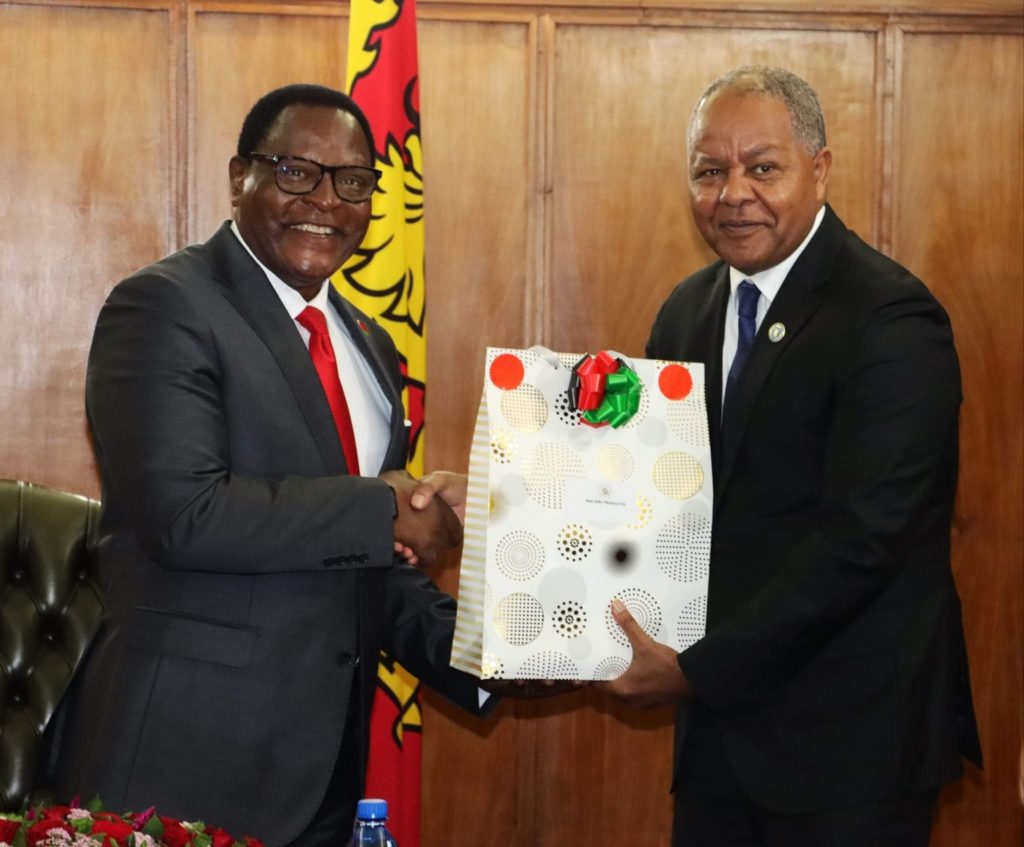
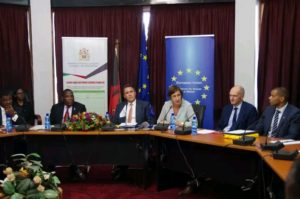
President Dr. Lazarus McCarthy Chakwera on Tuesday 9th January 2024 held an audience with a delegation from World Food Programme (WFP) at Capital Hill in Lilongwe.
Speaking to the media after the meeting, WFP Regional Director for Southern Africa Regional Bureau, Menghestab Haile said apart from food security, the meeting also discussed climate change, achieving regional self – sufficiency, transforming agriculture to support women farmers, addressing youth employment in the agriculture sector and climate – smart initiatives within the Southern African Development Community (SADC) region.
Haile explained that WFP aims to mobilize resources and establish resilient food systems to reduce reliance on food handouts.
“The issue of food insecurity is not only affecting Malawi but is a concern within the entire SADC region. The meeting aimed at strategizing on how to progress in addressing such problems,” said Haile.
Chakwera and Menghestab Haile
He disclosed that WFP will continue its intensified effort in supporting the Malawi government to distribute relief to those most affected by hunger in the country.
In his remarks, Commissioner for Disaster in the Department of Disaster Management Affairs, Charles Kalemba, mentioned that the meeting also focused on revamping and transforming agriculture through youth-friendly programs and exploring improved technologies to sustain the country’s food systems during adversities.
Kalemba emphasized the need for enhanced agriculture systems, including mechanization and commercialization, to replace outdated farming methods for better agricultural productivity.
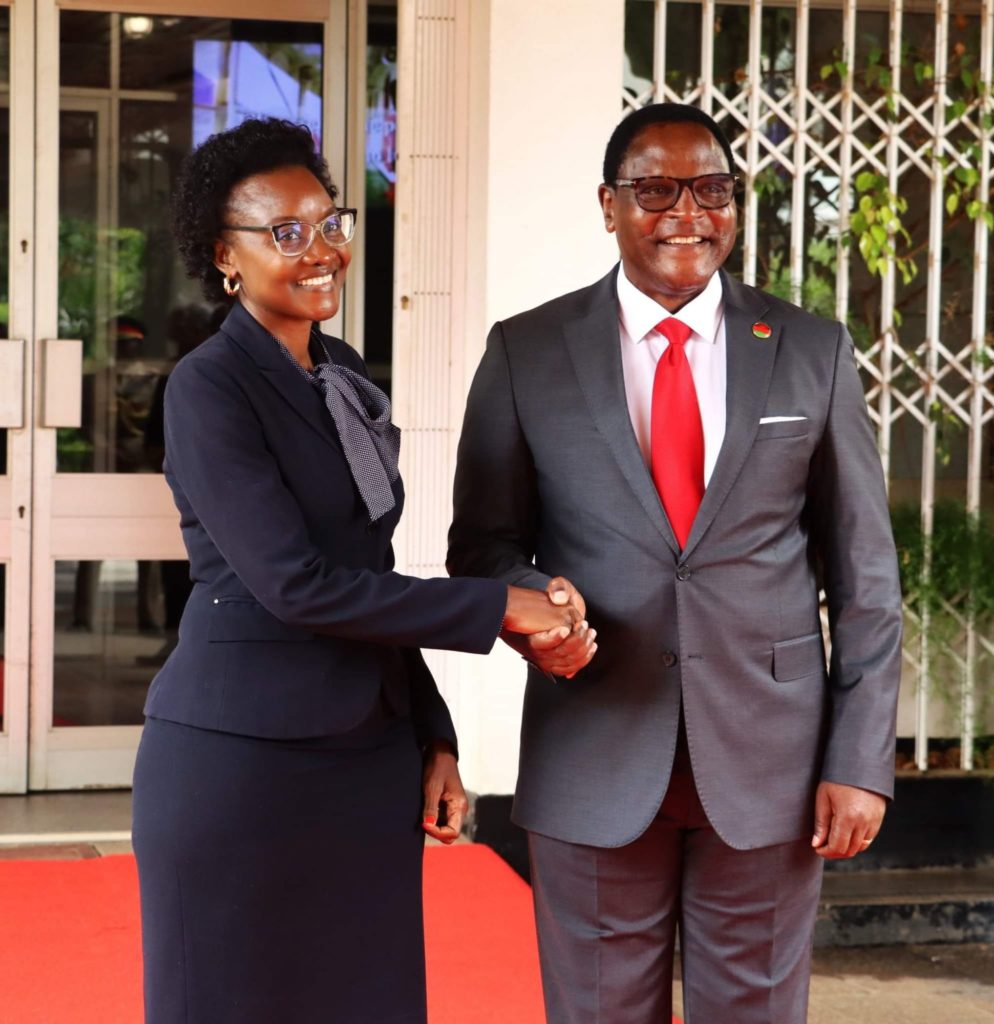
Among other notable individuals accompanying President Lazarus Chakwera were Secretary to the President and Cabinet Madame Colleen Zamba, Minister of Foreign Affairs Nancy Tembo, Principal Secretary in the Ministry of Agriculture, Dixie Kampani, and other government officials.
According to media reports, Democratic Progressive Party (DPP) Member of Parliament for Blantyre City South East Sameer Suleman has left the party ‘rebel’ group headed by former vice president for the south Kondwani Nankhumwa.
In view of this development, this article attempts to peep through the circumstances leading to this very interesting decision made by Sameer and what this means.
First of all, the breaking away of Sameer Suleman from Kondwani Nankhumwa rebel camp could be early warning signs of the camp falling apart. Suleman has realized something and is repositioning himself on the winning side just in good time before the Democratic Progressive Party (DPP ) convention scheduled for July 2024.
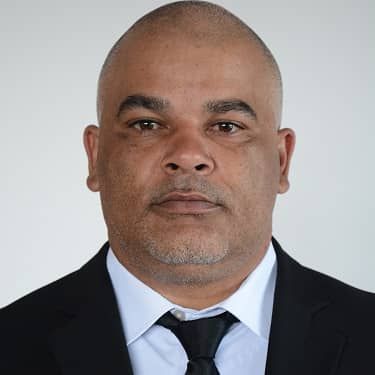
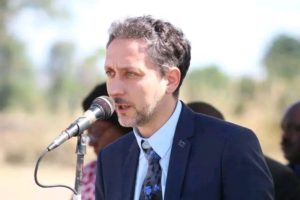
Sameer Suleman
The signs of which camp is likely to win at the convention between Nankhumwa and Mutharika are clearly written on the wall. Professor Arthur Peter Mutharika was once President of Malawi and every citizen knows how he governed this country. On the other hand, Kondwani Nankhumwa has been Leader Of Opposition, and his performance has equally been addressed for the past 3 years close to 4 years now. Therefore, for Sameer I would say he is well informed than many people who could be a better leader between the two warring sides. In other words Suleman has finally discovered that Kondwani Nankhumwa is a weak Leader both in Parliament and as former DPP vice president for the south.
It looks like Suleman has seen the situation in the DPP from a distance. It is paramount to see things from far before they happen and this is what I visualize in the decision made by the law maker. He has probably already seen the fall of Kondwani Nankhumwa before the actual fall takes place at the convention slated for July 2024. Some critics ask: does Kondwani Nankhumwa think he can defeat Professor Arthur Peter Mutharika at the convention and stand as a presidential candidate then finally beat President Reverend Lazarus Chakwera and become the State President of the Republic of Malawi and be addressed as His Excellency President Kondwani Nankhumwa? Many people think this could be a big joke and many critics have disqualified Nankhumwa completely out of this race after assessing his strength and weaknesses using a number of yardsticks such as that of Leader Of Opposition.
Finally, Sameer has probably thought very carefully before making his final decision. He is well exposed to both APM and KN leadership styles and he’s is able to see who has the potential of winning the presidential race. I want to believe that Sameer Suleman’s final decision leaving the party ‘rebel’ group headed by former vice president for the south Kondwani Nankhumwa speaks volumes for itself.
In conclusion, the Kondwani Nankhumwa camp has finally started falling apart while the Arthur Peter Mutharika camp is gaining ground before the final battle of the convention is fought. Other signs that have exposed cracks in the KN camp are the screen shots that were recently taken and went viral on social media, showing desperate discussions among his team members. That again speaks volumes of loss of trust from the overzealous camp and is deeper than what may be seen from the surface. The battle is finally lost before the loss itself.
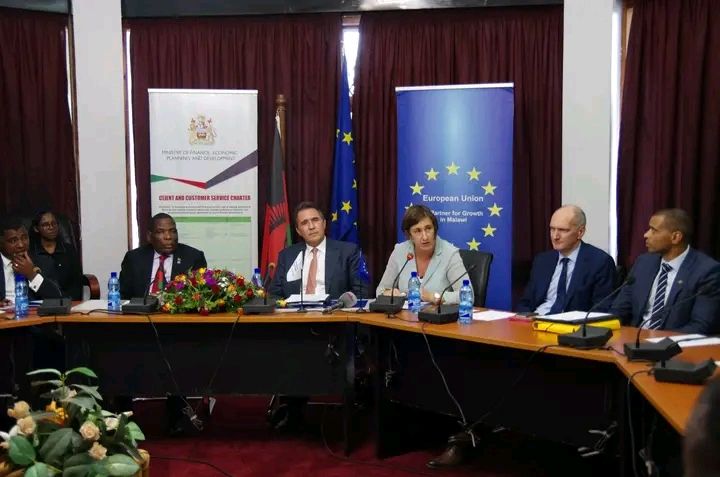
In a bid to retain production capacity and counter the attractive foreign subsidies for manufacturers, the European Union (EU) has unveiled a substantial €4bn (£3.4bn) state aid investment plan.
The funding will be directed towards the establishment of new factories dedicated to manufacturing electric car batteries, heat pumps, and solar panels. This move by the EU aims to expedite the production and adoption of green technologies, while simultaneously addressing the issue of inexpensive Chinese imports.
One of the primary recipients of state aid will be Northvolt, a Swedish battery producer, which is set to receive an impressive €902m for the construction of a new factory located in Heide, Germany.
Additionally, France is set to witness a significant boost in state aid, with a collective €2.5bn being allocated to various clean tech factories across the country.
The European Union’s investment in green technology manufacturing plants underlines its commitment to supporting the transition to a low-carbon economy. By fostering domestic production of electric batteries, heat pumps, and solar panels, the EU is not only aiming to reduce its reliance on imports but also to promote sustainability and create new employment opportunities.
The establishment of the new battery production facility by Northvolt in Heide, Germany, is expected to significantly enhance Europe’s capacity for electric vehicle (EV) batteries.
This strategic move comes as the demand for EVs is steadily increasing, driven by the need to reduce carbon emissions and combat climate change. With state aid from the EU, Northvolt is well-positioned to establish a state-of-the-art manufacturing plant that will contribute to Europe’s goal of becoming a global leader in green technology.
France, another key player in the European Union, is actively participating in the transition to a greener economy.
The €2.5bn in state aid earmarked for clean tech factories across the country will further strengthen France’s position in the green technology sector and boost its manufacturing capabilities.
This investment will facilitate the production of heat pumps, solar panels, and other clean technologies, propelling France towards a more sustainable future.
The EU’s decision to provide significant state aid to these sectors is prompted by the concern that domestic manufacturers could be enticed to relocate their production facilities overseas, where they may take advantage of more substantial financial incentives.
By backing domestic manufacturers, the EU hopes to prevent the outflow of production capacity and to safeguard its green technology industry, ensuring that it remains at the forefront of global innovation.
Furthermore, this investment by the EU serves as a crucial step in countering the influx of cheap Chinese imports. By supporting the growth and competitiveness of European manufacturing, the state aid aims to reduce dependence on imports and promote the purchase of locally produced, environmentally friendly products.
This strategic move not only strengthens Europe’s green technology sector but also bolsters its economic resilience while simultaneously reducing its carbon footprint.
The allocation of €4bn in state aid signifies the EU’s ambition to build a robust ecosystem for sustainable manufacturing within its borders.
By nurturing the growth of domestic battery and green tech factories, the EU is paving the way for a sustainable future that reduces greenhouse gas emissions and contributes to the achievement of its climate targets.
Ultimately, the EU’s investment in battery and green tech factories aims to drive innovation, economic growth, and job creation in the green technology sector.
By supporting the expansion of clean manufacturing, the EU is demonstrating its commitment to fostering a sustainable and competitive industrial base.
The state aid provided will not only incentivize manufacturers to choose Europe as their manufacturing base but also encourage the development of cutting-edge technologies that will shape the global future of clean energy.
In conclusion, the European Union’s announcement of €4bn state aid investments in battery and green tech factories represents a significant milestone towards achieving a greener and more sustainable future.
Through these financial incentives, the EU aims to retain domestic production capacity, combat cheap Chinese imports, and accelerate the adoption of green technologies.
By supporting the growth of the battery and green tech sectors, the EU is positioning itself as a global leader in clean energy, fostering economic growth, and contributing to the preservation of our environment.
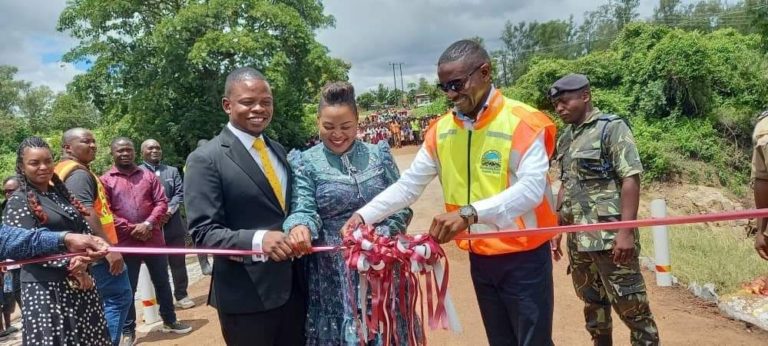
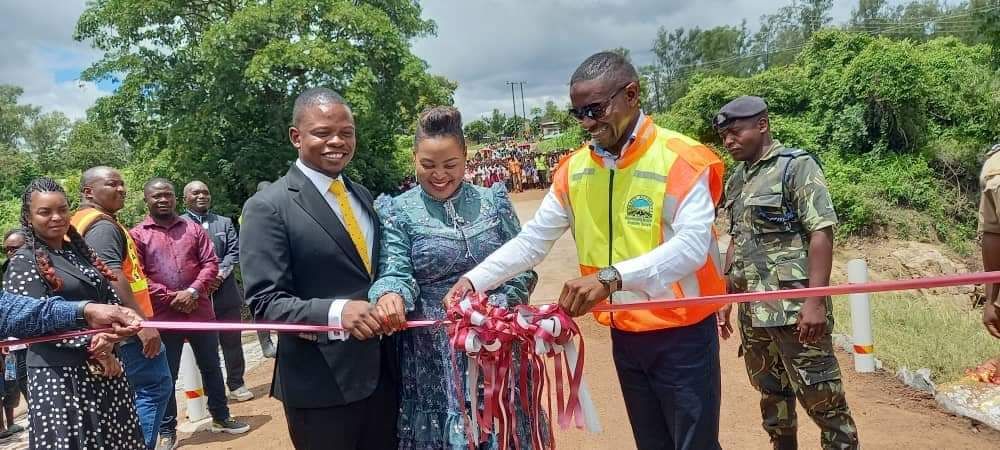
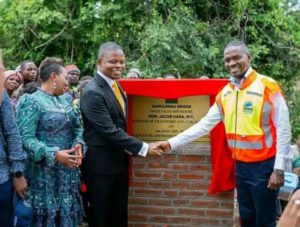
Prophet Shepherd Bushiri has on Monday handed over to Namulenga communities in Mulanje a new bridge, which he has constructed with K120 million.
The previous bridge was washed away by Cyclone Freddy.
Speaking in an interview with journalists, Bushiri said he funded and launched the construction of the new bridge on November 7,2023, following a request by community members in the area through Mulanje District Council.
Bushiri and Hon Jacob Hara
He said it is possible for citizens to redeem their government from relying on other countries by contributing to development activities.
Said Bushiri: “I do believe that we should not be waiting for government to look for donations from Norway to come and build a bridge like this one. I do believe that certain things, we as Malawians, can take up matters in our own hands.
“If we will have four or five Malawians doing this, our country will move forward.”
On his part, Minister of Transport and Public Works Jacob Hara commended Bushiri for supporting the government by constructing the bridge.
The Minister called on Malawians to be patriotic and support various government development programmes as Bushiri always do.
A Malawian human rights activist based in South Africa Charles Ben Longwe, has asked government through the Ministry of Agriculture to release 40 tones of maize imported from Tanzania which it is holding at Jetty in Nkhatabay.
The Ministry of Agriculture is holding the commodity following a directive restricting importation of maize from Tanzania and Kenya over Maize Lethal Necrosis (MLN) disease.
The move by the Ministry is aimed at protecting the maize disease which has devastated the two countries from entering into Malawi.
Currently, the government has declared the maize it is holding from Tanzania as not good for consumption.
But speaking through an audio clip circulating in various social media platforms, Ben Longwe says the banned maize is being eaten as food in Tanzania and Kenya wondering in what way it will kill Malawians.
Longwe has asked government and the starving Malawians that which is better for the citizens to die of the claimed maize which has a disease or dying after taking wild roots and government must explain to its citizens of how many people have died in Tanzania after taking the maize.
He has again alleged that trucks belonging to Gotani-Hara, Richard Chimwendo Banda and Eisenhower Mkaka are being seen carrying the banned maize in Chitipa to unknown warehouses for sale sorely for government purposes.
The activist claims that the banning of maize imports from Tanzania has been made by one to three people in the Chakwera’s MCP led government for sale to benefit themselves not vendors to sale for their own benefit.
He also claims that in the Chakwera led government, there are ministers who are deliberately destroying the image of President Chakwera for him to be labelled a failure and they feel happy that Malawians are against their elected President.
“The maize withheld in Nkhatabay jetty could have saved many people in Nkhatabay from dying of hunger,” says Longwe.
He has however, appealed to President Chakwera to have his eyes wide awake that some ministers in his government are punishing the poor citizens in his name and if he continues watching this without taking action, Malawians will judge him through a ballot in the 2025 elections.