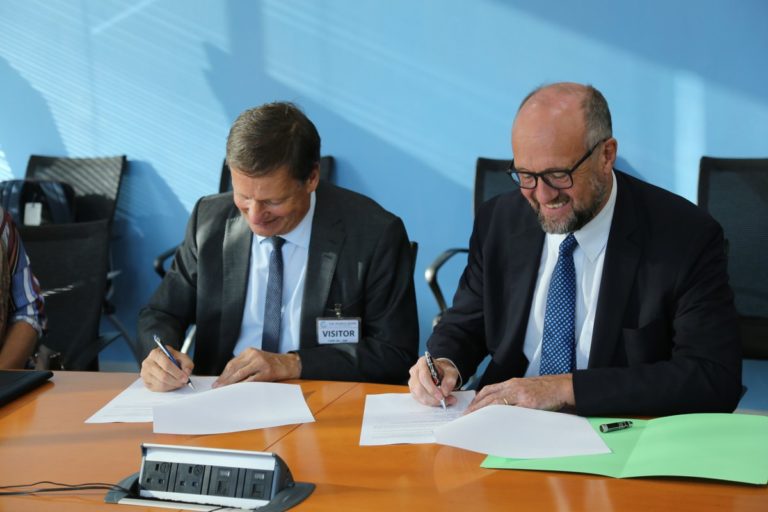
Farmers in 12 districts are expected to benefit from climate resilience technologies, new crop varieties, and improved agronomic practices through an additional 40 million Norwegian Kroners (approximately $4.4million) provided by the Norwegian Ministry of Foreign Affairs through the World Bank towards the Malawi Second Agriculture Sector Wide Approach Support Project (ASWAp SPII) Multi-Donor Trust Fund.
Norway Ambassador Steinar Hagen and World bank representative
“The collective effort of development partners in supporting ASWAp SPII in Malawi continues to show impact and good outcomes in nutrition and women’s empowerment, leading to more inclusive economic growth and increased resilience in Agriculture” said Greg Toulmin, World Bank Country Manager for Malawi.
Investments under the project will include road rehabilitation, which is critical to ensuring access to markets, capacity building of Ministry of Agriculture personnel, and establishment of model villages as demonstration hubs for good agricultural practices, led and managed by the own beneficiaries. All these areas are demonstrating the significant impact of ASWAp SPII in the agriculture sector in Malawi.
“It is Important to strengthen the Government system including sectors related to policy, extension and research, and at the same time reach out to the small-scale farmers with concrete support. These areas of support align fully with the Norwegian priorities”, said His Excellency, Steinar Hagen, Norwegian Ambassador to Malawi.
The second phase of the ASWAp multi donor trust fund, supported by United States Agency for International Development (USAID), European Union (EU), the Government of Flanders, the Norwegian Government and the Government of Ireland, started in 2018 and is expected to reach more than 350,000 people by December 2021.
Malawi government, the European Investment Bank (EIB) and the European Union has today signed a financing agreement worth 139 million euros (about K113 billion) for the rehabilitation of the 346 Kilometer stretch along M1 road.
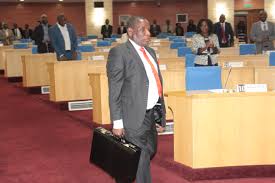
Minister of Finance Mwanamvekha signed the facility on behalf of Malawi government at Capital Hill, through a televised signing ceremony.
Finance Minister: Mwanamveka
The facility has been described as largest ever loan for investment in Malawi.
Of the 139 million euros or K113 billion, 120 million euros (approximately, K 97.3 billion) is earmarked for rehabilitation works for the Kamuzu International Airport Turn Off to Mzimba Junction sections of the M1 road, 15.5 million euros (about K12.6 billion) is an additional financing the rehabilitate the Kacheche to Chiweta section of the M1 in Rumphi district while 4 million euros (about K3.2 billion) is for a Technical Assistance Agreement for project implementation support to the Road Authority and Roads Fund Administration.
The rehabilitation works are expected to start from Kamuzu International Airport (KIA) Junction via Kasungu, then from Kasungu to Jenda, then from Jenda to Mzimba Junction and finally from Kacheche in to Chiweta in Rumphi district.
Currently, the M1 road is in dilapidated state and is considered as a death trap to motorists.
The rehabilitation works aim to reduce transport costs, cut travel time and facilitate export.
The M1 upgrade is also expected to improve international links to Zambia and enhance access to Dar es Salaam as part of the north-south regional transport corridor, according to Minister of Finance, Economic Planning and Development who signed the facility on behalf of Malawi government at Capital Hill, through a televised signing ceremony.
FDH Bank says they want to see the Malawi netball team, the Queens returning to the top position in Africa and dislodging South Africa’s Proteas.
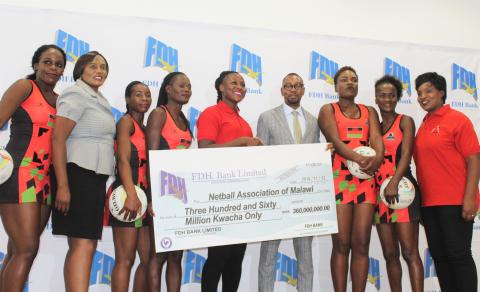
The bank’s acting managing director, William Mpinganjira said this on Tuesday when unveiling a record-breaking a three-year K360 million sponsorship to Netball Association of Malawi (NAM) for the team.
“No bank believes in the potential of the youth of Malawi than FDH. We observed that Netball, despite being the pride of the nation, has been lacking necessary support, structures and resources.
“The Queens were, among other milestones, the bronze medalist at the Fast5 International Series in 2016 in Australia and managed to beat the world’s number two team, New Zealand, at the 2018 Commonwealth Games in Australia, despite limited resources.
“The Queens through Netball Association of Malawi (NAM) have continuously exhibited massive potential and it is in this vein that today we are happy to unveil the sponsorship. K300 million will go directly towards sponsoring the Queens. K45 million will fund a Netball Cup while K15 million will be used to run NAM administration,” Mpinganjira said.
NAM president, Khungekire Matiya said they will ensure they retain the sponsorship by making it a win-win situation by making sure the girls open bank accounts with the bank.
“We will ensure that we market your brand wherever we go so that when people see the Queens, they will see FDH. The Queens are a big brand that will help propel FDH Bank’s growth.
“We see a bright future together. I am saying this because with such a landmark sponsorship, the Queens will strive for the best. We promise to make sure that the team continues to impress. We want the team to break into the top four in the world,” she said.
Matiya added that the reason for the Queens to drop to third-place on the rankings in Africa is not due to poor performance, but because they were not taking part in most of the small but ranking tournaments.
The event was also graced by Chief Director in the Ministry of Youth, Sports and Culture, Martin Kadzuwa who advised NAM to ensure proper use of the sponsorship money.
Apart from Netball, FDH sponsors the national football team, the Flames, Mayor’s Trophies and Football Association Malawi (FAM) FDH Cup.
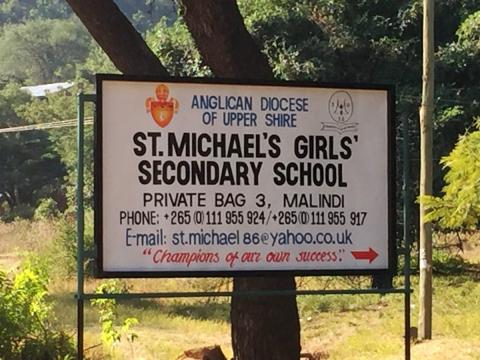
St. Michael’s Girls Secondary School students in Mangochi on Tuesday morning were forced to leave the school after vandalising school property in protest over poor diet.
By 11 am hordes of students were seen leaving the school, carrying their bags going home.
The students damaged the school property on Sunday evening.
It took the law-enforcers to intervene by firing teargas to disperse and restore peace at the school.
Mangochi Police station spokesperson, Rodrick Maida confirmed the incident saying they received a call from the school management to quell the situation after the students went on a rampage.
“It is true, we went there to restore peace but for what happened you can ask the school’s management,” he said.
One of the teachers who opted anonymity for fear of reprisals said the students went amok because of poor diet they have been receiving.
“The students have been complaining of the poor diet – nsima with beans and vegetables mostly; but there has never been an improvement.
“We saw the students regrouping before they started smashing the property,” revealed the teacher.
When contacted for comment head teacher for the school, Rose Chikhambi confirmed the closure of the school but refused to comment much on the development saying she is upset with the situation.
Chikhambi did not indicate when the school will reopen.
The new scramble for Africa is real. This will not be a new experience for Africa. In 1884/5 European powers met in Berlin, Germany, where they divided Africa among themselves.
They saw a continent that was poorly defended but has vast natural resources. Without consultation with the land dwellers, Europe descended upon Africa and took everything for herself.
For Malawi, then as Nyasaland, became a British protectorate in 1891. The British rule lasted for the next seven decades. But in between, the John Chilembwe uprising in 1915 was the earliest efforts towards Malawi’s independence.
Although it did not have an immediate impact, the Native Associations which were formed across the country two decades later referenced to the uprising. From them came the Nyasaland Africa Congress, later Malawi Congress Party, which fought for Malawi’s independence from late 1950s.
The country became independent in 1964 during the Cold War. This was an ideological warfare between the West for Capitalism, led by the USA and the East for Communism, led by the USSR, and signified by the Berlin Wall.
The independent Africa was caught in the rage. There were coups and civil wars on the continent which were direct results of which side the leader of a particular country leaned.
Kamuzu Banda in Malawi was aligned to the West, and this was a major reason for his three decade survival despite his poor human rights record. November 1989, the fall of the Berlin Wall in Germany, was the end of the Cold War, and with it the fall of strongmen like Kamuzu Banda as well.
The direct link between the end of Cold War and the fall of such men tells one story: They were mere pawns.
At this point it sounds like Africa was left to thrive and lead its own path. But in reality, the West and East have never left the continent. The relationship merely changes with time and circumstances. But largely, it still remains the same: Africa providing resources which are exploited by the developed nations. Africa still has its vast resources intact like petroleum and minerals, and presently, a growing population that is a huge market for goods and services.
The recent interest of countries like China and India on the continent should not be a surprise. These Eastern powers want to rival the grip of Western powers on Africa.
Other countries like Turkey, Israel and Russia are also into Africa evidenced by the opening of new diplomatic embassies and trade agreements. More importantly, the India-Africa, China-Africa and Russia-China summits.
African leaders are being invited for agreements and concessions with the West giving it a close watch. But there is a catch in the different approaches of these two blocks: The West hooks its aid to demands on good governance and accountability, while the East cares less.
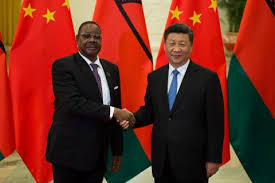
Mutharika and chinese leader Xi Jinping
The latter as well promotes the strongman politics on the continent, that democracy in a Western idea. As long as a leader is delivering, it does not matter how long they stay in power.
This will prove to be attractive to most African leaders who would like to stay on. The need for resources also goes with the need for a leader who can be controlled. This is where the dilemma rests.
Once again, the battle of who leads a country and its resources will mean everything between the West and the East. There are examples of countries such as Russia and France putting their men into power in Niger and Ivory Coast, respectively to ease access to the country’s resources.
Malawi comes in as well. Lacking minerals, just as it was during the Cold War, but it will still be significant. The recent growth in its trade with China has proved it to be a market.
Again, it will be a strategic political presence for whoever wins to be there. Still, there is a need for African leaders, including those in Malawi, not to fall into the strongman politics trap. Even more, it has been proved that countries with good governance and stable institutions are doing better than their counterparts. These are facts to be considered by African leaders when making agreements with these emerging Eastern powers.