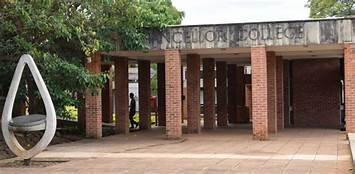
Concerned students task force, a grouping of students from Universities and Colleges in the country, have set June 5 this year to present their petition to government on calls to consider reopening of schools.
On 23rd March, 2020 President Prof Arthur Peter Mutharika directed the closure of all schools as one of the measures to prevent the spread of coronavirus in the country.
Leader of the taskforce who spoke on condition of anonymity said on Friday that they want government to hear their side of the story on reopening of schools following their closure.
“We have felt a great impact after government announced the closure of schools in the country. So our petition will border much on explaining consequences due to the closure and also providing recommendations.
“We feel like schools can be reopened and find ways on how to avoid the spread of the coronavirus at campuses. In colleges and universities we are all matured people and we can easily observe all precautionary measures to avoid the spread of the virus while proceeding with our education,” he said.
He, therefore, urged government to consider the partial re-opening of schools to allow students in their final years to complete their studies.
“For example fourth years Chancellor College student had two months to complete their studies. If these students are recalled it means there will be only few at the campus,” he said.
Recently government formed a national planning task force to look into the possibility of reopening of schools in the wake of Covid-19.
The task-force was formed against the background of consideration from the Ministry of Education to consider the reopening of schools.
So far, the country has recorded 203 confirmed Covid-19 cases with 4 deaths and 203 recoveries.
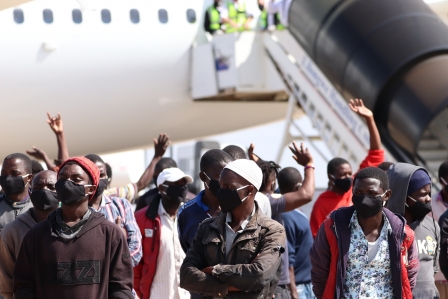
145 Malawians who were recently deported from South Africa arrived in the country on Friday through Kamuzu International Airport (KIA).
Ministry of Health Principal Secretary Dr. Dan Namarika and the members of the Presidential Taskforce on Covid-19 welcomed the deportees upon arrical at KIA.
Addressing the media Dr Namarika said that they have welcomed the deported Malawians as this is their home.
“These are our brothers and we want them to feel at home by taking care of them with a good place where they can rest as we are waiting for their Coronavirus tests to be conducted,” Namarika said.
He further said that when the results are out those negative will be taken to their districts of origin.
“As government we are providing them with everything. From here, after the results are out and those that will be found negative will be dispatched to their respective districts,” he said.
Those found positive will be managed by health personnel in places which government has put in place.
In his remarks Deputy Director for Disaster, Response and Recovery in the Ministry of Disaster Management Affairs and Public Events, Dyce Nkhoma, said government has, through the Ministry, provided blankets and food for the deportees.
“As ministry we have identified a place for these people to stay and we are also giving them food, soap and two blankets for each one of them,” Nkhoma said.
He added that government will make sure that they are well taken care of until everyone reaches their homes safe.
The country is expecting to receive 600 Malawians from South Africa who are stranded after the corona virus outbreak.
Lilongwe Chief Resident Magistrate’s court has sentenced a Nigerian national to four months Imprisonment with Hard Labour (IHL) but suspended to two years for illegally possessing cocaine drugs.
Lingadzi Police Spokesperson, Salomy Zgambo said the convict, Jude Okwuchukwu, 40, was found guilty on Wednesday for illegal possession of drugs contrary to Regulation 14 of the Dangerous drugs as read with Section 19 (1) of the Dangerous drugs Act.
The court heard through state prosecutor, Inspector Robert Kufandiko that on January 24, 2020, the convict was found with eight pieces of cocaine drugs which he was pegging at K500 per crack in Area 49.
“Illicit drugs are described as harmful since they cause brain disorder to the consumer and cocaine addicts are prone to commit offences since they are induced by drugs,” Kufandiko said.
The prosecutor, therefore, prayed that a custodial sentence be imposed because he was of the view that the aggravating factors much outweigh the mitigating factors.
He also asked for the accused person to be deported back to Nigeria to save Malawian youth from going astray due to drug abuse.
Okwuchukwu’s lawyer, Counsel Chrispine Ndalama, argued for leniency on the convict saying he had not wasted the court’s time owing to a plea of guilty his client had entered.
Counsel Ndalama also reminded the court that the accused person was the first offender, citing that as another mitigating factor that the court should consider in its sentencing.
In passing judgment, Chief Resident Magistrate Violet Chipao said that apart from the issue of good character and plea of guilty, there was the issue of possessing of drugs on the accused.
“Court found strong mitigating factors which outweighed the aggravating circumstances,” Chipao said.
The court, therefore, proceeded to sentence the Nigerian drug dealer to four months Imprisonment with Hard Labour (IHL) but suspended to two years in view of mitigations presented before the court.
Okwuchukwu who comes from Anambra State in Nigeria is currently remanded at Maula Prison awaiting deportation back to Nigeri
In Malawi, where children with albinism face attacks, and even ritual killings, going to school can expose them to life-threatening dangers. The UN is helping to make schools safer for these vulnerable students
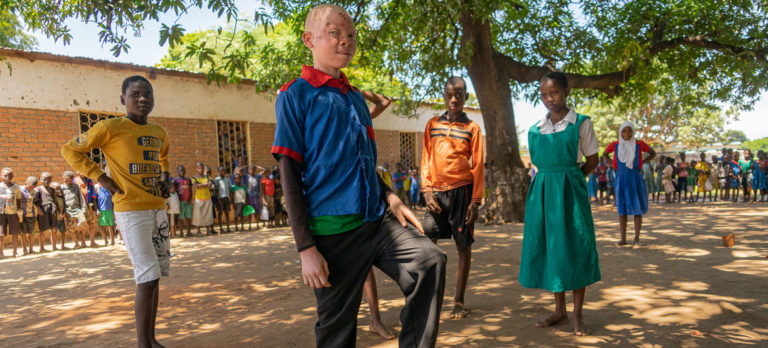
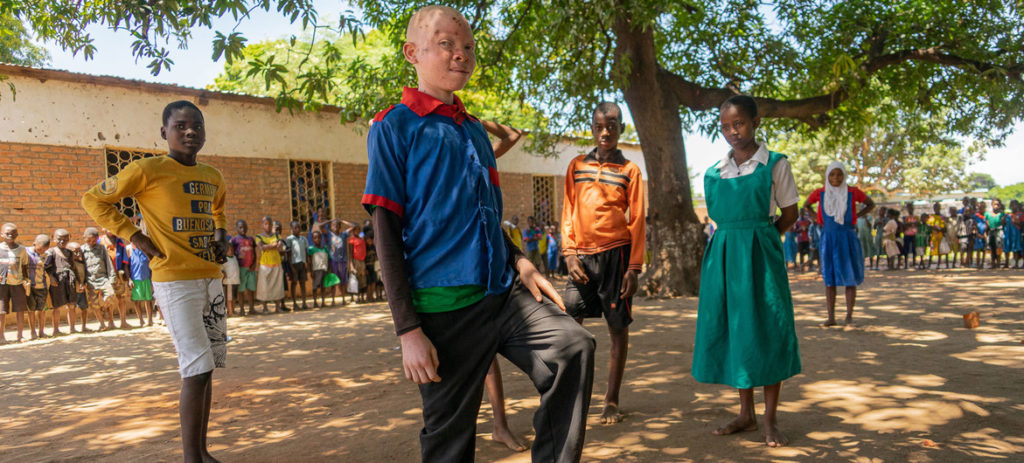
Chinsisi Jafali, a 14-year-old with albinism, knows that going to school is a risky prospect, but it’s a risk he’s prepared to take. “I have six siblings who are all looked after by my mother,” he says. “Fending for the entire family has been exceptionally difficult for my mother. Her fight for our survival motivates me to go to school and work hard, so that I can help my family in future.”
One in 130 people in Malawi has albinism, over 134,000 in total. Of these, 40 percent (about 53,000) are of primary and secondary school age. Yet going to school potentially puts them in grave danger. In some communities they are attacked or even killed for their body parts which are erroneously believed to possess magical powers. In the last five years, over 160 cases of killings, and other human rights violations against persons with albinism have been reported in the country, with similar cases also occurring in neighbouring Tanzania and Mozambique.
Chinsisi Jafali, a 14-year-old with albinism in Malawi
“Some parents are so afraid of sending their children with albinism to school that fewer children with albinism access education,” says Maria Jose Torres, the United Nations Resident Coordinator, the most senior UN humanitarian official in Malawi. She also points out that, with many of them visually impaired, a lack of schools offering special needs education also limits their chances of receiving a quality education.
Fighting for survival, and schooling
Despite their plight, many boys and girls with albinism are defying the odds to remain in school in search for a brighter future. Chinsisi, who is from Kunaunje Village in Salima district in the Central Region of Malawi, is one of these brave children.
When Chinsisi lost his father at age 4, many people in his village thought his future was over. Being raised by a single mother in a poor family was always going to be difficult, particularly with small-scale subsistence farming as their only tangible means of livelihood.
Ten years on Chinsinsi is now studying at a primary school in the district: normally, at his age, he should have been finishing primary education, but it is not uncommon in Malawi to have older children in lower grades due to dropping out, starting school late, repeating classes, and inadequate learning support.
“I repeated some classes because I was struggling to learn with my sight problem. I couldn’t clearly see things that teachers were writing on the board. But now I sit in front and teachers write in bigger letters than before so that I can read properly. My performance in class has been improving, which makes me feel good,” he says.
Creating a safe learning environment
Thanks to a collaboration between the school and the community, as part of the Joint Programme on Girls Education (JPGE), supported by the United Nations and Norwegian Government, pupils like Chinsisi now study in a safer environment. This has involved engaging the school, local community and police in efforts to stop violence against girls, and children with albinism.
They have also been teaching the students how to protect themselves: as part of the programme, Chinsisi and other students with albinism received an alarm device for alerting people and security authorities when they face attacks. “I used to be very afraid when going to school and struggling to concentrate on my studies before I received the alarm. Now this is one of my weapons against any threat that comes to me,” he says.
“Children with disabilities used to have poor attendance and poor performance, but that has changed,” says the school’s headteacher, Vincent Selemani. “Chinsisi is one of the students benefiting from an improved and safer learning environment. He is now able to walk from his home and stay at school without worrying about his safety.”
Education is not a luxury, it is a right
“For any child, anywhere, education is not a luxury. It’s a necessity and fundamental right regardless of their status”, says the UN’s Ms. Torres. “Educating girls and children with albinism helps us leave no one behind.”
“Education creates entrepreneurs, a skilled workforce, more consumers and more prosperous communities. A healthy, educated, empowered adolescent girl, or child with albinism has the unique potential to break the cycle of poverty for herself, her family and her country.”
Since the programme has been running, supporting schools in Salima, Dedza and Mangochi districts, school dropouts have fallen from around 16 per cent, to about five percent. As well as stopping violence, and raising the quality of learning, the programme, provides school meals to students like Chinsisi, who would otherwise go hungry, and promotes access to youth-friendly sexual and reproductive health services to reduce teen pregnancies.
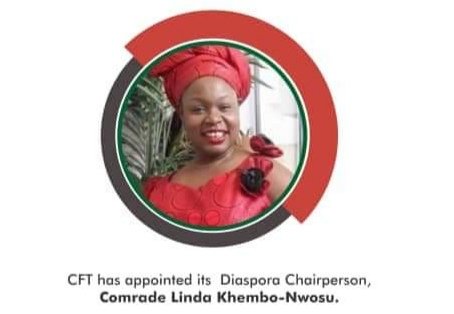
The chairperson of CFT people power movement in the diaspora Linda Khembo Nwosu has expressed her amazement at the number of Malawians who are showing interest and committing themselves to the movement . CFT which is led by the fearless Timothy Mtambo , who gets the title of Commander in Chief, was only started two months ago but is already having big impact both in Malawi and among Malawians living abroad.
Linda Khembo said her role is to make sure that the movement grows and that the diaspora chapter can play a role in helping see real change in Malawi. “ The past 5 years we have seen the rise of diaspora groups getting involved in Malawi politics . What is of interest is that a lot of these people get involved out of their love for Malawi and after getting frustrated with the way democracy is being undermined in Malawi. Most people in the diaspora are not doing this for positions but out of pure love for their home country”
When asked what role the diaspora will play in the movement, Khembo said, resource mobilisation is on top of the activities. The group also aims to bring together people with various skills to work in areas like policy development, strategy formulation alongside the main movement in Malawi.
She went further to say that the main challenge so far has been to convince people that this movement is not a political party . “Our commander in Chief has made it clear , when he was introducing the movement as well as, in a number of interviews that this movement is not a political party and will never be . So, members of various political parties are free to join us. We have members from MCP, UTM , PP and others not affiliated to any party”
Khembo echoed the sentiments of Mtambo that the movement belongs to Malawians “ Timothy Mtambo has said this movement is not a one person movement , it’s not Mtambo’s, it’s not Linda Khembo’s , but it is for every Malawian who buys into the philosophy of the movement “ The movement will always be there to provide counter checks and balances to whosever is in power.
Khembo also admitted that CFT has endorsed the candidacy of Dr Lazarus Chakwera and Dr Saulos Chilima of Tonse alliance. She said the movement short term goal is to rescue Malawi from the accidental and despotic regime of DPP and Mutharika. “Our commander in Chief has been at the forefront of fighting for Malawi Freedom from his time at HRDC. Malawi has suffered from Non-respect for the Rule of Law and Constitutionalism, Killings of Persons with Albinism, Collapse of the Public Service and Civil Service, Rape perpetrated by the Police, Tribalism & Nepotism, corruption and many more atrocities and enough is enough, we cannot continue like this. Therefore, we are endorsing Tonse alliance as we want to see change in Malawi” said Khembo
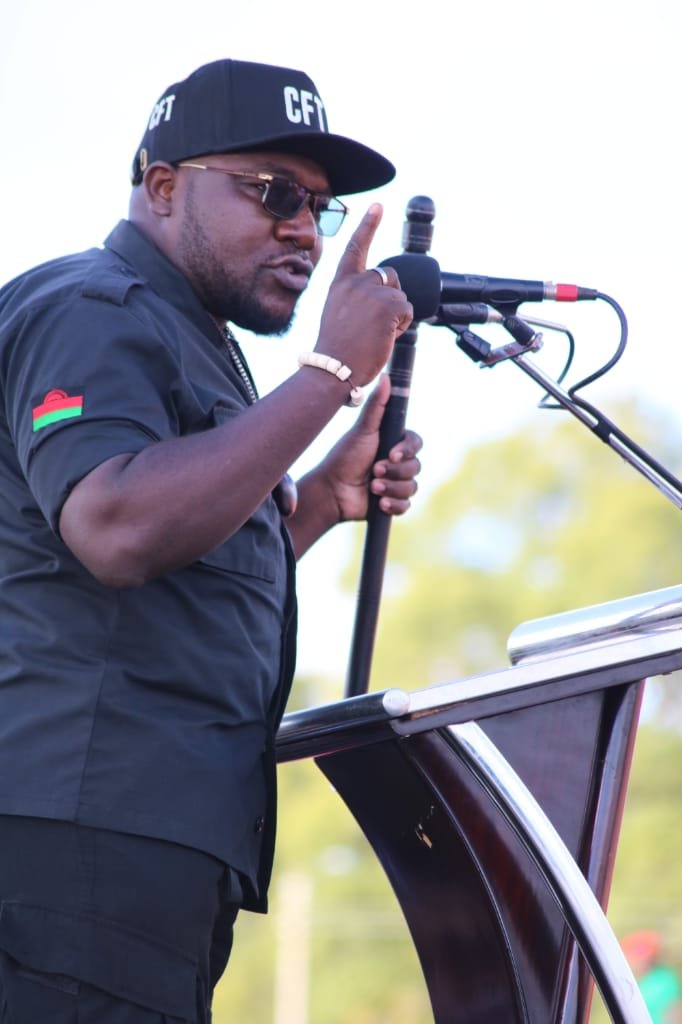
CFT Commander In Chief Timothy Mtambo
So far the diaspora Chapter of CFT has members from United Kingdom, Switzerland , USA , Germany and another sub chapter called Asia Division with its base in Taiwan. Khembo urged all Malawians living in diaspora and interested to be part of the movement to send a message using CFT diaspora official page or to contact any of the current members.