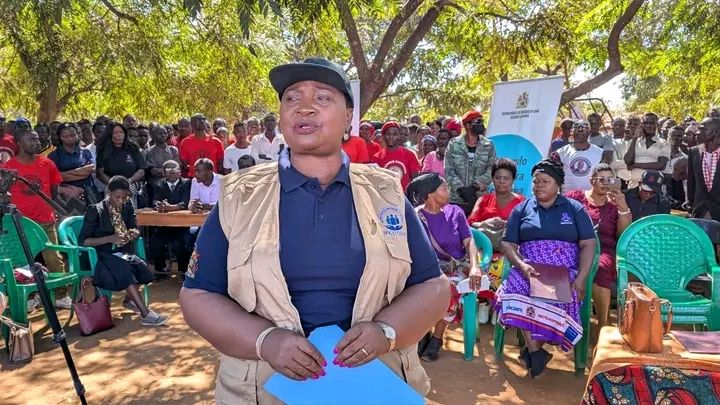
Prophetess Mary Bushiri of the Enlightened Christian Gathering Church (ECG) The Jesus Nation has emphasized the importance of women’s empowerment in creating economically stable households.
Speaking at the ‘Woman on Fire’ gathering in Lilongwe, Bushiri highlighted that financial independence is vital for women’s empowerment.
Prophetess Bushiri
The conference, dubbed ‘unstoppable women,’ featured sessions on business skills and financial literacy, aiming to equip women with the tools they need to succeed.
Bushiri’s message underscored the significance of empowering women to drive economic stability in households.
As part of the initiative, over 10 women’s businesses have received financial assistance, providing them with the necessary support to grow and thrive.
The ‘Woman on Fire’ gathering serves as a platform for women to connect, learn, and support one another in their personal and professional endeavors.
By empowering women, households can become more economically stable, and communities can benefit from the positive impact.
The initiative aligns with efforts to promote women’s economic empowerment and support their role in driving economic growth and development.
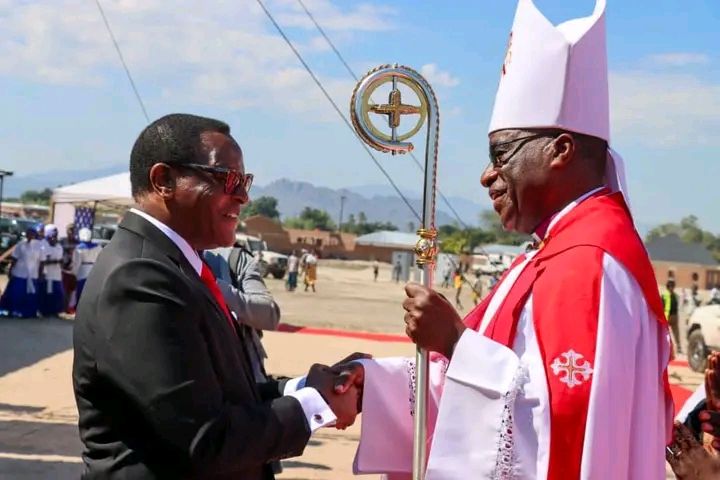
President Dr. Lazarus Chakwera has emphasized the importance of collaboration between the government and the Anglican Church in addressing the challenges facing the country.
Speaking at the Anglican Diocese of Upper Shire’s (ADUS) ordination of three transitional deacons in Mangochi, Chakwera highlighted the existing partnership between the two entities in areas such as education and health.
The President applauded the Anglican Church’s contributions to the country’s development and emphasized the need for continued collaboration to overcome the challenges facing the nation.
Chakwera’s remarks underscore the significance of partnerships in driving progress and improving the lives of Malawians.
During the event, Chakwera also inspected classroom blocks that were destroyed by Tropical Cyclone Freddy at Mpondasi Primary School and expressed concern over the damage.
He called for collective efforts to rebuild the damaged infrastructure, noting that the school serves not only the Anglican faithful but the broader community.
Bishop of the ADUS, William Mchombo, charged the newly ordained deacons to serve humanity with humility and to speak the truth in their ministerial work.
The three deacons, Elias Banda, Paul Kampeni, and Roy Mkize, took their call of Canonical Obedience and made a declaration to assent to the Book of Common Prayer and of the ordering of Bishops, priests, and deacons.
The ordained deacons will serve in various parishes, with Deacon Elias Banda deployed to Malindi, Deacon Roy Mkize to Mkope, and Deacon Paul Kampeni to Mpondasi.
Police in Zomba have arrested a 23-year-old man, Akimu James, for burglary and theft offences involving property worth K2 million.
The suspect, who hails from Khwayi Village in the area of Traditional Authority Jenala in Phalombe District, was apprehended by Domasi Police after a series of investigations.
According to Patricia Sipiliano, Publicist for Zomba Police, the police received numerous reports of burglary and theft from business people owning shops at Songani Trading Centre in June.
The Criminal Investigation Department (CID) initiated investigations, which led to James’ arrest and the recovery of stolen items, including three fans, three electric irons, a plasma TV screen, and a cell phone.
The suspect will appear in court soon to answer charges of burglary and theft.
The police are working to ensure that justice is served and that the stolen property is returned to its rightful owners.
The Minister of Gender, Community Development and Social Welfare, Jean Sendeza, has announced plans to discuss with the Chief Justice, Rizine Mzikamanda, to expedite cases of elder abuse.
Speaking at a commemoration event for older persons at Bindula in the area of Senior Chief Malili, Sendeza noted that elder abuse cases are often delayed due to family ties between the perpetrators and the victims.
Sendeza
Sendeza highlighted the challenges faced by law enforcement in handling elder abuse cases, where family members often intervene to settle disputes, leading to cases being closed. “It’s difficult because when the police get involved, the family members often go and close the case, but we want this to stop,” Sendeza said.
Andrew Kavala, head of the Malawi Network of Older Persons Organizations (Manepo), emphasized that older persons continue to face abuse, particularly accusations of witchcraft.
He called for the implementation of the Elderly Persons Protection Act, enacted in 2024, to protect older persons from abuse.
At the event, Manepo distributed blankets to 100 older persons, highlighting the organization’s commitment to supporting vulnerable members of society.
The government’s initiative to fast-track elder abuse cases is a step towards ensuring justice and protection for older persons in Malawi.
The political rivalry between Edgar Chagwa Lungu and Hakainde Hichilema was one of the most defining dynamics of Zambia’s recent democratic history.
As President of Zambia from 2015 to 2021, Edgar Lungu led the Patriotic Front (PF), while Hakainde Hichilema, leader of the United Party for National Development (UPND), emerged as his fiercest opposition challenger.
Lungu and Hichilema
The tension between the two leaders was not merely personal—it reflected deeper ideological, regional, and economic divides within Zambian society.
Lungu often presented himself as a guardian of national stability, leveraging state institutions, religious rhetoric, and a legacy of the late President Michael Sata to consolidate power.
In contrast, Hichilema positioned himself as a modernizing reformist with a technocratic approach, appealing particularly to Zambia’s urban youth, business sector, and regions feeling politically marginalized under PF rule.
The rivalry intensified during election periods, especially the hotly contested 2016 general elections, where allegations of vote rigging and post-election violence eroded public trust in Zambia’s democratic processes.
Following the 2016 polls, Lungu’s administration was accused of undermining democratic institutions, suppressing dissent, and limiting media freedoms—all actions perceived by Hichilema’s camp as targeted political persecution.
In 2017, tensions escalated dramatically when Hichilema was arrested and charged with treason for allegedly failing to give way to the presidential motorcade—a move widely condemned as politically motivated.
The international community, including human rights organizations and diplomatic missions, raised concerns over democratic backsliding under Lungu, amplifying calls for reforms and electoral transparency.
Meanwhile, Hichilema emerged from detention emboldened and increasingly viewed as a symbol of resistance to authoritarianism by a growing segment of the Zambian population.
Their rivalry was not only played out in political rallies and parliament but also through courtrooms, the media, and the streets—each episode contributing to Zambia’s polarized political atmosphere.
Throughout this period, the Zambian economy struggled with rising debt, inflation, and youth unemployment—issues both leaders sought to exploit or address in their competing narratives.
Lungu’s leadership style became increasingly associated with patronage and populism, while Hichilema projected an image of business-minded competence and international credibility.
The rivalry finally culminated in the 2021 general election, where Hakainde Hichilema defeated Edgar Lungu in a landslide victory, marking one of Africa’s most peaceful and significant democratic transitions.
The Lungu-Hichilema rivalry thus represents more than a clash of personalities—it encapsulates Zambia’s evolving struggle for accountable governance, regional equity, and democratic resilience.