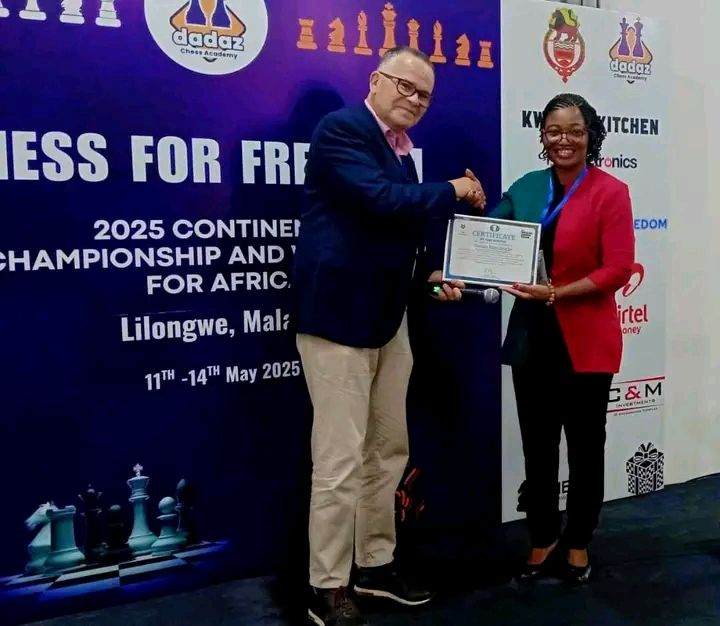
The Malawi Prison Service has introduced an innovative rehabilitation program that uses chess to transform the lives of inmates.
The program, known as “Chess for Freedom,” combines a workshop with a continental championship, aiming to instill discipline, critical thinking, and emotional stability in prisoners.
According to Commissioner of Prisons Bazirial Chapuwala, the service is shifting its focus towards correction and rehabilitation. “Chess fosters essential skills that help inmates reintegrate into society,” Chapuwala said.
The program is a collaboration between the Malawi Prison Service, the International Chess Federation, and the Dadaz Chess Academy.
Susan Namangale
It marks a significant milestone, being the first continental championship of its kind to be hosted in Malawi.
Andre Vogtlin from the International Chess Federation highlighted the impact of chess, saying it can bring people together and transform lives.
Susan Namangale, founder of Dadaz Chess Academy, noted that chess has reached 20 prisons in Malawi, with local teams participating in international tournaments.
The Chess Association of Malawi has welcomed the initiative, with Vice President Francis Kudzula expressing enthusiasm for promoting chess as a tool for rehabilitation and social development.
This initiative demonstrates the Malawi Prison Service’s commitment to rehabilitation and reducing recidivism rates.
By harnessing the power of chess, the service aims to promote safer communities and a brighter future for inmates.
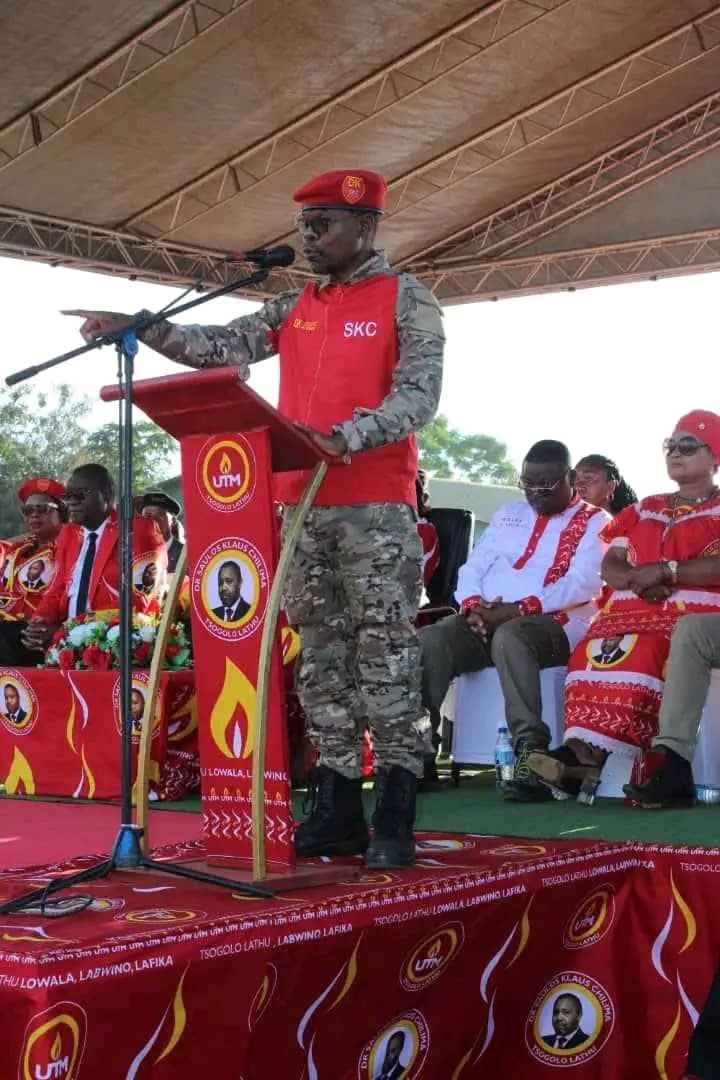
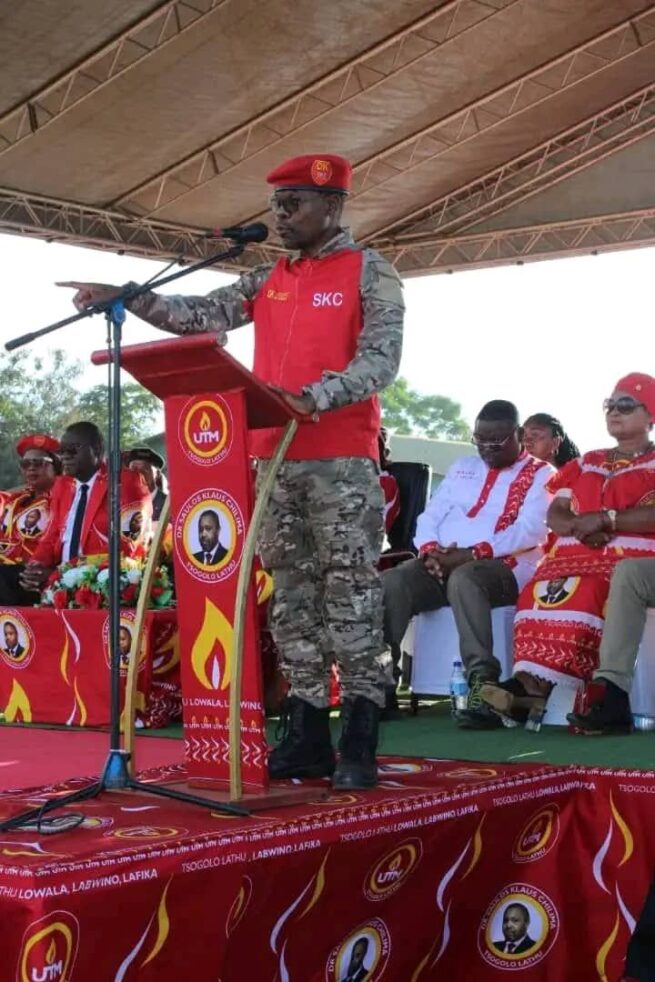
On Sunday, 11 May 2025, UTM senior official Felix Njawala addressed a lively crowd at Masintha Ground in Lilongwe, where he reflected on Malawi’s past leadership and economic management.
In his speech, Njawala revisited the pivotal year of 2004, when the late President Bingu wa Mutharika took office and began assembling a team of professionals who would drive his ambitious development agenda.
Njawala emphasized that President Mutharika appointed individuals based on merit, singling out two notable figures—Goodall Gondwe and Dr. Dalitso Kabambe—as exemplary choices.
Njawala
He noted that Dr. Dalitso Kabambe, in particular, played a crucial role in shaping Malawi’s fiscal direction and economic reforms during Mutharika’s first term.
Njawala described Kabambe as “the man who made the subsidy program possible,” referring to the revolutionary Farm Input Subsidy Program (FISP) that transformed Malawi’s agricultural landscape.
At the time, Kabambe was serving as Budget Director, a role that placed him at the center of national resource planning and allocation.
Njawala pointed out that under Kabambe’s watch, all components of the subsidy program were adequately financed, ensuring timely procurement and distribution of fertilizer and seed to farmers across the country.
He added that Kabambe also ensured that all contractors involved in government-supported infrastructure works—referred to as “crushers”—were funded on time and received sufficient financial support.
This efficiency, Njawala stated, was instrumental in supporting both agriculture and infrastructure development, the two pillars that defined the success of the Mutharika administration.
Njawala went further to mention that following the death of President Bingu wa Mutharika in 2012, Kabambe’s competence and reliability continued to earn him recognition in government circles.
As a result, Kabambe was appointed as Principal Secretary, a senior civil service position that underscored the trust placed in his capabilities by the leadership that followed.
This appointment, Njawala argued, was not political but a reflection of Kabambe’s consistent track record of service and professional excellence.
Felix Njawala’s remarks come at a time when the country is facing mounting economic challenges, with many Malawians yearning for visionary and competent leadership.
By invoking the legacy of Dr. Dalitso Kabambe, Njawala drew a sharp contrast between past and present economic management, suggesting that the key to progress lies in appointing people of merit and technical know-how.
His speech was not only a tribute to the technocrats of the Bingu era but also a subtle reminder to current political players of the importance of placing professionalism above partisanship.
As the 2025 elections approach, Njawala’s comments may be seen as part of a broader UTM strategy to engage in dialogue about governance standards and the type of leadership Malawi desperately needs.
In elevating Kabambe’s legacy, Njawala may also be sending a message to voters and political leaders alike: that the success of a nation depends on the strength, integrity, and competence of those entrusted with public office.
The Malawi Congress Party (MCP) has strongly condemned the recent episode of political violence that erupted on Sunday in Mponela, Dowa District, labeling it a dangerous threat to the country’s democratic fabric.
In a statement released to the media, the party expressed deep concern over the incident, while simultaneously questioning the circumstances surrounding the violence and the possibility of it being premeditated.
MCP National Publicity Secretary Jessie Kabwila voiced the party’s skepticism, suggesting that the timing and coverage of the incident may point to a staged event rather than a spontaneous outbreak of violence.
Kabwila
Kabwila particularly noted with surprise that certain individuals seemed to have been strategically positioned to take photographs and contact media houses during the violent episode.
She described this as unusual behavior during a genuine moment of crisis and hinted that it could be part of a broader scheme to tarnish the party’s image or manipulate public sentiment.
Despite the disturbing nature of the incident, Kabwila emphasized that the MCP will refrain from making further comments on the matter until a full investigation has been conducted.
She stressed that the party remains firmly committed to upholding peace, non-violence, unity, and the democratic principles that form the cornerstone of Malawi’s political system.
The MCP’s call for calm was echoed by Human Rights Defenders Coalition (HRDC) Executive Director, Gift Trapence, who urged law enforcement agencies to treat the matter with the urgency it deserves.
Trapence appealed to the Malawi Police Service to expedite their investigations and ensure that those behind the violence are brought to justice without delay.
He also called upon all political parties across the spectrum to take a firm stand against any form of violence and instead promote peaceful coexistence in the lead-up to the general election scheduled for 16th September.
According to Malawi Police Service spokesperson Peter Kalaya, investigations into the Mponela violence are already underway.
Kalaya assured the public that those identified as perpetrators will face the full weight of the law.
As Malawi approaches a critical election period, the need for political maturity, restraint, and genuine commitment to democratic ideals becomes ever more pressing.
The events in Mponela serve as a stark reminder of the fragility of peace and the dangers posed by politically motivated violence, whether real or orchestrated.
MCP’s cautious but firm response, along with the calls from civil society and law enforcement, signals a collective determination to protect Malawi’s democratic gains from the threats of division and disorder.
The nation now waits to see whether justice will be delivered swiftly, and whether all political players will choose the path of peace over provocation in the weeks ahead.
The Minority Shareholders Association of Listed Companies (MISALICO) has identified a lack of financial literacy as a major obstacle to Malawians’ participation in the Malawi Stock Exchange (MSE) market.
According to Reverend Frank Harawa, Secretary General of MISALICO, the knowledge gap about the market remains a significant contributing factor to poor participation.
Speaking in Rumphi during an engagement with locals, Harawa emphasized the need for civic education to address this issue.
He noted that those who have benefited from the market often do not share their experiences openly, making it difficult for others to learn from their successes.
Reverend Father Christopher Isaiah Mnkhwamba of St Thomas Anglican Church acknowledged the problem, highlighting the potential for economic transformation if Malawians were civically educated on the subject.
With 16 companies listed on the MSE, there are opportunities for individuals to invest and benefit from the market.
MISALICO’s initiative to educate Malawians about the MSE market is a step towards promoting financial literacy and inclusion.
By empowering individuals with knowledge, they can make informed decisions about investing in the stock market and improving their economic well-being.
Malawian author Tendai Shaba has written a new book titled “How to Make Money Grow on Trees,” which aims to educate readers on financial literacy, personal finance, and financial inclusion from an African perspective. The book is scheduled for launch on July 28.
According to Shaba, the novel uses storytelling as a powerful tool to address critical financial issues, blending entertainment with education.
Set in postcolonial Malawi in 1995, the story introduces characters whose experiences reflect the financial challenges many face, using culturally grounded analogies to explain complex issues like budgeting, saving, investing, and debt management.
Shaba
Shaba, an established writer with previous titles such as “Moments to Cherish” (2020), “A Lady in a Yellow Dress” (2023), and “Living with the Wildflowers” (2024), believes that financial knowledge is crucial for Malawians.
“This novel is designed to educate and entertain while also teaching Malawians some good financial knowledge,” he explains.
The book has been praised for its accessibility and practical advice, making financial concepts clear and applicable to everyday life in Malawi and beyond.
By using local examples and analogies, Shaba’s book provides a relatable guide to managing money, tailored to the economic context of Malawi and addressing broader African realities.
Shaba’s work is significant in a country where only 34% of adults have access to formal financial services, according to the World Bank.
By providing practical tools for improving financial health, the book fills a critical gap and offers readers simple, actionable strategies for saving and investing.