Breaking news has emerged that Ben Longwe, a self-proclaimed activist and vocal critic of the Malawi Congress Party (MCP) led government, has passed away.
According to sources, Longwe died on Wednesday at Malamulo Adventist Hospital. Details surrounding his death are still sketchy, but sources close to the family have confirmed the news.
Longwe was known for his outspoken criticism of the MCP government, and had been a thorn in the flesh of the administration with his vocal condemnations of its policies and actions.
Charles Ben Longwe
As news of his death spreads, tributes are pouring in from various quarters, with many describing Longwe as a fearless and principled individual who was not afraid to speak truth to power.
The circumstances surrounding Longwe’s death are still unclear, and it is not yet known whether his passing is related to his activism or other factors.
This is a developing story, and we will provide updates as more information becomes available.
The recent case of a 37-year-old Kenyan woman, who was convicted and sentenced to death in Vietnam for trafficking cocaine, has once again highlighted the risks and consequences faced by African women who engage in illicit trade.
Despite the dangers and harsh penalties, many women continue to be drawn into this world, often with devastating consequences.
To understand why African women engage in illicit trade, it is essential to examine the complex interplay of factors that drive them to take such risks.
Poverty, lack of economic opportunities, and limited access to education and job training are some of the primary factors that contribute to the allure of illicit trade.
In many African countries, women are disproportionately affected by poverty and lack of economic opportunities.
According to the African Development Bank, women make up approximately 70% of the informal sector in Africa, which is often characterized by low-paying and precarious work.
This lack of economic stability and security can make illicit trade seem like an attractive option, particularly for women who are desperate to provide for themselves and their families.
Another factor that contributes to the involvement of African women in illicit trade is the lack of access to education and job training.
In many African countries, women have limited access to education and job training, which can make it difficult for them to secure formal employment.
This can lead to a sense of desperation and hopelessness, which can make illicit trade seem like a viable option.
The case of the 37-year-old Kenyan woman who was convicted and sentenced to death in Vietnam is a tragic example of the consequences of engaging in illicit trade.
According to reports, the woman was arrested in 2018 at Ho Chi Minh City’s Tan Son Nhat International Airport with 3.5 kilograms of cocaine in her luggage.
She was subsequently convicted and sentenced to death, although her execution has been delayed to allow for diplomatic discussions.
The involvement of African women in illicit trade is not limited to cocaine trafficking. Women are also involved in the trafficking of other illicit goods, including heroin, methamphetamine, and counterfeit goods.
The consequences of engaging in these activities can be severe, including imprisonment, fines, and even death.
So, what can be done to prevent African women from engaging in illicit trade?
One solution is to provide women with access to education and job training, which can help them to secure formal employment and improve their economic prospects.
Governments and non-governmental organizations can also provide support and resources to women who are involved in illicit trade, including counseling, rehabilitation, and reintegration programs.
In addition, governments can take steps to address the root causes of poverty and lack of economic opportunities, including investing in education, healthcare, and infrastructure.
This can help to create jobs and stimulate economic growth, reducing the allure of illicit trade.
The case of the 37-year-old Kenyan woman who was convicted and sentenced to death in Vietnam is a tragic reminder of the consequences of engaging in illicit trade.
However, it also highlights the need for governments and non-governmental organizations to provide support and resources to women who are involved in illicit trade, and to address the root causes of poverty and lack of economic opportunities.
By providing women with access to education and job training, and by addressing the root causes of poverty and lack of economic opportunities, we can help to reduce the involvement of African women in illicit trade and prevent tragedies like the one that befell the 37-year-old Kenyan woman.
As the diplomatic discussions surrounding the Kenyan woman’s execution continue, it is essential that we remember the human cost of illicit trade and the need for compassion and understanding.
By working together, we can create a safer and more prosperous future for African women and reduce the allure of illicit trade.
As we reflect on the life and legacy of Ben Longwe, we are reminded that death is not just an end, but also a beginning. It is a transition to a new chapter in the grand narrative of human existence. It is a reminder that our time on this earth is finite, and that every moment we share with loved ones is precious.
Ben Longwe’s passing is a poignant reminder of the importance of living in the present. He was a man who lived life to the fullest, who was not afraid to speak his mind, and who was passionate about justice and human rights. His legacy is a testament to the impact that one person can have on the world.
Ben Longwe
As we mourn the loss of Ben Longwe, we are also reminded of the importance of community and solidarity. We come together to mourn, to comfort one another, and to celebrate the life of the deceased. We find strength in our shared humanity, and we are reminded that, despite our differences, we are all connected in our mortality.
In the face of death, we are forced to confront our own mortality. We are reminded that our time on this earth is finite, and that every moment we share with loved ones is precious. This realization can be both sobering and liberating. It can inspire us to live life to the fullest, to pursue our passions, and to make a positive impact on the world around us.
Ben Longwe’s passing is a reminder that death is not just an end, but also a beginning. It is a transition to a new chapter in the grand narrative of human existence. As we mourn the loss of this remarkable individual, we take comfort in the knowledge that his legacy will live on. His passion, his conviction, and his commitment to justice and human rights will continue to inspire and motivate us, even in his absence.
In the words of the African proverb, “When an old man dies, a library burns to the ground.” Ben Longwe’s passing is a reminder that every life is precious, and that every person has a unique story to tell. As we mourn the loss of this remarkable individual, we honor his memory by keeping his legacy alive.
As we say goodbye to Ben Longwe, we take comfort in the knowledge that his spirit will live on. His passion, his conviction, and his commitment to justice and human rights will continue to inspire and motivate us, even in his absence. We will remember him as a champion of the oppressed, a voice for the voiceless, and a tireless advocate for justice and human rights.
In the end, death is not something to be feared or avoided, but rather something to be acknowledged and accepted as a natural part of the human experience. As we mourn the loss of Ben Longwe, we honor his memory by embracing the beauty and complexity of life, and by recognizing the necessity of death in the grand tapestry of human existence.
Rest in peace, Ben Longwe. Your legacy will live on.
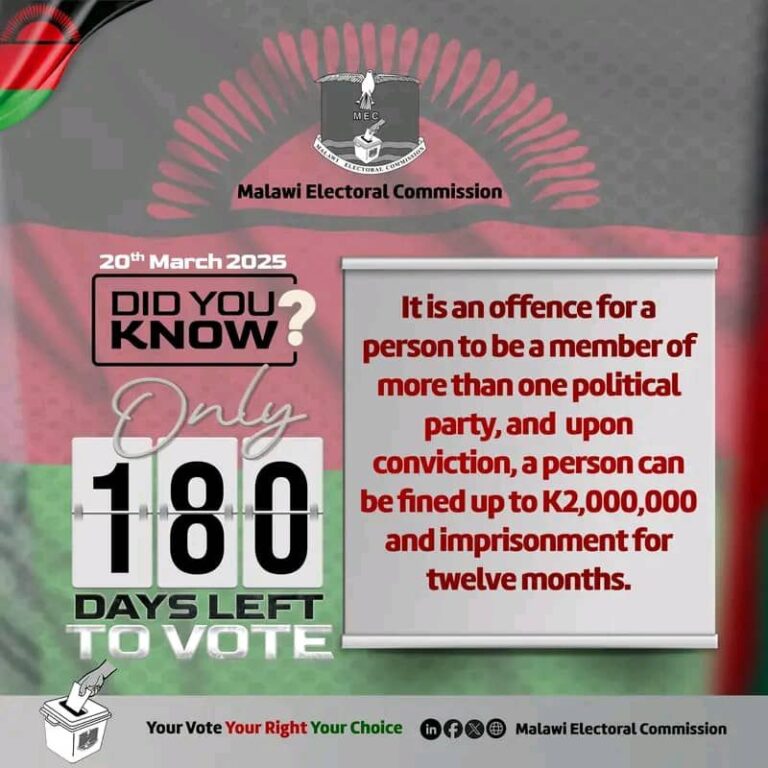
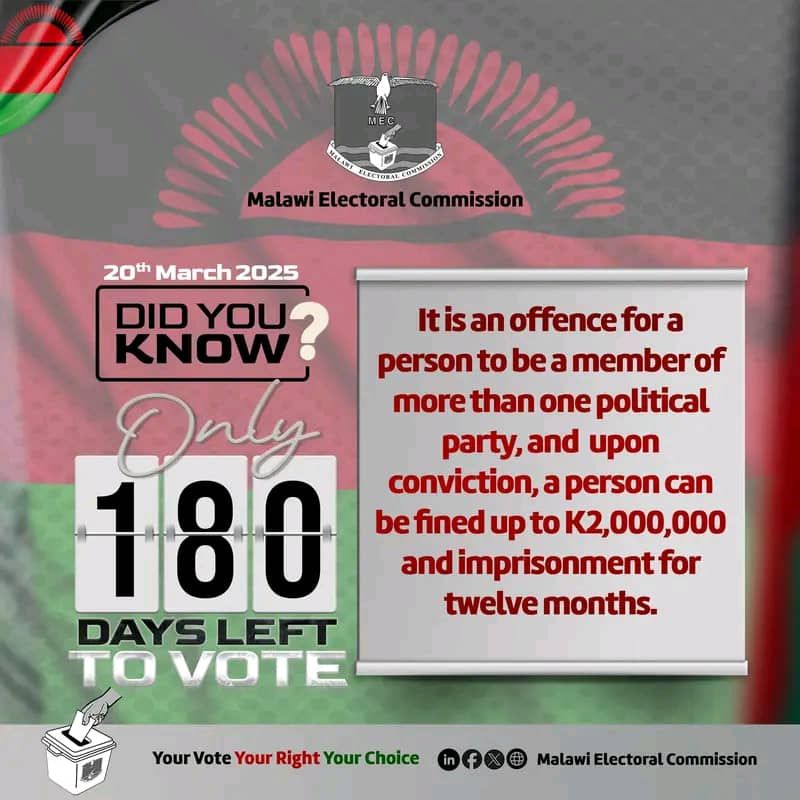
There are exactly 180 days remaining until polling day on 16th September 2025.
As the countdown continues, citizens must prepare to participate in one of the most significant democratic exercises in the nation.
It is important for all eligible voters to ensure they are well-informed about the electoral process, rules, and regulations governing political participation.
One crucial regulation to note is that it is a legal offence for any person to be a member of more than one political party.
This law is in place to uphold political integrity and prevent individuals from manipulating the electoral process by affiliating with multiple parties simultaneously.
Anyone found guilty of violating this law faces serious legal consequences.
Upon conviction, an offender can be fined up to K2,000,000, a significant penalty designed to deter individuals from engaging in dual party membership.
Additionally, the law provides for a custodial sentence of up to twelve months for those who breach this regulation.
As the election approaches, misinformation and unverified electoral news can pose a significant threat to peace and transparency in the electoral process.
It is crucial for citizens to avoid spreading unverified news, as false information can lead to confusion, panic, and possible political instability.
Instead, people should rely on credible sources and official communication channels to stay updated on electoral matters.
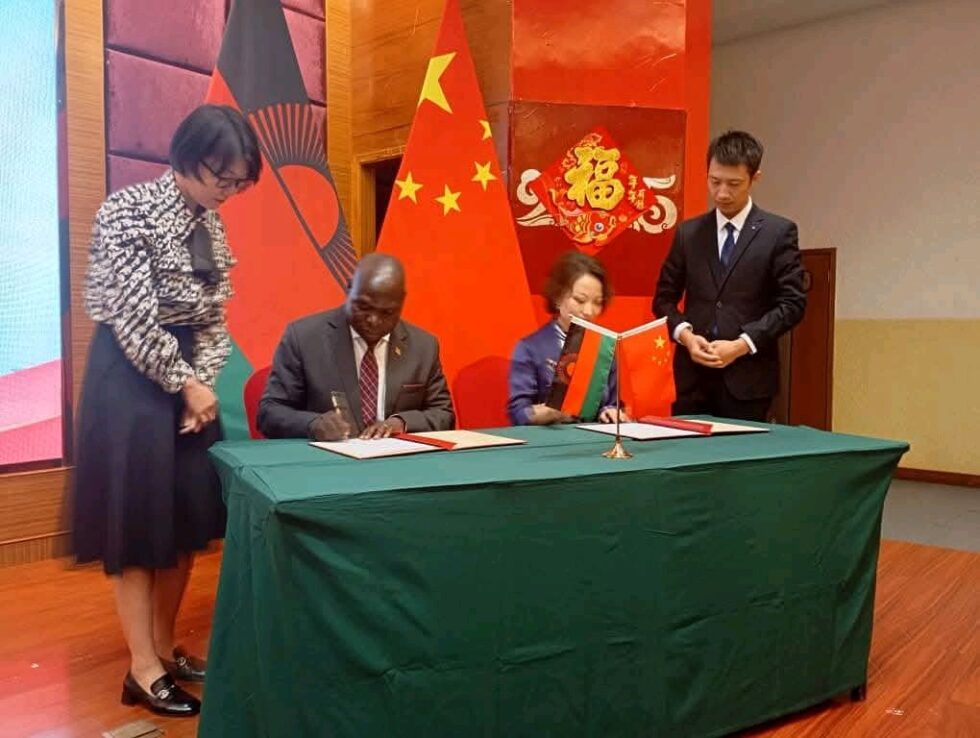
Malawi and China are strengthening their ties, with China reaffirming its commitment to supporting Malawi’s development across various sectors, including humanitarian aid.
This renewed commitment comes as Chinese Ambassador to Malawi, Lu Xu, assumed office in Lilongwe on Wednesday.
Xu highlighted the 18-year bilateral relationship between China and Malawi, which has focused on infrastructure development, education, and agriculture.
China’s support has been instrumental in various development projects, including the construction of the Judicial Complex in Lilongwe, praised by Minister of Foreign Affairs Nancy Tembo.
China has also provided significant financial support to Malawi, including US$28 million (approximately K48 billion) through the Forum on China-Africa Cooperation (FOCAC) to improve livelihoods in the country.
This funding is part of China’s broader efforts to promote economic development and cooperation with African nations.
The China-Malawi partnership has also led to significant advancements in agriculture, with China introducing new technologies and training programs to improve crop yields and food security.
These initiatives have benefited many smallholder farmers, empowering them economically and enhancing their productivity.