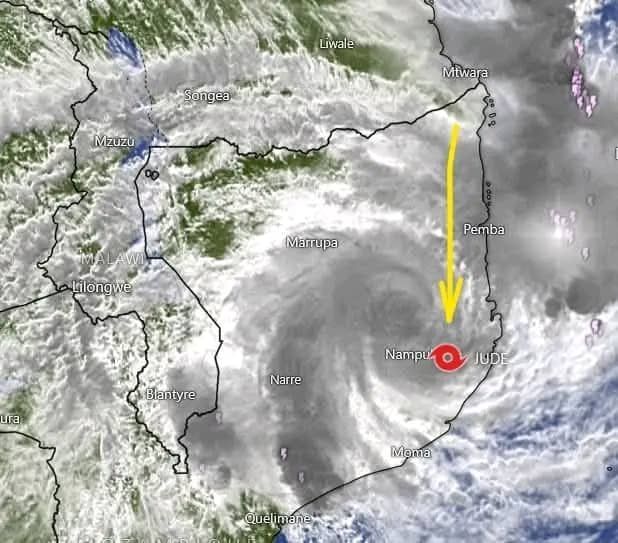
The Department of Meteorology in Malawi has announced that Cyclone Jude has now reached Nampula in Mozambique.
According to the latest updates, the cyclone has gained strength and is currently located about 470 kilometers from Phalombe.
The department has issued a warning to residents in the southern region of Malawi, urging them to remain vigilant as the weather conditions are expected to change at any moment.
Cyclone Jude is moving at a considerable speed and is projected to enter Malawi through Phalombe, bringing with it heavy rains and strong winds.
Several districts are expected to be affected by the cyclone, including Mulanje, Phalombe, Machinga, Neno, Mwanza, Chikwawa, Nsanje, Blantyre, Balaka, Thyolo, Zomba, and Chiradzulu.
These areas are likely to experience intense rainfall, flash floods, and strong winds, which could lead to damage to infrastructure, displacement of people, and possible loss of life.
At present, many parts of the affected districts are already experiencing cloudy weather conditions and intermittent showers, though strong winds have not yet been reported.
Authorities have urged residents in low-lying areas to take precautionary measures, such as moving to higher ground and securing their homes to minimize damage.
Relief organizations and disaster management teams are on high alert, preparing to assist communities that may be affected by flooding and other weather-related hazards.
In recent years, Malawi has experienced severe weather patterns due to tropical cyclones, which have caused significant damage to homes, roads, and farmland.
The government and humanitarian agencies are advising the public to closely follow weather updates and adhere to safety guidelines to protect lives and property.
Cyclone Jude’s impact on Mozambique is still being assessed, but initial reports indicate that heavy rains and strong winds have already affected several communities.
Meteorologists are closely monitoring the cyclone’s trajectory to determine the exact extent of its potential impact on Malawi.
Residents have been advised to stock up on essential supplies such as food, water, and medicine in case of prolonged adverse weather conditions.
As Cyclone Jude moves closer, authorities continue to emphasize the importance of preparedness and early response to mitigate potential disasters.
The situation remains dynamic, and further updates will be provided as new information becomes available from weather monitoring stations.
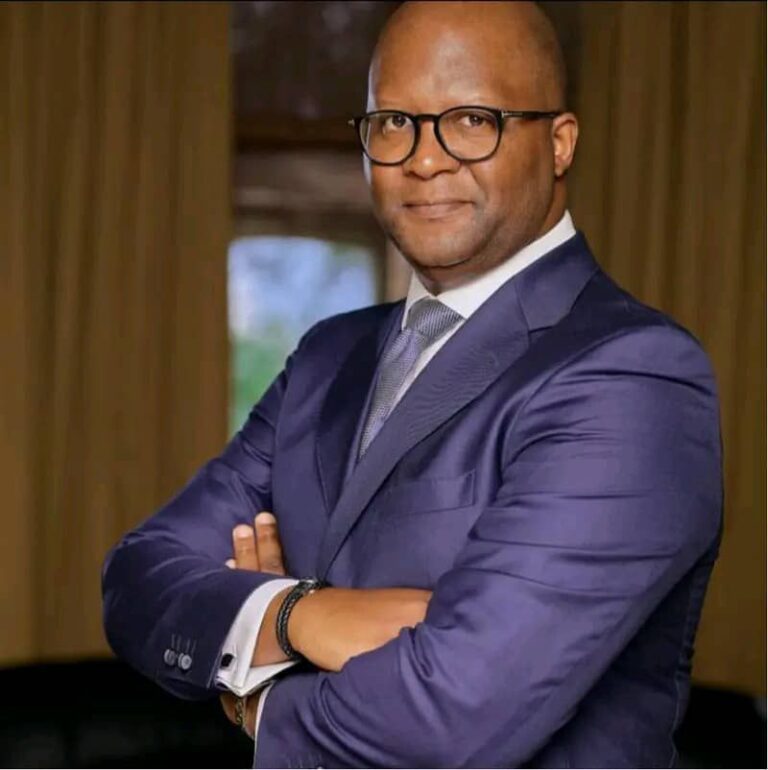
Atupele Muluzi, the former Minister and leader of the United Democratic Front (UDF), has made a bold and defiant statement on social media, vowing not to be intimidated by threats from the Malawi Congress Party (MCP) government.
His declaration, shared on his official Facebook page, follows a phone call that he claims threatened him with arrest due to remarks he made during an interview on Zodiak Radio.
In this analysis, we will explore the significance of Muluzi’s declaration, the context in which it has emerged, and the broader implications for Malawi’s democracy and political environment.
Atupele Muluzi
The nature of the threat: A signal of political tension
Muluzi’s statement begins with a clear condemnation of the threat that was made against him.
The phone call, which allegedly came from individuals connected to the MCP government, was in direct response to comments he made during his appearance on Zodiak Radio.
According to Muluzi, the threat centered on his supposed crime of speaking out against the government.
The phone call, which implied that Muluzi would face arrest for his comments, sets a dramatic stage for his response.
It is important to note that Muluzi’s words are not just a simple claim of being wronged but rather a declaration of resistance, suggesting that the threat is part of a larger pattern of political suppression that has affected other opposition figures as well.
While the threat itself may not have led to any immediate consequences, it is a clear sign that political tensions are running high in Malawi.
With the MCP government increasingly under scrutiny for its handling of political opposition, this incident highlights the lengths to which some political actors might go to control the narrative and suppress dissent.
For Muluzi, however, the threat is less about personal fear and more about the broader struggle for Malawi’s democracy.
*Muluzi’s defiant response: A stand for democracy*
In his statement, Muluzi made it clear that he will not back down or be intimidated.
This bold proclamation emphasizes his commitment to the people of Malawi and the preservation of democratic principles.
Muluzi’s resolve is anchored in a core belief that democracy must be defended, regardless of the pressure or intimidation tactics employed by those in power.
His words resonate with those who feel that the current government has taken steps to stifle opposition voices and suppress the free flow of ideas.
Muluzi’s firm stance is significant for several reasons.
First, it positions him as a key figure in Malawi’s opposition, someone who is willing to face the full force of government retaliation for the sake of democratic principles.
Second, his declaration of not being intimidated signals a broader defiance against the notion that speaking out against the government is a criminal act.
By openly challenging the MCP government, Muluzi has highlighted a growing frustration within the opposition, who believe their voices are being silenced through coercion and fear.
The notion that “speaking the truth” might be considered a crime is central to Muluzi’s message.
He questions the legitimacy of an administration that views truth-telling as an offense and expresses his readiness to face the consequences, whatever they may be.
This challenge to the government’s authority raises important questions about the state of Malawi’s democracy and the limits of free speech under the current administration.
*Political climate in Malawi: Shrinking democratic space*
Muluzi’s statement comes at a time when political tensions in Malawi are reaching a boiling point.
The nation has seen increasing concerns over the shrinking democratic space, with several opposition figures raising alarm about the growing use of intimidation tactics by the government.
Reports of arrests, harassment, and attempts to stifle opposition voices have become more frequent, with critics accusing the MCP-led government of using fear to maintain control.
The threat against Muluzi is not an isolated incident but rather part of a broader pattern of suppression that has affected a number of key political figures.
In recent months, numerous opposition leaders have spoken out about being targeted for their criticisms of the government, making Muluzi’s declaration all the more significant.
His refusal to back down in the face of such threats serves as a rallying cry for other opposition figures who may feel silenced or marginalized by the current political climate.
As Muluzi pointed out in his post, the fight is not just for him personally but for the people of Malawi, who he believes deserve to live in a country where democratic values are upheld.
His statement underscores the growing frustration with the way in which Malawi’s political environment is evolving, particularly for those who oppose the ruling government.
The public’s response to his declaration will likely shed light on whether the people of Malawi are willing to support leaders who continue to stand for democratic values in the face of growing authoritarian tendencies.
*Public reactions: Divided opinions*
Since Muluzi posted his statement, the political discourse surrounding the issue has intensified.
Many Malawians, particularly those who support the opposition, have praised Muluzi for his courage and resolute stance.
His supporters see him as a champion for democracy, willing to take on the government despite the risks involved.
Social media platforms have been flooded with messages of solidarity, with many applauding Muluzi’s bravery in standing up for his beliefs.
However, there are also voices of dissent.
Some critics have questioned whether Muluzi’s remarks during the Zodiak Radio interview were truly a threat to the government or merely a political move to gain attention.
These critics argue that politicians should focus on substance rather than engaging in rhetoric that stokes division.
They may view Muluzi’s statement as an exaggeration of the situation or an attempt to gain political leverage in a highly competitive political environment.
The mixed reactions underscore the polarizing nature of Malawi’s political landscape.
While Muluzi’s supporters view him as a fearless leader, others may see his defiance as a challenge to the established political order.
As the situation develops, it will be interesting to see whether public opinion shifts, particularly in light of the government’s response to his claims.
*The future of Malawi’s political landscape: What’s next for Muluzi?*
The big question now is how the MCP government will respond to Muluzi’s statement.
If the government follows through on its threats of arrest, it could escalate political tensions further, leading to protests and widespread condemnation from both domestic and international observers.
The arrest of an opposition leader, especially one as prominent as Muluzi, would send a clear message about the government’s stance on dissent, potentially leading to greater polarization in the country.
On the other hand, if no action is taken, the government could be seen as backing down from its threats, which may fuel further opposition activity.
Either outcome is likely to keep the political situation in Malawi volatile.
Muluzi’s statement, regardless of the government’s reaction, has already achieved its purpose of drawing attention to the issues of political intimidation and democratic freedoms in Malawi.
In the days and weeks to come, Muluzi’s statement will continue to dominate political discussions, particularly as other opposition leaders weigh in on the matter.
The issue of political repression is unlikely to disappear anytime soon, and Muluzi’s firm stand may inspire others to take a similar approach.
The growing movement of resistance against intimidation may be the spark that Malawi’s opposition needs to push for greater political freedoms and accountability.
*Conclusion: Muluzi’s defiance and the struggle for democracy*
Atupele Muluzi’s vow not to be intimidated by the MCP government is a powerful statement of defiance against political suppression and a call for the defense of democratic values in Malawi.
His words highlight the growing concerns over the erosion of political freedoms and the use of intimidation tactics to silence opposition voices.
As the situation unfolds, Muluzi’s defiant stance will continue to shape the political conversation in Malawi.
Whether his stance leads to personal consequences or inspires broader political change, it has already reignited discussions on the state of democracy in the country.
In the end, Muluzi’s refusal to back down demonstrates his commitment to the people of Malawi and his belief in the importance of standing up for truth, even in the face of adversity.
The Concerned Citizens of Malawi – People Power Movement (CCM-PPM) has issued a scathing indictment of the Malawi Broadcasting Corporation (MBC) under the leadership of Director General George Kasakula.
In a strongly worded letter, the group has expressed outrage over what they describe as a blatant abandonment of professionalism, neutrality, and ethical journalism at MBC.
Kasakula
As a public broadcaster funded by taxpayers’ money, MBC has a mandate to serve all Malawians, irrespective of their political affiliations.
However, CCM-PPM argues that Kasakula has turned MBC into a partisan propaganda machine, systematically attacking opposition figures while shielding the failures of the ruling administration.
The role of the Director General of MBC is to ensure that the broadcaster upholds its mandate of providing fair, balanced, and professional coverage of national affairs.
This responsibility is enshrined in the Communications Act, which obligates MBC to provide diverse perspectives and uphold Malawi’s democratic values.
Instead, CCM-PPM alleges that under Kasakula’s leadership, MBC has become a vehicle for misinformation, character assassination, and political bias.
One of the most concerning issues raised by the group is MBC’s aggressive stance against opposition figures such as former President Arthur Peter Mutharika (APM) and presidential aspirant Dr. Dalitso Kabambe.
In a recent broadcast, MBC labeled Dr. Kabambe a “political fraud,” a move that CCM-PPM describes as reckless and an attempt to manipulate public opinion through distortion rather than truth.
The group challenges this characterization, posing a rhetorical question: If Dr. Kabambe is a fraud, what should we call those who made grand promises of economic prosperity but have led Malawi into economic hardship?
They further ask: What should we call those who vowed to end corruption but are now shielding and enabling it?
Additionally, they question what name should be given to a public broadcaster that has abandoned its constitutional duty and become a propaganda tool.
CCM-PPM warns that history has shown that state-sponsored misinformation never succeeds in preserving a government’s grip on power.
They cite Malawi’s past experiences in 1994, 2004, and 2020 as evidence that propaganda from MBC has failed before and will fail again in 2025.
The group draws a troubling parallel between MBC’s biased reporting and the role of the media in Rwanda’s tragic history, where irresponsible broadcasting contributed to conflict and violence.
They argue that using MBC as a platform to attack and dehumanize political opponents is a dangerous game that could destabilize the country.
Malawi, they insist, cannot afford to follow that path, and its leaders must learn from history rather than repeat its mistakes.
In light of these concerns, CCM-PPM is demanding an immediate end to biased political reporting at MBC.
They insist that MBC mustb return to its rightful role as a national broadcaster that serves all Malawians fairly and impartially.
The letter urges Kasakula to rise above partisan interests and commit to journalistic integrity.
Should he fail to do so, CCM-PPM warns that his legacy will be one of tarnishing the credibility of public broadcasting in Malawi.
The group concludes with a reminder that while governments change, the principles of professionalism, integrity, and fairness remain constant.
They challenge Kasakula to make a choice—either to be remembered as a leader who strengthened MBC’s credibility or as one who destroyed it.
A currency that continuously depreciates has severe consequences for an economy, affecting businesses, individuals, and the government.
In Malawi, the persistent fall of the Kwacha has led to increased inflation, making essential goods and services more expensive for ordinary citizens.
When the value of the Kwacha declines, the cost of imported goods rises, leading to higher prices for fuel, medicines, and other basic necessities.
Businesses that rely on imported raw materials and equipment face increased production costs, which are then passed on to consumers through higher prices.
The weakening currency also reduces the purchasing power of Malawians, meaning that salaries and wages lose their real value over time.
As a result, many people struggle to afford food, rent, and other basic needs, leading to a decline in the overall standard of living.
For the government, a falling currency increases the cost of repaying foreign debt, as more Kwacha are needed to service loans borrowed in U.S. dollars or other foreign currencies.
Foreign investors also become hesitant to invest in a country where the currency is unstable, fearing losses when converting profits back to stronger currencies.
A depreciating currency discourages savings, as money kept in banks loses its value over time, pushing people toward investing in physical assets like land and livestock instead.
The decline in the value of the Kwacha also leads to increased smuggling and black-market activities as people seek alternative ways to access foreign currency.
The cost of fuel, which is crucial for transportation and electricity generation, rises sharply when the currency weakens, leading to increased prices across all sectors of the economy.
Devaluation can sometimes boost exports by making Malawian goods cheaper on the international market, but this benefit is often offset by the rising cost of imported inputs.
Farmers and businesses that rely on imported fertilizers, machinery, and other essentials suffer as their production costs become unsustainable.
A weakening currency can also result in capital flight, where businesses and individuals move their money to more stable economies to protect their wealth.
To counteract the effects of currency depreciation, the government may be forced to introduce strict foreign exchange controls, limiting access to U.S. dollars and other stable currencies.
Such measures can create shortages of essential goods, leading to panic buying and worsening economic instability.
If not managed properly, continuous currency depreciation can trigger social unrest, as people protest against the rising cost of living and economic hardships.
Malawi’s devaluation crisis requires urgent and well-planned economic reforms to restore confidence in the currency and stabilize the economy.
Policies that promote local production, reduce reliance on imports, and attract foreign investment are crucial to addressing the negative impacts of a falling currency.
Without immediate action, the continued depreciation of the Kwacha will push more Malawians into poverty and create further economic instability.
State President Dr. Lazarus McCarthy Chakwera, says the country needs to intensify efforts to ensure that more women are incorporated into key positions.
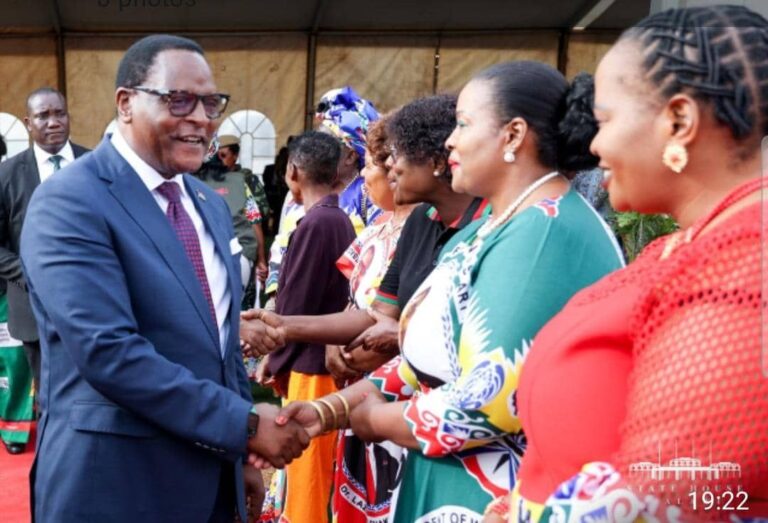
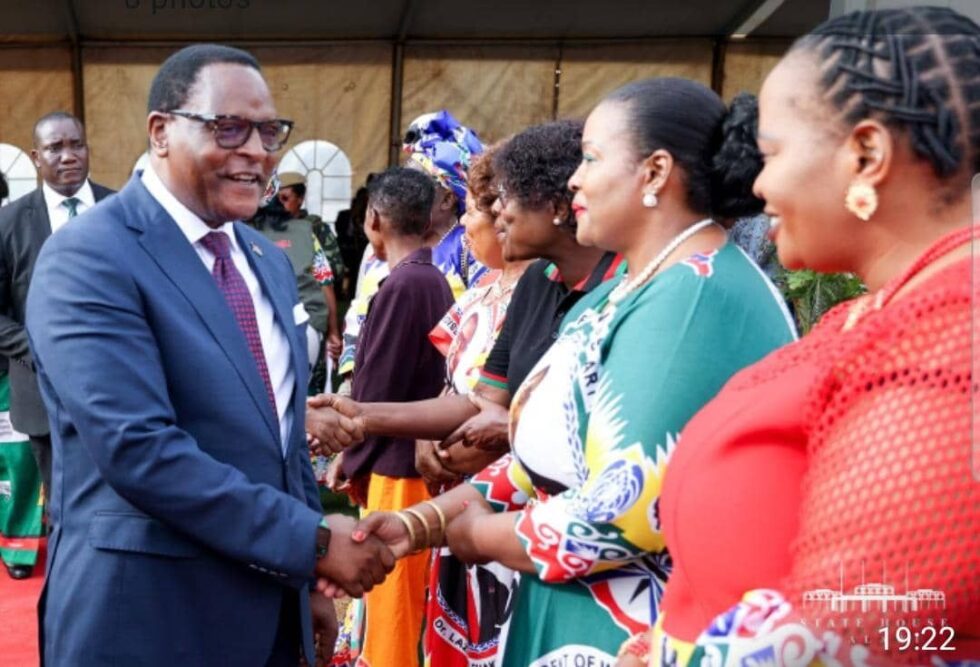
President Chakwera made the remarks on Monday afternoon at Mzuzu State Lodge in Mzuzu, where he hosted Women Leaders from Mzimba.
In his speech, President Chakwera said women should never be left behind because they are in the majority. He explained that although his administration has worked tirelessly to appoint women into key positions, a lot more needs to be done to boost the numbers.
President Chakwera empowering women
“Let’s not leave women behind. Remember that when you have elevated a woman, you have elevated the whole nation,” said Chakwera.
On this note, the Malawi leader warned public officers against having a laissez-faire attitude, in the delivery of public goods and services warning that government will not condone such practices.
“Some public officers do that deliberately. Nobody should sit on programs that are aimed at assisting the people. Let us all work together for the benefit of all Malawians,” he said.
Malawi Congress Party (MCP) Mzimba North-South Regional Chairman Joseph Chavula says President Dr. Lazarus McCarthy Chakwera deserves another term to complete his development agenda for Malawi.
In his remarks, Chavula explained that President Chakwera has proved to be a visionary and selfless leader who has the welfare of his people at heart. He therefore called on women to unanimously vote for Chakwera.
On hunger, the regional Chairman deplored the tendency by some ADMARC staff to allegedly hoarding and selling Maize to vendors at night.
Chavula cautioned the concerned staff to desist from such behaviour before the long arm of the law catches up with them.
MCP First Deputy President, who is also Speaker of the National Assembly, Catherine Gotani Hara, saluted President Chakwera for uplifting the lives of women through the provision of National Economic Empowerment Fund (NEEF). Hara further thanked the President for working tirelessly to uplift the lives of women.
Mzimba North-South Regional Chairlady Martha Chimpozo hailed President Chakwera for hosting the women at his official residence.