

Wednesday, May 6, 2026
No menu items!
spot_img
Home Blog Page 759

Malawi Red Cross Society Distributes K120 Million to Phalombe Communities Affected by TC Chido

0

By Shaffie A Mtambo

The Malawi Red Cross Society (MRCS) has distributed K120 million to 3,175 people in Phalombe district whose houses were destroyed by Tropical Cyclone Chido. The financial assistance, provided by the Danish Red Cross, aims to support families with shelter needs.Malawi Red Cross Society Distributes K120 Million to Phalombe Communities Affected by TC Chido

The Malawi Red Cross Society (MRCS) has distributed K120 million to 3,175 people in Phalombe district whose houses were destroyed by Tropical Cyclone Chido. The financial assistance, provided by the Danish Red Cross, aims to support families with shelter needs.

The beneficiaries, who received the cash support, were overjoyed and expressed their gratitude. Mary Mangazuwa, a mother of four from Misomali village, said, “This money will help us buy black sheet paper to cover part of our house that was destroyed.” Godfrey Banda, a 54-year-old father of six from Mileme village, added, “This support has come at the right time, during the rainy season. We will now be able to cover our house, thank you Red Cross.”
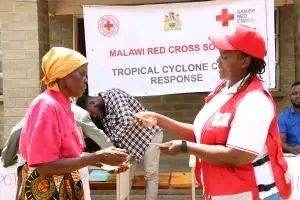
MRCS Director of Programs and Development, Gloria Kunyenga, advised the beneficiaries to use the support for its intended purpose. “We understand that many communities are currently focused on growing crops during the rainy season, and cash may be diverted to other needs. However, we encourage families to prioritize solving shelter issues first.”

During the distribution, communities also received health and hygiene promotion messages, including cholera prevention. This emergency response specifically targets Phalombe district with cash transfers and other mental health and psychological social support activities.

*Malawi Red Cross Society Distributes K120 Million to Phalombe Communities Affected by TC Chido*

By Shaffie A Mtambo

The Malawi Red Cross Society (MRCS) has distributed K120 million to 3,175 people in Phalombe district whose houses were destroyed by Tropical Cyclone Chido. The financial assistance, provided by the Danish Red Cross, aims to support families with shelter needs.Malawi Red Cross Society Distributes K120 Million to Phalombe Communities Affected by TC Chido


The Malawi Red Cross Society (MRCS) has distributed K120 million to 3,175 people in Phalombe district whose houses were destroyed by Tropical Cyclone Chido. The financial assistance, provided by the Danish Red Cross, aims to support families with shelter needs.

The beneficiaries, who received the cash support, were overjoyed and expressed their gratitude. Mary Mangazuwa, a mother of four from Misomali village, said, “This money will help us buy black sheet paper to cover part of our house that was destroyed.” Godfrey Banda, a 54-year-old father of six from Mileme village, added, “This support has come at the right time, during the rainy season. We will now be able to cover our house, thank you Red Cross.”

MRCS Director of Programs and Development, Gloria Kunyenga, advised the beneficiaries to use the support for its intended purpose. “We understand that many communities are currently focused on growing crops during the rainy season, and cash may be diverted to other needs. However, we encourage families to prioritize solving shelter issues first.”

During the distribution, communities also received health and hygiene promotion messages, including cholera prevention. This emergency response specifically targets Phalombe district with cash transfers and other mental health and psychological social support activities.

Other districts, including Mwanza, Nneno, Balaka, Machinga, Blantyre, Mulanje, Mangochi, Zomba, Chikwawa, and Nsanje, also received anticipatory actions. The Danish Red Cross has provided critical support to the MRCS in responding to the needs of affected communities.


The beneficiaries, who received the cash support, were overjoyed and expressed their gratitude. Mary Mangazuwa, a mother of four from Misomali village, said, “This money will help us buy black sheet paper to cover part of our house that was destroyed.” Godfrey Banda, a 54-year-old father of six from Mileme village, added, “This support has come at the right time, during the rainy season. We will now be able to cover our house, thank you Red Cross.”

MRCS Director of Programs and Development, Gloria Kunyenga, advised the beneficiaries to use the support for its intended purpose. “We understand that many communities are currently focused on growing crops during the rainy season, and cash may be diverted to other needs. However, we encourage families to prioritize solving shelter issues first.”

During the distribution, communities also received health and hygiene promotion messages, including cholera prevention. This emergency response specifically targets Phalombe district with cash transfers and other mental health and psychological social support activities.

Other districts, including Mwanza, Nneno, Balaka, Machinga, Blantyre, Mulanje, Mangochi, Zomba, Chikwawa, and Nsanje, also received anticipatory actions. The Danish Red Cross has provided critical support to the MRCS in responding to the needs of affected communities.Other districts, including Mwanza, Nneno, Balaka, Machinga, Blantyre, Mulanje, Mangochi, Zomba, Chikwawa, and Nsanje, also received anticipatory actions. The Danish Red Cross has provided critical support to the MRCS in responding to the needs of affected communities.

The beneficiaries, who received the cash support, were overjoyed and expressed their gratitude. Mary Mangazuwa, a mother of four from Misomali village, said, “This money will help us buy black sheet paper to cover part of our house that was destroyed.”


While Godfrey Banda, a 54-year-old father of six from Mileme village, added, “This support has come at the right time, during the rainy season. We will now be able to cover our house, thank you Red Cross.”

MRCS Director of Programs and Development, Gloria Kunyenga, advised the beneficiaries to use the support for its intended purpose. “We understand that many communities are currently focused on growing crops during the rainy season, and cash may be diverted to other needs. However, we encourage families to prioritize solving shelter issues first.”

During the distribution, communities also received health and hygiene promotion messages, including cholera prevention. This emergency response specifically targets Phalombe district with cash transfers and other mental health and psychological social support activities.

Other districts, including Mwanza, Nneno, Balaka, Machinga, Blantyre, Mulanje, Mangochi, Zomba, Chikwawa, and Nsanje, also received anticipatory actions. The Danish Red Cross has provided critical support to the MRCS in responding to the needs of affected communities.

Analysis: The controversy surrounding Lawyer Sylvester Ayuba James’ remarks on street children: A human rights perspective

By Burnett Munthali

The recent controversy involving lawyer Sylvester Ayuba James has sparked outrage among human rights organizations, with many activists condemning his remarks regarding street children. The debate surrounding his statements underscores a deeper societal issue—the treatment of vulnerable children in Malawi and the responsibility of legal and governmental institutions in addressing their plight.

The outrage stems from concerns that Ayuba James’ remarks may reflect a broader failure of society to protect and uplift street children, who are among the most marginalized groups in the country. While the exact content of his statements has not been fully detailed in the Sunday Times front-page report, the intensity of the backlash suggests that they were perceived as dismissive, derogatory, or contrary to principles of child welfare and human rights.

Sylvester Ayuba James

Street children in Malawi face multiple challenges, including homelessness, hunger, abuse, lack of access to education, and vulnerability to criminal exploitation. Many of these children come from broken homes, fleeing domestic violence, extreme poverty, or family neglect. Others have lost their parents to diseases such as HIV/AIDS and are left to fend for themselves.

Despite these harsh realities, there has been a persistent failure by authorities to provide sustainable solutions. Government efforts to rehabilitate and reintegrate street children into society remain inadequate, with shelters and social programs underfunded and poorly managed. As a result, street children continue to be seen as a social nuisance rather than victims of structural failures.

Human rights organizations have long advocated for the protection of street children, emphasizing their right to shelter, education, and security. Their outrage over Ayuba James’ remarks suggests that his statements may have trivialized or undermined these efforts. Activists argue that such rhetoric only deepens societal stigma against street children, making it harder for them to receive the assistance they need.

Statements from influential figures, particularly legal professionals, hold significant weight in shaping public discourse. If Ayuba James’ comments were perceived as insensitive or discriminatory, they risk reinforcing negative stereotypes, potentially justifying neglect or even harsher treatment of street children by law enforcement and the public.

From a legal perspective, Malawi is bound by both local and international laws that safeguard children’s rights. The Child Care, Protection, and Justice Act of 2010 outlines provisions that ensure children’s welfare, including protection from abuse, neglect, and discrimination. Furthermore, Malawi is a signatory to the United Nations Convention on the Rights of the Child (UNCRC), which obligates the government and society at large to prioritize children’s welfare.

If Ayuba James’ remarks contradict these legal frameworks, his statements could be seen as not only morally questionable but also legally problematic. In some cases, public figures can face legal scrutiny if their statements are deemed to incite discrimination or promote harmful policies.

The public reaction to Ayuba James’ statements reflects a larger conversation about how Malawian society perceives and treats vulnerable groups. Street children often face police brutality, social exclusion, and lack of public sympathy. Instead of addressing the root causes of child homelessness—such as poverty, unemployment, and weak social services—many people view street children as troublemakers who should be removed from public spaces rather than rehabilitated.

This controversy should serve as a wake-up call for policymakers, social workers, and the legal community to engage in constructive dialogue about real solutions. Malawi needs a more robust child protection system, greater investment in education and family support programs, and stronger advocacy to ensure that every child has a chance at a better future.

The outrage over Sylvester Ayuba James’ remarks is a reflection of the deep frustration among human rights organizations regarding the ongoing neglect of street children in Malawi. While free speech allows individuals to express opinions, public figures—especially legal professionals—have a responsibility to ensure that their words do not reinforce discrimination or hinder efforts to protect vulnerable populations.

Instead of debating whether his remarks were justified, Malawi should use this moment to push for stronger policies that address the root causes of child homelessness. The real question is not just what Ayuba James said, but what society as a whole is willing to do to protect and uplift its most vulnerable children.

The leadership and political influence of Catherine Gotani Hara: A divided public perception

By Burnett Munthali

Catherine Gotani Hara, the Speaker of the Malawi National Assembly, is a figure who commands both admiration and criticism. Many view her as a disciplined, well-educated, hardworking, respectful, and compassionate leader. However, her role as Speaker has sparked intense debate, particularly regarding her impartiality in parliamentary proceedings. Some argue that she prioritizes the interests of the Malawi Congress Party (MCP) over fairness, while others defend her as a competent and wise leader.

The public discourse surrounding her leadership has intensified, especially with speculation about her potential candidacy for Vice President. If she were to assume such a role, opinions are split on whether she would uphold democratic values or further entrench party interests within government structures.

Gotani Hara

A key criticism leveled against Gotani Hara is that she does not always uphold the neutrality expected of a Speaker. Lucius Nkhoma argues that she consistently prioritizes her party’s interests, often bending standing orders to align with MCP’s agenda. This accusation raises concerns about the objectivity of parliamentary proceedings under her leadership.

Similarly, Washington Kanyenda asserts that Gotani Hara struggles to separate her role as Speaker from her loyalty to the ruling party. While such behavior is often observed in Malawian politics—where even ministers tend to favor party lines—critics believe that the Speaker’s position demands a higher level of impartiality. If she were to become Vice President, her critics fear that she would govern with the same perceived bias, potentially undermining democratic processes.

Despite the criticisms, Gotani Hara also has a strong base of supporters who commend her leadership style. Stanley Eduardo Kaludzu describes her as a humble, intelligent, and wise leader, emphasizing her dedication to public service. For her defenders, her leadership is characterized by grace under pressure and a commitment to national development.

Her supporters also highlight that being loyal to a party does not necessarily mean she is incapable of fair governance. Angelina Mbwana quotes a statement from Gotani Hara: “If we’re to continue ruling, we should continue sacrificing.” This could be interpreted as a reflection of her commitment to governance, rather than an outright admission of prioritizing party interests.

With speculation about Gotani Hara possibly becoming Vice President of Malawi or the MCP, opinions are sharply divided on what this could mean for the country’s political landscape. Chisomo Miks believes that her current role as Speaker already signals her alignment with the MCP’s agenda, making it likely that she would continue in the same direction if elevated to the executive branch.

For critics, this raises concerns about the concentration of power within the ruling party, especially if key leadership roles remain within the same political circle. However, her supporters argue that her experience in governance makes her a strong candidate for the role, as she already understands the complexities of national leadership.

Catherine Gotani Hara’s leadership continues to generate both praise and criticism. While some see her as a committed public servant, others argue that she prioritizes party loyalty over parliamentary neutrality. If she were to become Vice President, the debate would likely intensify, with some fearing increased partisanship in government, while others see her as a capable and experienced leader who can drive national progress.

Ultimately, her legacy will depend on whether she can balance party interests with national duty. As Malawi moves toward future elections, her leadership style and decision-making will remain under scrutiny, shaping her political future and the country’s democratic trajectory.

The open letter to Mzuzu University Students: A controversial perspective on religious respect and consequences

By Burnett Munthali

The open letter by Mami Wa Shabe addressed to Mzuzu University students has sparked significant debate, primarily due to its strong condemnation of certain students’ actions, which are perceived as disrespectful to religious values. The letter not only calls for disciplinary action but also invokes a curse upon the students, raising ethical and moral concerns about the appropriateness of such pronouncements.

At the heart of the letter is the outrage over alleged misconduct by Mzuzu University students, who are accused of dressing and behaving in a way that disrespects the Catholic faith. This has led to disappointment and anger among those who hold religious values in high regard. However, while the call for disciplinary measures may be justifiable within the university’s regulations, the tone of the letter—especially the invocation of curses—raises questions about how society should address moral transgressions, particularly within an academic institution.


Mami Wa Shabe’s letter reflects the sentiments of many Malawians who feel that religious institutions deserve utmost respect, and any perceived mockery or disregard for religious customs is unacceptable. The letter suggests that the students’ attire and behavior misrepresented Catholicism and portrayed a negative image of their faith, leading to frustration among religious followers.

In Malawi, where religion plays a crucial role in shaping moral and social values, actions that seem to mock or undermine religious beliefs can trigger strong reactions. This explains why the author demands swift action from Mzuzu University’s management and religious authorities to address the matter within two weeks.

However, freedom of expression and individual choice in a secular institution like Mzuzu University also need to be considered. While religious sensitivity is important, the extent to which university students should conform to religious expectations remains debatable. Should universities enforce religious discipline, or should students be allowed to express themselves freely as long as they do not break institutional rules?

Beyond calling for disciplinary action, the letter takes an extreme stance by cursing the students, predicting that they will struggle in life, fail to secure employment, and experience hardships. The author goes as far as to state that their educational qualifications will be worthless, and their children will not benefit from their efforts.

This raises serious ethical concerns:

Firstly, it is questionable whether a moral or religious error should result in a lifetime of misfortune. People, especially students, learn from their mistakes, and extreme punishment may not always be the best way to correct behavior.

Secondly, invoking curses can have psychological and emotional effects on the students, especially in a society where belief in spiritual consequences is strong. Instead of guiding the youth toward correction, such pronouncements may instill fear, depression, or self-doubt in students who are still shaping their futures.

Thirdly, every society, especially one built on religious values, should uphold forgiveness, guidance, and mentorship rather than eternal condemnation. If the students’ actions were inappropriate, constructive disciplinary action and education would be more effective than declaring a curse upon their lives.

The controversy surrounding this letter is part of a larger conversation on morality, religious respect, and freedom of expression in Malawi. It raises critical questions such as:

To what extent should universities enforce religious discipline?

How should society correct youthful mistakes without permanently damaging young people’s futures?

Is it ethical or fair to curse individuals rather than educate and reform them?

While maintaining cultural and religious values is essential, society must also recognize the role of personal freedoms and institutional boundaries. Mzuzu University, like any academic institution, has rules and policies that students must follow, but disciplinary actions should align with legal and ethical standards rather than personal emotions.

Mami Wa Shabe’s letter expresses the deep frustration of religious followers, but its approach raises serious ethical concerns. While it is valid to call for discipline and respect for religious institutions, the invocation of a curse and lifelong misfortune is extreme and counterproductive.

A more constructive approach would be open dialogue between students, university management, and religious leaders to educate, correct, and guide young people toward moral responsibility without resorting to extreme punishments. Society must find a balance between preserving religious respect and allowing academic spaces to function as platforms for learning, growth, and transformation.

ACB probes fuel and fertilizer procurement cases, vows to protect whistleblower

0

By Twink Jones Gadama

The Anti-Corruption Bureau (ACB) has launched investigations into several cases involving the procurement of fuel and fertilizer, Acting Director General Hillary Chilomba revealed yesterday on Times Television’s Times Exclusive Programme.

While Chilomba refrained from divulging more information on the matter, he assured the public that the ACB is carefully investigating the issues before making any arrests. “Whatever we are doing, we want good results in court, so it is not just a matter of arresting people,” he emphasized.

The ACB’s independence, Chilomba noted, enables the bureau to deal with all corrupt public officers, ensuring effective public service delivery. “I am here to please the law and not a person,” he stated firmly.

Hillary Chilomba

Chilomba also reassured the public that the Whistle Blower Act will protect individuals who report corrupt officers. “Fighting corruption should start with the individuals,” he added, encouraging citizens to take an active role in combating corruption.

This development comes as the ACB continues to crack down on corruption in various sectors. Recently, the bureau arrested eight immigration officers for alleged corrupt practices at the Lilongwe immigration office.

The ACB’s efforts to combat corruption have been ongoing, with a focus on promoting transparency and accountability in public institutions. As the bureau continues to investigate and prosecute corruption cases, Malawians can expect a renewed commitment to fighting corruption and promoting good governance.

In his remarks, Chilomba underscored the importance of individual responsibility in fighting corruption. By encouraging citizens to report corrupt activities and protecting whistleblowers, the ACB aims to create a culture of transparency and accountability in Malawi.

As the investigation into the fuel and fertilizer procurement cases continues, the ACB’s commitment to fighting corruption remains unwavering. With the Whistle Blower Act in place, Malawians can feel empowered to report corrupt activities, knowing that they will be protected.

The ACB’s efforts to combat corruption are a step in the right direction for Malawi, a country that has struggled with corruption in the past. As the bureau continues to investigate and prosecute corruption cases, Malawians can expect a brighter future, one where transparency and accountability are the norm.

The ACB’s investigation into the fuel and fertilizer procurement cases is a significant development in the fight against corruption in Malawi. With the Whistle Blower Act in place, citizens can feel empowered to report corrupt activities, knowing that they will be protected. As the ACB continues to promote transparency and accountability, Malawians can expect a renewed commitment to fighting corruption and promoting good governance.