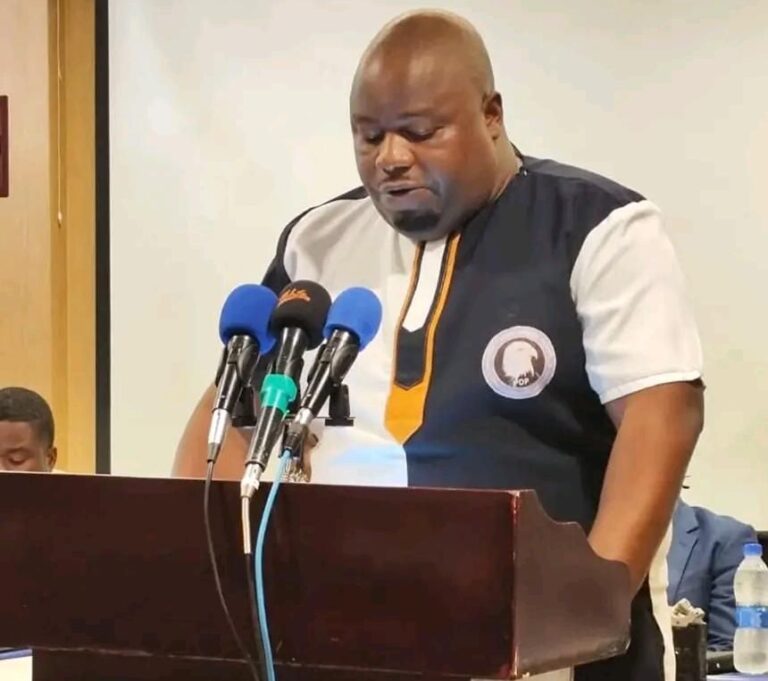
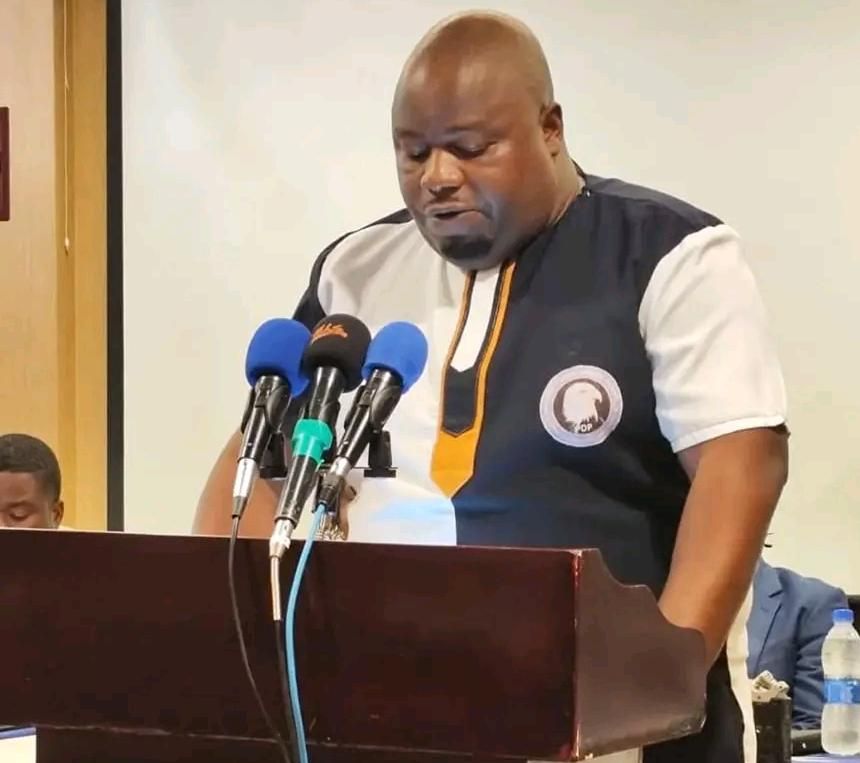
The People’s Development Party (PDP) president, Kondwani Nankhumwa, has urged individuals who failed to secure positions in the United Transformation Movement (UTM) National Governing Council (NGC) during the recent party’s convention not to abandon the party.
UTM held its elective convention on November 17 this year in Mzuzu.
Speaking at a press briefing at Golden Peacock Hotel in Lilongwe on Tuesday, Nankhumwa,said UTM members must unite and support the current leadership, emphasizing that working together will strengthen the party.
Nankhumwa
The PDP president also congratulated Dalitso Kabambe, who was elected UTM president after defeating former Secretary General Patricia Kaliati, Director of Economic Planning Newton Kambala, and businessman Matthews Mtumbuka.
Nankhumwa further reiterated that, in line with their party’s policies, the PDP will not rush into alliances with any political party ahead of next year’s general elections.
During the UTM convention, prominent figures, including the party’s patron Noel Masangwi, Kaliati and Kambala, failed to secure seats in the NGC.
former Malawian President, Professor Arthur Peter Mutharika, and his wife, former First Lady Gertrude Mutharika, are scheduled to visit Goliati tomorrow.
According to a press release issued by Presidential Spokesperson Shadrick Namalomba, the couple will register at Goliati and later address a public rally at the trading center.
This move is seen as a strategic outreach effort by the former ruling party, aiming to reconnect with grassroots supporters.
The registration drive is expected to bolster the party’s membership base ahead of future elections.
Mutharika
The public rally, slated for the afternoon, promises to draw large crowds eager to hear Mutharika’s vision for Malawi’s future.
Political analysts speculate that the event may serve as a platform for the former President to reaffirm his influence and address pressing national concerns.
Mutharika’s visit comes at a time when the country is grappling with economic and social challenges.
The opposition has been vocal about the need for change, and this rally may provide insight into the former President’s plans to address these issues.
As the nation watches with bated breath, tomorrow’s event promises to be a pivotal moment in Malawi’s political landscape.
Will Mutharika’s message resonate with the people, or will it falter?
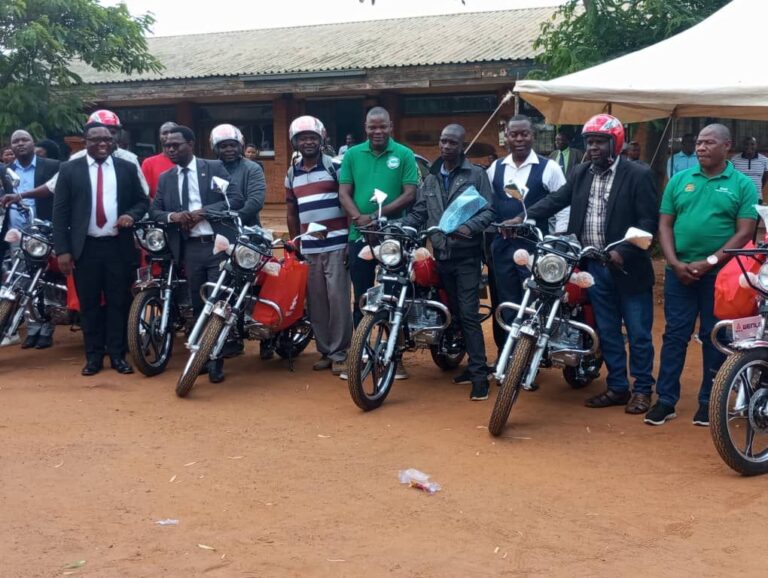
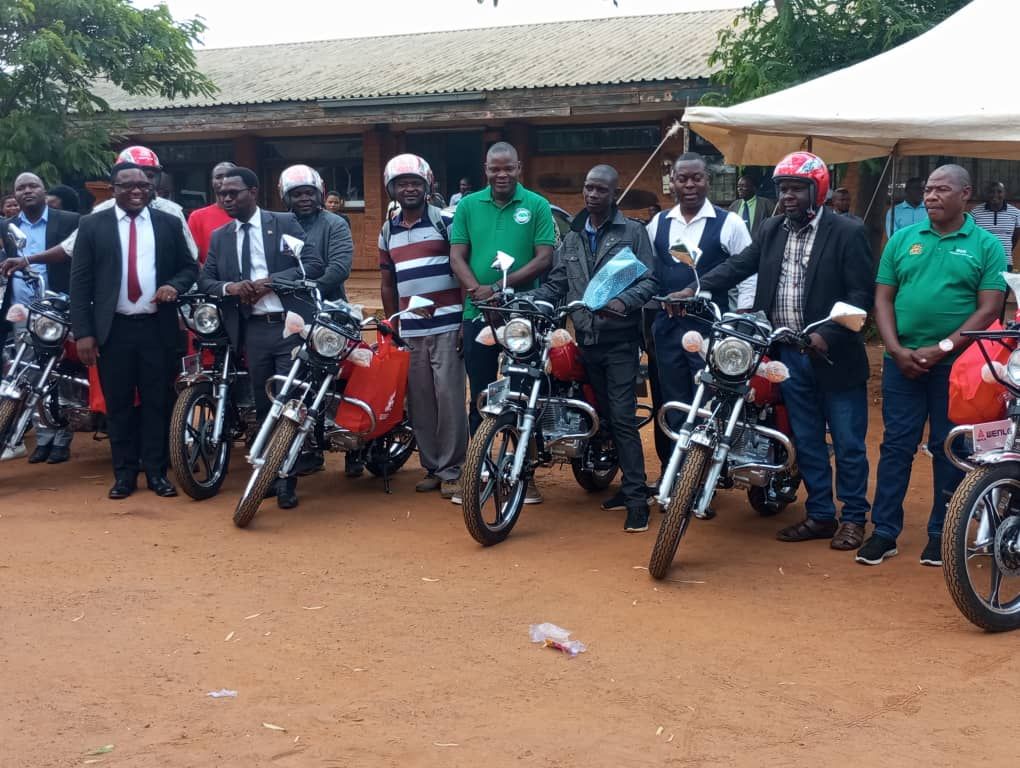
Dowa district council has procured 11 motorbicycles for its agriculture extension development officers in all the Extension Planning Areas to ease mobility challenges.
The initiative follows a concept the district learnt from Machinga district where lead farmers, clubs, cooperatives and associations are requested to pay an annual recognition fee to the council.
Speaking during the handover ceremony held at it’s agriculture offices in Mponela- Dowa on Wednesday, Deputy director of Agriculture Extension Services, Kenneth Chaula expressed excitement with the purchase saying it will help improve service delivery.
“Our extension workers experience a number of challenges like failing to visit farmers’ households because of mobility challenges.
This particular burden on government has been lessened because of the contributions from farmers so that the extension workers can serve them better,” he said.
He said he was optimistic that the extension workers will frequently visit the farmers and advise them so that they adopt good agriculture practices to boost agriculture produce in the district.
Dowa district commissioner, Stallich Mwambiwa said they had decided to procure the motorcycles using the annual subscription contributions to ease mobility challenges.
“Our analysis shows that we are a district that is agriculture based and we thought of easing mobility challenges of our extension workers to enhance their responsiveness,” he said.
One of the district’s agriculture extension development officer, Daniel Chisale of Mponela Extension Planning Area said the motorbicycles will help in broadening their areas to farmers.
“This will assist in increasing the coverage to our farmers especially in hard to reach areas and will help us serve the farmers in the district better,” he said.
Apart from the motorbikes, the council has also purchased bags of fertilizer, maize seed, chemicals, sprayers and other farm inputs for it’s mega farm project.
Picture: Mwambiwa( in suit left)- the motorbikes will ease mobility for our extension workers.
The age-old question of why God remains silent in the face of human suffering has plagued theologians, philosophers, and everyday people for centuries.
In ancient times, it was believed that God communicated directly with prophets and leaders, guiding them through trials and tribulations.
But in today’s world, where conflict, poverty, and injustice reign supreme, many are left wondering: Does God still speak to us? Does He care about our struggles?
For those caught in the midst of war, famine, or disease, the silence can be deafening. Innocent children, in particular, suffer disproportionately, their lives forever scarred by the horrors they witness. It begs the question: Where is God in all of this? Can’t He send angels to rescue these children, to free them from the clutches of violence and despair?
The Bible tells us that God is all-powerful, all-knowing, and all-loving.
Yet, the world around us seems to contradict this notion. We see images of children crying, their homes reduced to rubble, their families torn apart.
We hear stories of entire communities displaced, forced to flee their homelands in search of safety. And we ask: Why?
Some argue that God’s ways are mysterious, that His plan is beyond human comprehension. Others claim that humanity’s free will is to blame, that our choices lead to suffering.
Still, others question the very existence of God, citing the absence of divine intervention as proof.
But what about the countless stories of miraculous interventions? The survivors of natural disasters who credit God for their salvation? The cancer patients who experience unexpected remissions? Do these instances not demonstrate God’s continued presence in our lives?
Perhaps the issue lies not with God’s willingness to intervene but with our understanding of His nature.
We often expect God to work in dramatic, visible ways, forgetting that His power can also manifest in subtle, quiet moments.
A comforting word from a stranger, a generous donation from an anonymous source, or a peaceful night’s sleep amidst chaos – these, too, can be evidence of God’s care.
Moreover, scripture reminds us that God’s timeline is not our own.
His response to suffering may not always align with our expectations or schedules.
The biblical account of Joseph, sold into slavery by his brothers, only to rise to prominence in Egypt, illustrates this point. God’s plan unfolded over decades, not minutes.
This is not to trivialize the pain and anguish that many endure. The suffering is real, and it is valid to question God’s silence.
However, in our seeking answers, we must also acknowledge the complexity of human nature and the consequences of our collective choices.
In war-torn countries, it is often humanity’s darkness – greed, power struggles, and hatred – that creates the very suffering we attribute to God’s inaction.
Can we truly expect God to intervene in every conflict, every instance of injustice, when we ourselves contribute to these problems?
And yet, even amidst this darkness, there are glimmers of hope.
Humanitarian organizations, fueled by compassion and faith, work tirelessly to alleviate suffering.
Medical teams risk their lives to treat the wounded. Activists advocate for policy changes to prevent future conflicts.
In these selfless acts, we see the hand of God at work. We witness the divine in the human, the spark of goodness that refuses to be extinguished.
It is here, in the midst of suffering, that we find the truest expression of God’s care.
As we grapple with the question of God’s silence, let us not forget the countless ways He speaks to us still – through scripture, prayer, and the quiet whispers of conscience.
Let us recognize that His plan may unfold in ways both dramatic and subtle, visible and invisible.
Most importantly, let us remember that we are not alone in our suffering.
We are part of a global community, connected in our struggles and our hopes.
And it is in this shared humanity that we find the strength to persevere, to seek answers, and to hold onto faith – even in the darkest of times.
Communities in Dowa and Kasungu districts have hailed the Livelihoods support programme being implemented by COMSIP Cooperative Union Limited for introducing the Legume Enterprise Structure Programme (LESP) in their areas.
The members say through the program in which they contribute 30 percent, they have managed to become food secure while at the same time start up small scale businesses from profits realized from sale of surplus.
They said this on Monday during a media tour COMSIP organized for Dowa and Kasungu.
Under the program, participants contribute 30 percent towards purchase of farm inputs while the rest is shouldered by the livelihoods support program, a sub component of the Social Support for Resilient Livelihoods Project, which COMSIP is implementing.
Eluby Phiri of Masaka Cluster in Kasungu said through the inputs she got from COMSIP identified agrodealers, she managed to harvest 22 bags of maize weighing 50 kilograms each from an acre last year.
“After selling the surplus, I have been able to support my son’s education through fees and other school requirements,” she said.
Phiri says she expects to have an increased yield this growing season as she has already bought the farm inputs under the COMSIP project.
Grace Chombo a community facilitator at Masaka Cluster in T/A Wimbe Kasungu said the project has assisted farmers in buying certified seeds from certified agrodealers.
“In the past we were not able to afford buying the inputs but now we are able to buy a quantity we want depending on the size of our farm land,” she says.
Rebecca Munthali, a COMSIP caseworker in Dowa under Traditional Authority Dzoole said the LESP program has seen increased profits for the participating households through the sale of surplus.
“Different households have been able to set up group businesses while individual households have been able to invest in livestock and purchase of family assets through proceeds from sale of farm produce,” she said.
Chairperson of Khwema cluster in Dowa, Gremison Kachikonga said through the project, farmers are able to increase the amount of inputs based on the sizes of their farm land.
Kasungu District COMSIP coordinator, Christina Josiya said in an interview that through the project they would like to alleviate poverty and ensure food security among households.
“We are happy that since the project started a number of households have been transformed as some have been building houses, paying fees for their children and bought livestock,” she said.
She further said through the program, participants are given funds for every farm input ranging from fungicides, pesticides, masks, sprayers, fertilizer to best seed varieties. Farmers are also embracing actionable climate smart agriculture practices including producing and applying mbeya manure in their fields that replenish fertility and moisture for crops.
The organization has invested K2.6 Billion in LESP this farming season to enhance food security and income generation in participating households, providing farm inputs support grants to 844 Savings and loans groups and cooperatives and 27,321 households (10,002 males and 17,376 females) in 15 districts.
The beneficiaries are households on social cash transfer and public works programme under the SSRLP, a government of Malawi project being implemented with funds from World Bank and Social protection Multi Donor fund.
Through the project, COMSIP is expected to be the offtaker of the produce and will identify other markets for project’s participants to get fair prices from their labour.
Currently targeted districts in the southern region have already procured the farm inputs.
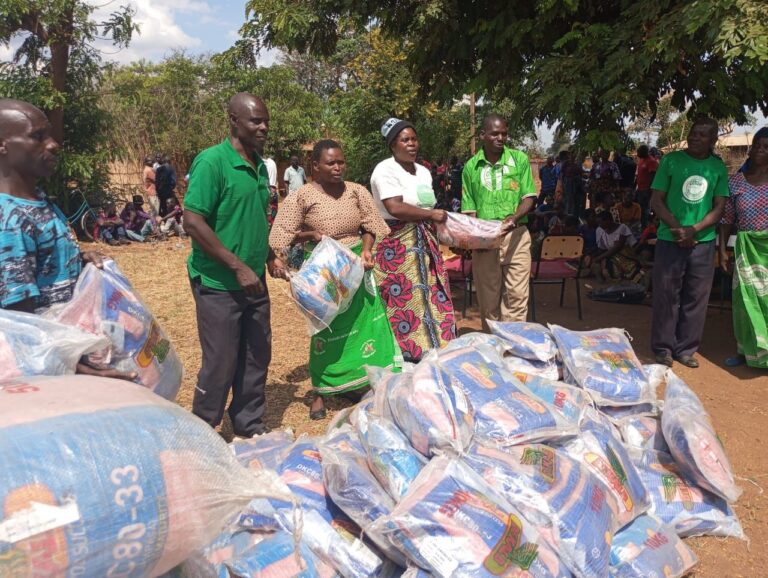
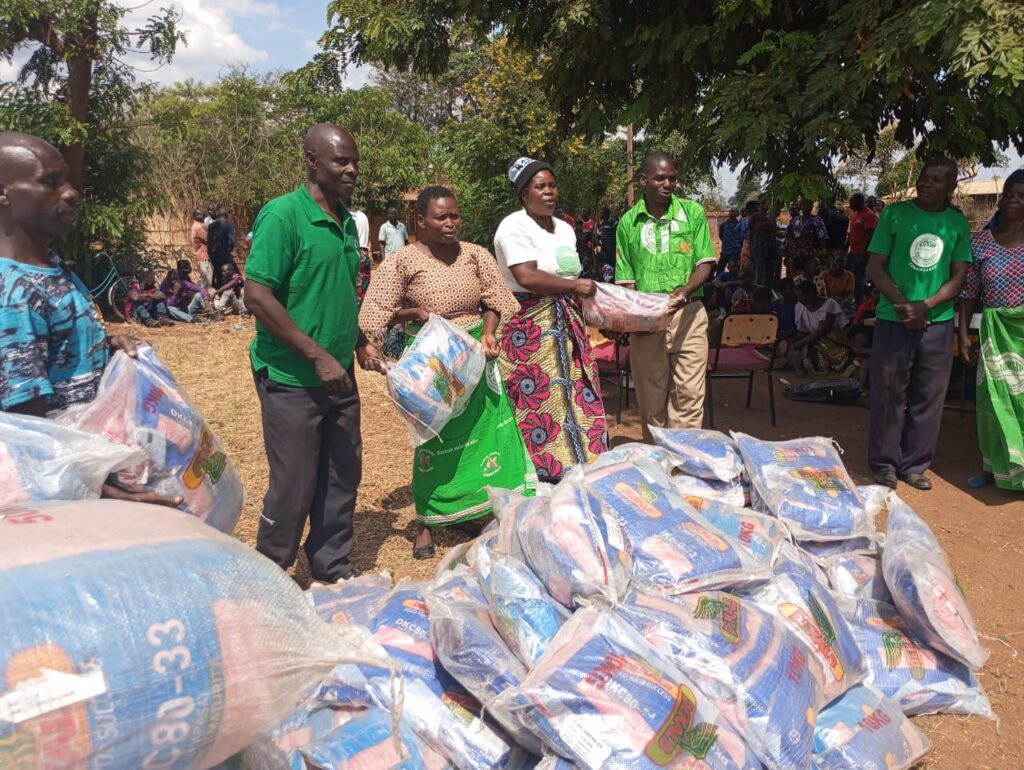
Pic: Some beneficiaries smiling after receiving the farm inputs