On Friday 25 October 2024, the Malawi Human Rights Commission (MHRC) delivered a pointed criticism of what it described as unconstitutional and unlawful practices by the Malawi Police Service (MPS) in handling arrests. The MHRC expressed deep concern over the trend of detaining suspects without gathering adequate evidence and criticized the unlawful seizure of personal property, such as mobile phones, without a court order.
Peter Chisi, the MHRC’s Director of Political Affairs and Civil Rights, emphasized the need for law enforcement to operate within the bounds of the Constitution, noting that arbitrary seizure of personal belongings, such as phones, is not only intrusive but also illegal without proper judicial authorization. “It is unconstitutional to grab someone’s phone without court orders,” Chisi stated, underscoring the critical importance of respecting due process.
Chisi further expressed dismay at the police’s failure to comply with the legal requirement to present suspects in court within 48 hours, as outlined in the Constitution. Detaining individuals beyond this period without court appearances is a violation of their right to due process and fair treatment. “It is mindboggling to see police failing to take suspects to court within the stipulated legal timelines,” Chisi added, stressing that such actions amount to serious human rights violations.
The MHRC has shown its commitment to addressing these concerns by visiting the police station in Area 3, where suspect Kaliati is currently being held. This on-site visit underscores the Commission’s determination to ensure that the rights of detained individuals are not infringed upon and that proper legal protocols are observed.
In addition to visiting Kaliati, the MHRC has pledged to engage Kaliati’s legal team, offering support to ensure that the suspect’s rights are upheld. By working directly with the defense team, the MHRC hopes to expedite the legal process and address any grievances arising from the police’s conduct.
This intervention by the MHRC highlights a growing need for the MPS to reassess its arrest procedures to align with the principles of justice and the Constitution. Arbitrary arrests and delays in presenting suspects in court undermine public trust in the legal system and raise concerns over the protection of civil rights in Malawi.
The MHRC’s active role in advocating for due process is a reminder of the importance of upholding constitutional rights and ensuring that justice is served fairly and transparently for all Malawians.
The establishment of a commission of inquiry after a tragic incident, such as a plane crash, serves multiple essential purposes. It is not only a step toward unraveling the causes and circumstances surrounding the tragedy but also a mechanism to provide accountability, ensure transparency, and offer some closure to those affected. The commission’s effectiveness, however, lies heavily in its composition. When examining a commission like the one established for the Chikangawa plane crash, which took the life of former vice president Dr. Saulos Chilima and eight others, it becomes crucial to assess whether the appointed members bring the required expertise, represent key interests, and inspire public confidence.
The primary expectation from a commission investigating a plane crash is that it includes members with technical knowledge and relevant investigative experience. In this case, the inclusion of retired Brigadier Cosgrove Mituka and legal minds such as Justice Jabbar Alide points toward an understanding of investigative processes and critical analysis. However, an inquiry into a technical event like a plane crash ideally demands aviation and engineering professionals who understand the complexities of flight operations, maintenance, and accident investigation. Without such expertise, the commission might face limitations in thoroughly analyzing technical evidence and providing accurate conclusions.
A well-balanced commission needs to incorporate representatives from various sectors and regions affected by the tragedy. The inclusion of community leaders like Inkosi ya Makosi Mbelwa V and Senior Chief Makwangwala offers cultural representation, which is particularly significant in Malawian society. Their involvement signals respect for traditional authority and aims to address concerns from grassroots communities. Additionally, religious figures like Monsignor Patrick Thawale and Bishop Mary Nkosi symbolize moral authority, expected to uphold ethical considerations throughout the investigation.
Legal professionals, such as Allan Chinula SC, are vital for interpreting and upholding the rule of law in commission inquiries. Their role is to ensure that the investigation remains within legal frameworks and respects the rights of all individuals involved, including the victims and the government. In this commission, Mrs. Emma Kaliya, a renowned gender and human rights advocate, can further provide insights into issues like the rights of survivors and families, fostering a human-centric approach to the inquiry.
The appointment of high-profile individuals like Dr. Sunduzwayo Madise and Mr. Sylvester Namiwa is intended to reinforce public confidence and add a level of transparency to the process. However, some voices question the suitability of specific members, with concerns that political affiliations or previous roles could influence the inquiry’s objectivity. Addressing these concerns early on is critical to avoid undermining the commission’s credibility.
5. Representation of Affected Families Perhaps the most discussed issue is the absence of a direct representative from the families impacted by the crash. This omission has raised concerns among the public and the families themselves, who believe they deserve a voice in a process that directly affects them. A commission that fails to be consider the experiences and insights of those who lost loved ones risks appearing disconnected from the very people it aims to support. Including family representatives or appointed advocates can bridge this gap, ensuring the commission remains people-centered.
The Commission’s Mandate: Clarity and Scope
While the composition of a commission is fundamental, so is the clarity of its mandate. This particular inquiry is expected to submit a comprehensive report to the president by November 30, 2024. With such a limited timeframe, there is an urgent need for the commission to define a clear scope and prioritize areas that will provide the most significant insights and accountability.
The mandate likely includes identifying potential negligence, examining systemic issues within the aviation sector, and making recommendations for future prevention. If the commission’s structure does not support these objectives due to insufficient technical expertise, a reliance on third-party consultants or external technical experts may be necessary.
Public Expectations and the Road Ahead
This commission was long-awaited, and its delay until October 25, 2024—nearly four and a half months after the crash—has created a cloud of skepticism. The public’s patience is now wearing thin, and the commission must work effectively and transparently to restore confidence. Each member’s conduct, the rigor of their findings, and their final recommendations will be under public scrutiny.
Ultimately, the effectiveness of this commission lies in its ability to rise above political influences, maintain transparency, and deliver findings that resonate with both the technical and emotional complexities of this tragedy. For the families, for the country, and for the aviation sector, this is a test of Malawi’s commitment to truth, accountability, and, most importantly, respect for the lives lost.
The Department of Climate Change and Meteorological Services in the Ministry of Natural Resources and Climate Change says rainfall onset in Dowa district is expected to begin between the fourth week of November, 2024 to the second week of December, 2024 with thunderstorms and strong gusty winds.
The Department said in Dowa, most areas are likely to receive rainfall amounts ranging from 50 mm to 100 mm in November, 2024 and the length of the season is expected to be between 110 to 140 days with possibility of dry spells of more than 7 days in January and February, 2025.
It said the 2024-2025 rainfall season is expected to be influenced by a week of La Nina saying between October-December, 2024 most areas of the country are expected to receive normal to below normal rainfall particularly in the central and northern lakeshore.
Brenda Mdzagada Soko
Speaking during a meeting which brought together District Disaster Officers, Area Extension Development Coordinators, Area Civil Protection Committees and District Civil Protection Committees in Dowa, The Department’s Meteorologist Brenda Mdzagada-Soko, said most parts of Dowa during the month of October, 2024 are likely to have dry conditions with Chizimalupsa rains likely in few areas of the district.
Mdzagada-Soko said in December, 2024 most parts of the district are likely to receive around 200 mm of rainfall saying some areas to the North of Senior Chief Kayembe, the expected rainfall amounts may be more than 200mm.
She said the onset of the rainfall season is expected to cover the entire Dowa district by the second week of December, 2024 and in January, 2025 the district is expected to be in wet with most areas receiving rainfall totals between 200mm to 250mm with the central areas of T/A Chiwere expected to receive more than 300mm of rainfall amounts.
The Meteorologist said dry spells lasting 7 days or more are expected especially in some areas of Senior Chief Mponela, Dzoole and Chakhaza and in February, 2025 the district will receive below normal rainfall amounts in some areas ranging from 100mm to 150mm.
She said in March, 2025 most areas of the district are expected to receive rainfall total amounts ranging from 100mm to 200mm and cessation of rainfall is expected between the third week of March and the second week of April, 2025 with most areas receiving rainfall total amounts of less than 50mm.
“From November to December, 2024 temperatures are expected to stabilize near normal levels and in January to March, 2025 high temperatures are expected,” said Mdzagada-Soko.
In her remarks, District Disaster Officer for Dowa Twambilire Ngosi, assured the Ministry officials that communities of the district will receive one message urging the committees to disseminate the information for farmers to plan well in their farming calendar for 2024-2025 season.
Ngosi has asked communities in the district to plan and prepare well by renovating their houses especially roofs so that they withstand the strong winds and thunderstorms that usually come with the rains.
The Human Rights Defenders Coalition (HRDC) has urged the police to safeguard the constitutional and legal rights of United Transformation Movement (UTM) secretary general Patricia Kaliati, who is still in custody after her arrest on Thursday for suspected conspiracy to commit a felony.
The human rights organization emphasizes the importance of conducting investigative and legal proceedings fairly, transparently, and strictly in accordance with the law.
In a statement, HRDC notes that Section 42 of the country’s Constitution ensures that every detained person has the right to be promptly informed of the reason for their arrest and to be brought before a court within 48 hours.
Reads part of the statement signed by national coordinator Kelvin Chirwa and chairperson Gift Trapence:“Adhering to due process strengthens our national commitment to human rights and the rule of law, and reinforces public trust in Malawi’s justice system.”
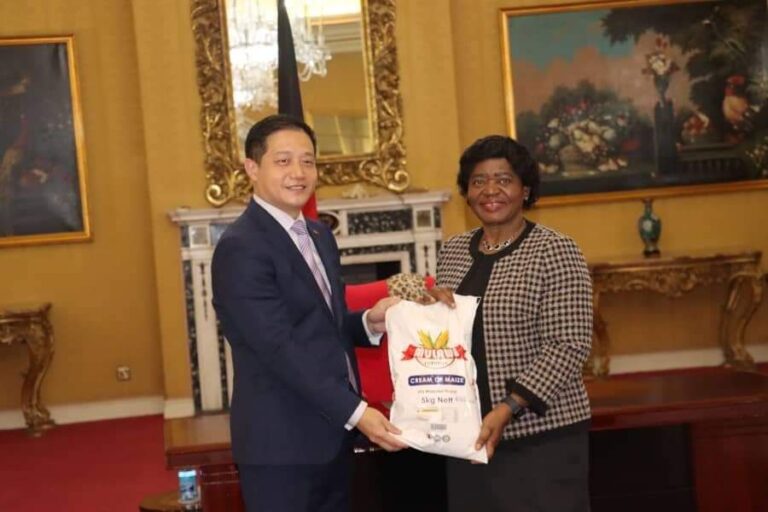
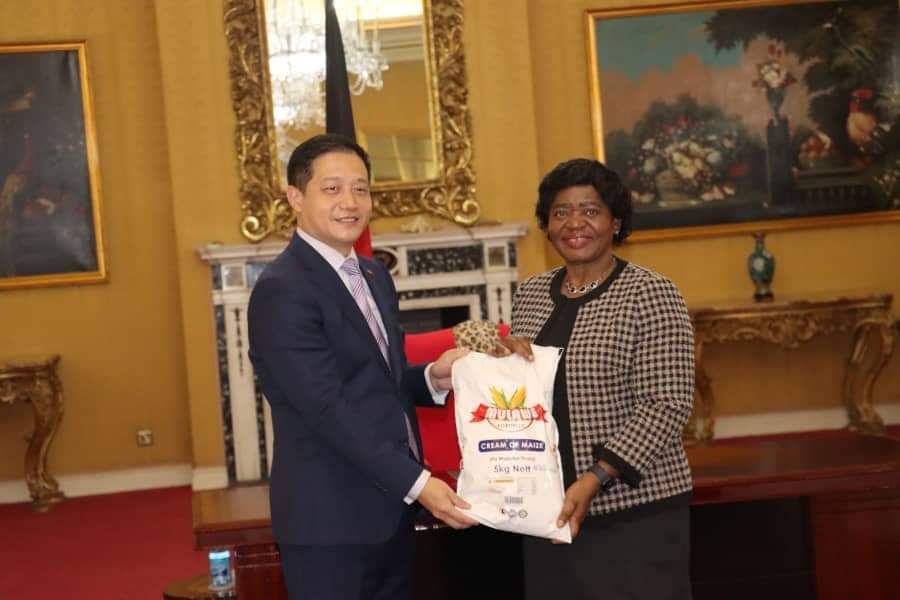
The Chinese Embassy in Malawi has donated K47,535,000 to Shaping Our Future Foundation (SOFF) to cover school fees for 75 students across Malawi in the 2024/2025 academic year.
The embassy also donated K70.7 million worth of maize floor and beans to help people affected by hunger in Nkhotakota District.
Madame Chakwera receiving donation from Chinese Embassy
First Lady Madame Monica Chakwera received the donation, on behalf of SOFF, on Friday at Kamuzu Palace in Lilongwe.