By Sarah Banda
As the succession battle continues in the ruling Democratic Progressive Party (DPP), embattled Vice President Dr. Jane Ansah is said to be receiving enormous pressure to immediately resign from her position.
There is palpable fear that, at 86, anything can happen to President Mutharika, who has recently travelled to South Africa twice for treatment since being elected into office a few months ago. His inner circle fears that once Ansah assumes the presidency in the event that he is incapacitated or dies, that will mark the end of their access to power, as she, like Joyce Banda before her, would bring in her own inner circle.
Well placed sources say a small circle of the Mutharika’s most trusted allies has quietly formed an informal governing council, assumed control over key executive decisions, and is now actively working to consolidate power and block any constitutional succession that falls outside their sphere of influence and cabal.
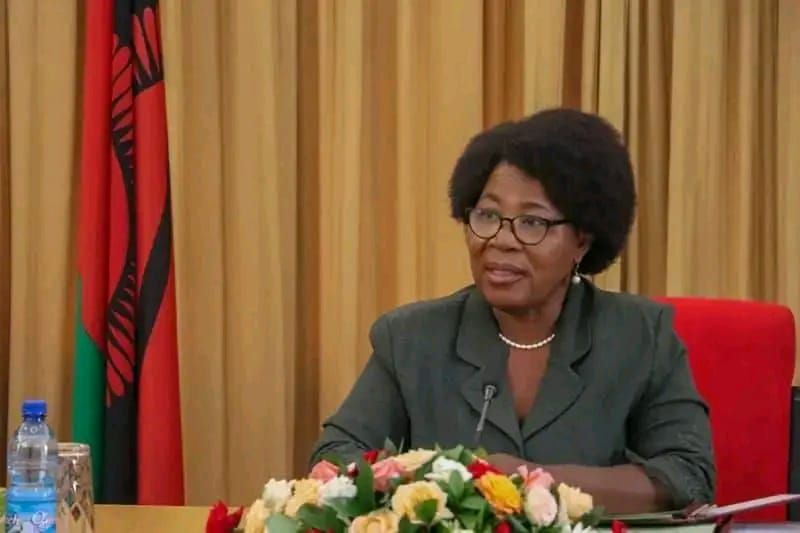
According to the sources, the president is said to have cited Ansah’s December 2025 trip to Britain, where she attended her husband’s birthday in Nottingham, as the trigger. Government spokesperson Shadrick Namalomba confirmed publicly on 24 December 2025 that approximately MWK168 million, about US$100,000, in public funds had been approved for the Vice-President and five officials for this particular trip, while a subsequent presidential statement suggested the trip was privately funded. However, sources say the move is rooted in a deepening power struggle within the ruling party over who will succeed Mutharika.
“There are many who realise that, at his advanced age, Mutharika may not complete his term to 2030,” said one source within DPP.
The source added that because Malawi’s Constitution stipulates that when a president is incapacitated or dies, the Vice-President automatically takes over to finish his elected term, factions within Mutharika’s inner circle are pushing to remove her to block that succession pathway for her. The source said the trip is not the real issue but a pretext for getting rid of her.
In January 2026, the Department of Disaster Management Affairs, one of the most operationally significant portfolios attached to the Office of the Vice-President, was removed by presidential directive and transferred to the Office of the President and Cabinet. The Department of Public Sector Reforms was also removed from her office within days. Sources also say that Dr Ansah’s security team has been materially reduced in what they describe as a deliberate effort to weaken the office.
The discussions to have Ansah relinquish her post, says the source, are said to be taking place at senior levels within the party. The discussions are also said to be looking for the possibility of impeaching Dr Ansah through parliament.
This is not the first time that Malawi has been hit by such a crisis. In 2012, when President Bingu wa Mutharika was in office, he died suddenly, and members of his inner circle attempted to block the then Vice-President Joyce Banda from assuming power. However, she ultimately took over in accordance with the constitutional provision that the vice-president succeeds the president in the event of death in office. Former President Bingu wa Mutharika was the current president’s brother.
The Malawian Constitution, in Section 83, provides that the Vice-President automatically succeeds the President in the event of death or incapacitation.
Malawi’s “Vice-President problem” is not accidental. It is the result of a constitutional system designed to ensure continuity of power, but which, in practice, has produced repeated political battles, mistrust, and succession crises for over 20 years.
At the centre of the problem is a constitutional design that gives the Vice-President automatic succession powers but does not require them to remain politically aligned with the President after election. This has repeatedly created situations where Presidents and their deputies fall out, yet the vice-president can not easily be removed.
The issue can be traced back to the early years of multiparty democracy in Malawi. Tensions emerged within the ruling elite over succession and loyalty, setting the tone for future instability around the vice-presidency.
The problem became more pronounced under the current president’s brother, Bingu wa Mutharika. After falling out with his Vice-President Cassim Chilumpha, Mutharika senior attempted to sideline Chilumpha politically. Chilumpha was even arrested on treason allegations in 2006, yet constitutionally, he remained vice-president, exposing the limits of presidential power over the office.
A major turning point came in 2012 when Bingu wa Mutharika died in office. His relationship with his Vice-President Joyce Banda had completely broken down after she formed her own party. It was so bad that the inner circle of former president Bingu wa Mutharika transported his body to South Africa under the pretext that he was going to receive treatment, when in fact he had already died in Malawi. They were buying time. President Jacob Zuma’s administration is said to have threatened to expose this if they did not do the right thing by taking the body back to Lilongwe.
Members of Mutharika senior’s inner circle, including his brother and current president, tried to block Banda from taking over, but the Constitution prevailed, and she was sworn in as president. This moment cemented fears within ruling elites that a vice-president outside their control could inherit power.
The pattern continued under Peter Mutharika during his first term. His vice-president, the late Dr Saulos Chilima, also fell out with him, formed his own political party, and eventually ran against him in elections. Despite the fallout, Chilima remained vice-president because the Constitution did not provide an easy mechanism for dismissal.
What makes the current situation more revealing is that the pressure is not directed at the First Vice-President alone. Second Vice-President Enoch Chihana is also facing a public campaign of attacks from within the same DPP inner circle. At a campaign rally in Rumphi, DPP Vice-President for the Northern Region Jappie Mhango told a public gathering that Chihana holds no ministerial post and would need to beg DPP ministers for development in his own constituency, adding that “a stepchild can never become chief.”
DPP Northern Region Governor Christopher Mzomera Ngwira publicly declared that Chihana would not last in his position and accused him of fighting President Mutharika.
There is a constitutional distinction. Unlike the First Vice-President Dr Ansah, who was elected on the presidential ticket and can only be removed through parliament through impeachment, the Second Vice-President is appointed under Section 80(5) of the Constitution and serves at the President’s discretion.
The attempt to clear out the Mutharika’s deputies is clear. One vice-president is being stripped of portfolios, asked to resign, threatened with impeachment, and deprived of security. The other is being publicly undermined, humiliated, and warned that his tenure will end and that he exists at the mercy of the DPP mafia. Although the mechanisms differ because the constitutional positions differ, the objective is the same.