


By Chisomo Phiri
Former Malawi Communications Regulatory Authority (MACRA) Director General (DG) Daud Suleman on Thursday September 24,2026 told the Parliamentary Ad-hoc Committee investigating the Chikangawa plane crash that claimed the lives of former vice-president Saulos Chilima and eight others that the regulator helped trace mobile phone numbers linked to passengers but had no statutory mandate to track or navigate the missing aircraft.
Suleman said MACRA’s involvement began shortly after the then Secretary to the President and Cabinet (SPC), Colleen Zamba alerted him about the missing aircraft on June 10, 2024.
He said that at around 13:46, Zamba called him while he was travelling from Blantyre to Lilongwe and, after noticing that he was driving, asked him to stop along Zarewa Road.
According to Suleman, a second call was made at around 13:47, during which he established a four-way conference call involving himself, the SPC, the Chief Executive Officers (CEOs) of Airtel Malawi and TNM.
He said a list of telephone numbers believed to belong to passengers on the aircraft was subsequently shared with the two mobile network operators for further action in accordance with the law.
“The SPC became the primary recipient of the information because she had assumed the role of a coordinator, while I was briefed on progress as a noting item,” said Suleman.
He said the MACRA Board Chairperson Bridget Chibwana was alerted immediately after the engagement with the mobile operators.
Suleman said MACRA subsequently issued a statement on June 11, 2024, advising all licensed broadcasters to maintain professionalism and avoid airing unverified reports and information concerning the missing aircraft.
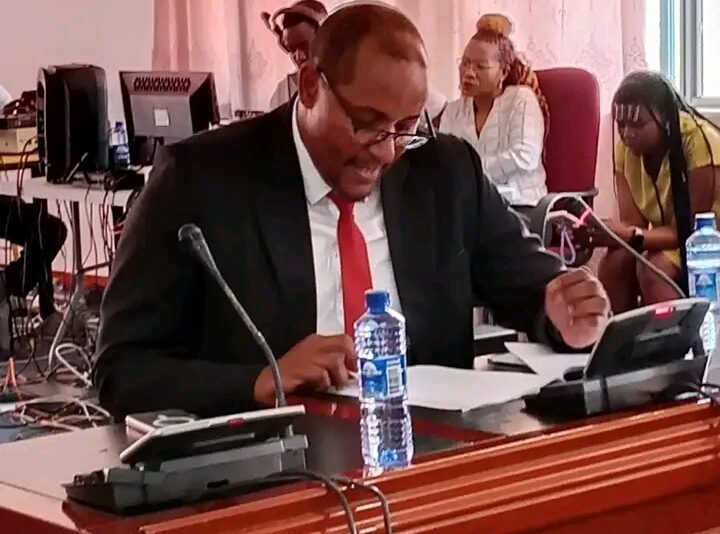
Suleman testifying
He said on June 12, 2024,MACRA issued another public statement over graphic and insensitive material circulating on social media that was purportedly linked to victims of the aircraft accident.
He said the statement invoked MACRA’s mandate under Section 97 of the Electronic Transactions and Cyber Security Act to promote public education on safe and responsible online behaviour, including cyber hygiene.
Suleman also told the committee that MACRA used a Communications Emergency Response Disaster WhatsApp group, which was established during the response to Cyclone Freddy, to coordinate communications-related issues during emergencies.
He said officials from the Office of the President and Cabinet (OPC) and State House were added to the group as designated points of contact.
He said among those added were Dr.Kent Mphepo, representing State House, and Robert Kalindiza, representing OPC.
However, Suleman stressed that MACRA’s involvement should not be interpreted as an aviation tracking function.
He said telecommunications networks generate information capable of indicating the approximate location of a connected mobile device, but such information is fundamentally different from an aircraft tracking system.
“MACRA’s regulatory relationship with telecoms operators did not confer upon the authority operational responsibility for locating, tracking or navigating an aircraft,” he said.
Suleman said mobile network information do not necessarily establish an aircraft’s precise location, altitude, heading, airspeed, flight path, navigation status or airworthiness, nor it independently establish an aircraft’s location where no relevant mobile device is connected to the network.
He said any information supplied by a mobile operator should therefore be accurately described as communications network information rather than an aviation tracking result unless the underlying technical evidence established otherwise.
Suleman further explained that the accuracy of network-derived location information is affected by factors including network coverage, cell-site configuration, sectorisation, terrain, propagation conditions, network technology, availability of historical records and the methodology used by the operator.
He said a location estimate from a mobile network should consequently not automatically be treated as an exact geographic coordinate or an aviation tracking record.
On subscriber information, Suleman said Section 54 of the Communications Act provides protections concerning information held by communications service providers.
He said mobile network operators do not simply release subscriber or communications-related information without regard to the applicable legal framework.
According to Suleman, any request for such information is considered under the Communications Act, the Electronic Transactions and Cyber Security Act, applicable legal and authority requirements, any required court order or other lawful process, the purpose and circumstances of the request, and applicable privacy and data-protection requirements.
He also referred to the Data Protection Act of 2024, saying it regulates the processing of personal data and requires personal information to be handled on a lawful basis.
Suleman said location information constitute personal data where it relates to an identifiable individual and therefore has to be handled within the applicable data-protection framework.
“The fact that information may be useful to an investigation does not by itself create an unlimited power for a regulator to obtain or disclose personal data,” he said.
Suleman told the committee that it should distinguish between a regulatory direction issued by MACRA, a request for technical assistance during inter-agency coordination, a request originating from a competent law-enforcement, security, emergency-management or aviation authority, and a technical response provided by a mobile network operator.
He said these are legally and institutionally different actions and should not be attributed to MACRA interchangeably.
Suleman said Airtel Malawi CEO Charles Kamoto reported back to him and the SPC at around 16:47 on June 10, 2024, with information showing the Raplai tower as the last tower where some Airtel devices linked to people aboard the aircraft were connected.
He said he also engaged the TNM CEO Michael Herbert and the company’s technical team through email regarding the passenger numbers.
Suleman said he additionally asked Airtel and TNM to establish whether their Chikangawa and Raplai telecommunications sites were still operational after reports emerged that the aircraft might have hit a telecommunications tower.
He said both operators subsequently confirmed that the relevant towers were operational.
According to Suleman, the Raplai information was generated by Airtel engineers and indicated a possible area associated with the devices.
He however, cautioned that the information should not be interpreted as proof of the aircraft’s precise location.
“If tracing means operationally determining the position, the route, altitude, navigation status or movement of an aircraft, that is an aviation function and should not be attributed to MACRA,” he said.
Suleman said MACRA also contacted communications regulators in neighbouring countries as part of the search for information associated with the passenger telephone numbers.
He said he was in contact with the then DG of the Tanzania Communications Regulatory Authority (TCRA), the then DG of the Zambia Information and Communications Technology Authority (ZICTA), and the DG of Mozambique’s communications regulator.
Suleman said the communication with the three regulators took place through WhatsApp and email.
He said he has a screenshot of his communication with Choolwe Nalubamba, who was then ZICTA DG, but could not retrieve some of the communication with the Mozambican regulator because disappearing messages were enabled.
Suleman also said he no longer has access to his former official MACRA email account and therefore cannot produce some of the email correspondence.
He explained that mobile coverage did not necessarily stop at international borders and that a handset in a border area could connect to infrastructure in a neighbouring country or roam onto a foreign network.
Where a relevant device interacted with a foreign network, he said, the records would ordinarily have to be obtained through the relevant foreign operator or competent authority using lawful cooperation mechanisms.
He cautioned that regulator-to-regulator cooperation arrangements, including those concerning cross-border interference, should not automatically be interpreted as giving MACRA authority to compel a foreign operator to disclose subscriber or traffic information.
Suleman said MACRA cooperate with state institutions where communications-sector expertise or information is relevant, but such cooperation do not mean the regulator assumes the statutory functions of those institutions.
He said responsibility for aviation operations, air navigation, search and rescue and aircraft accident investigations remains with authorities designated under the civil aviation framework.
“MACRA, as a communication sector regulator, could appropriately cooperate with state institutions where communication sector expertise or information was relevant.
“Such cooperation does not mean that MACRA assumed the statutory function of those institutions,” he said.
Suleman said that, to the best of his recollection, MACRA’s main engagement during the search and rescue operation was with the OPC through the then SPC, with limited engagement with other state agencies because much of the search-and-rescue work fell outside MACRA’s statutory mandate.
He further said mobile operators were expected to preserve relevant records requested during the period in accordance with their licence conditions and applicable communications, electronic-transactions and data-protection laws.
On MACRA’s internal records, Suleman said decisions concerning communications licensees, spectrum, communications infrastructure, network information, technical assistance, electronic evidence, cybersecurity and regulatory compliance should be assessed against MACRA’s statutory mandate.
He argued that matters concerning aircraft navigation, air-traffic management, aircraft surveillance, aircraft tracking, search and rescue, aviation safety and accident investigation should not retrospectively be attributed to MACRA merely because telecommunications information is involved.
Suleman also told the committee that Malawi’s digital regulatory framework needs to be updated to reflect technological developments.
He said the Communications Act of 2016 and Electronic Transactions and Cyber Security Act of 2016 has become outdated in some respects because of rapid developments in the digital environment.
He called for the development of updated digital laws, including legislation addressing digital literacy and emerging cyber-related issues.
Suleman also highlighted the importance of international cooperation and conventions dealing with cybersecurity and electronic evidence.
He said MACRA has worked with the Ministry responsible for Information and other government institutions on Malawi’s accession to the Budapest Convention on Cybercrime.
He said Malawi was formally invited by the Council of Europe on October 9, 2024, to accede to the convention, although the accession process remained subject to completion of the required domestic procedures.
Suleman said a locally constituted committee established under his leadership also prepared proposed cybercrime and electronic-evidence legislation, which was presented to the Ministry responsible for Information in 2025.
He said documentary records should be consulted to establish the precise status and dates of those processes.
He further referred to the African Union Convention on Cyber Security and Personal Data Protection, commonly known as the Malabo Convention, as another important international framework in the digital and data-protection environment.
Suleman maintained that MACRA’s approach during the Chikangawa crisis was to provide telecommunications assistance within the law, cooperate with competent state institutions, protect legally protected information and avoid assuming functions assigned to other authorities.