


By Jones Gadama
Malawi is not alone.
The fuel crisis that has left motorists queuing for hours and prices rising is not a Malawian problem alone. It is a regional and global crisis, triggered by war in the Middle East.
According to a report by Citizen Digital, Kenya’s leading news platform, the whole of East Africa, Central Africa and the SADC region has been caught in the same storm. Malawi, which sits in the heart of Southern Africa, has not been spared.
Citizen Digital reported that the crisis started on 28 February when the United States and Israel launched a joint attack against Iran, code-named “Operation Epic Fury.”
In retaliation, Iran fired hundreds of ballistic missiles and launched thousands of drones at US military assets and allied nations, including the UAE, Saudi Arabia, Kuwait, Qatar, Bahrain, Jordan, Oman and Iraq.
Most of these countries are the main source of petroleum oil for Kenya and for almost every country in this region. Kenya, similar to a majority of African nations, is a net importer of oil products from the Gulf countries.
Within days, Citizen Digital reported, the Strait of Hormuz was effectively closed to commercial shipping courtesy of threats from Iran. Roughly a fifth of the world’s oil supply passes through this narrow choke point.
At the same time, the Bab el-Mandeb corridor feeding into the Red Sea was threatened as Houthi militants announced a resumption of attacks on shipping.
When these lifelines of global oil trade are blocked, the whole world feels it. But Africa feels it first and hardest, because Africa does not produce enough of its own fuel to survive without imports.
The impact has been immediate. Global oil prices have surged beyond $100 per barrel.
This is pushing global inflation higher and threatening to shave 0.25 to 0.4 percentage points off Kenya’s debt-stressed economy.
If Kenya, East Africa’s biggest economy, is facing such a threat, what about Malawi, Zambia, Mozambique, Zimbabwe, Burundi and Ethiopia? These are economies already struggling with debt, forex shortages and high prices.
Kenya’s Treasury Cabinet Secretary John Mbadi did not hide the gravity of the situation when he addressed Parliament.
He said, “The Middle East serves as the continent’s largest external supplier of petroleum products and natural gas, making African economies highly vulnerable to supply disruptions and price shocks arising from instability in the region.”
Mbadi said Kenya holds 16 days of petrol, 19 days of diesel and 49 days of jet fuel. But he warned that imports for May and June were likely to reflect higher global prices.
Citizen Digital also reported that Kenya’s ports of Mombasa and Lamu face severe disruption. These ports serve Uganda, Rwanda, Burundi, South Sudan, Ethiopia and DRC.
Ships are now forced to reroute around the Cape of Good Hope. This adds thousands of miles and about $1 million extra in fuel costs per round-trip voyage, plus higher insurance and war risk surcharges.
Those costs are passed on to importers. They are felt in factories, food markets and fuel stations.
The same costs are felt in Lilongwe, Blantyre, Lusaka, Harare and Maputo. Malawi and its neighbours depend on those same ports, ships and routes to get fuel.
In another report, Citizen Digital said the regional fuel crisis deepened as Mozambique, Ethiopia and Burundi reported shortages and long queues.
In Tanzania, the government sanctioned a more than 30 percent increase in fuel prices. In Uganda, oil shipments had been affected.
This is proof that no country in this region has been spared. Central African countries are affected. SADC countries are affected.
And Malawi, which depends on Mozambique’s ports of Beira and Nacala and Tanzania’s port of Dar es Salaam, has not been spared.
When ships cannot pass through Hormuz, when freight costs go up, when the dollar price of oil goes up, Malawi pays the price at the pump.
Malawians must therefore understand the real causes of this crisis. It is the war itself. It is the closure of Hormuz. It is the threat to the Red Sea. It is the rise in shipping and insurance costs. It is the shortage of forex in countries like Malawi.
All these have combined into a perfect storm.
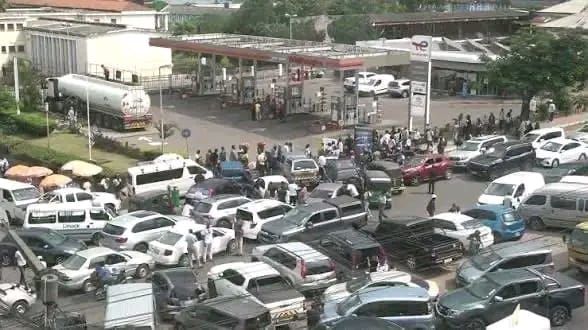
The queues seen in Lilongwe and Blantyre are the same queues seen in Nairobi, Addis Ababa, Maputo and Bujumbura.
This is a time for national understanding, not blame and division. The war in the Middle East has choked the world’s oil, and Malawi, like all its neighbours, has not been spared.