By Jones Gadama
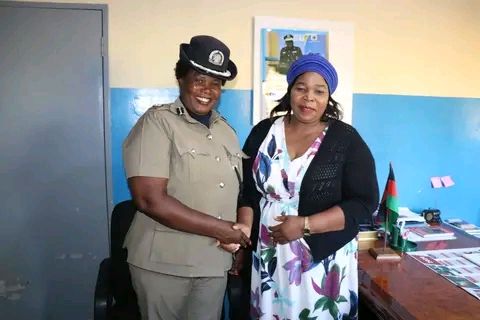
Minister of Gender, Children, Disability and Social Welfare, Mary Navicha, has issued a stern warning to Malawians against all forms of child abuse, describing the vice as both a moral failure and a criminal offense punishable by law.
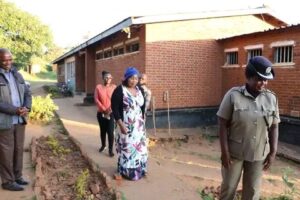
The minister made the remarks during an impromptu visit to Ntchisi District this week, following the arrest of a 39-year-old man accused of tying his 12-year-old stepchild to a tree in a nearby bush.
The suspect, identified as Kingstone Headson, was apprehended by police after reports emerged that he had bound the minor to a tree and left him in the bush for several hours. Headson allegedly accused the boy of losing a slasher, a tool commonly used for clearing grass.
Neighbors who discovered the child raised an alarm, leading to the intervention of community members and local authorities.
The boy was rescued in distress and taken to Ntchisi District Hospital where he received medical attention and psychosocial support. Medical officials confirmed he sustained rope burns and trauma but is in stable condition.
Addressing community members, traditional leaders, and child protection workers in Ntchisi, Minister Navicha condemned the incident as “inhumane, illegal, and unacceptable.” She said the government will not tolerate any acts that threaten the safety and dignity of children. “Children are not property.
They are human beings with rights. They deserve full care, love, and protection from all of us,” Navicha said. “Anyone caught abusing, neglecting, or exploiting a child will face the full force of the law. There will be no sacred cows.”
The minister stressed that the Ministry of Gender, in collaboration with the Malawi Police Service, the Judiciary, and the Ministry of Justice, has intensified efforts to prosecute child abuse cases swiftly.
She cited the Child Care, Protection and Justice Act, the Penal Code, and Malawi’s Constitution as key legal instruments that criminalize corporal punishment, torture, and any form of cruel treatment against children.
Under Malawian law, child abuse offenses can attract custodial sentences ranging from several years to life imprisonment, depending on the severity.
Navicha also used the visit to engage with local structures, including the District Social Welfare Office, Community Child Protection Committees, and Mother Groups. She urged them to strengthen reporting mechanisms and community surveillance systems to detect and prevent abuse before it escalates.
“Silence protects the abuser, not the child,” she said. “I am appealing to every citizen in Ntchisi and across Malawi: if you see something, say something. Report to the police, to social welfare officers, to chiefs, or to any trusted authority. Your action can save a life.”
Traditional Authority Kalumo, who was present at the meeting, pledged the full support of local leaders in fighting child abuse.
He admitted that some harmful cultural beliefs still contribute to violence against children, especially stepchildren, and promised to use village forums to sensitize subjects.
“We must change the mindset that children can be disciplined through violence. There are better ways to correct a child,” the chief said.
Meanwhile, civil society organizations working in the district have welcomed the minister’s visit. The Ntchisi Civil Society Network said high-profile government intervention sends a strong message that child protection is a national priority.
The organization’s coordinator, Grace Banda, however, called for more investment in community awareness campaigns and in training police and social workers to handle child abuse cases with sensitivity.
Police in Ntchisi confirmed that Headson remains in custody and will appear in court soon to answer charges of child cruelty and unlawful confinement.
Ntchisi Police Station spokesperson Yohane Bilesi said investigations are complete and the docket has been forwarded to the Director of Public Prosecutions for direction. “We are treating this matter with the urgency it deserves,” Bilesi said.
The Ntchisi incident adds to a growing list of child abuse cases reported across the country this year, prompting calls for a national dialogue on parenting, mental health, and poverty-related stressors that often trigger violence.
According to the Ministry of Gender, over 3,000 child abuse cases were recorded nationwide in 2025, ranging from physical assault and defilement to child labor and trafficking.
Minister Navicha concluded her visit by interacting with the survivor and his guardians, assuring them of government support, including counseling and safe placement. She reiterated that protecting children is a collective responsibility.
“A nation is judged by how it treats its most vulnerable,” she said. “Let us all be guardians of our children. Let us build a Malawi where every child grows up free from fear and harm.”
As the case proceeds to court, residents of Ntchisi say they hope it will serve as a deterrent to others.
Community members have since formed a local watch group to monitor the welfare of vulnerable children in the area, a move the ministry has pledged to support with training and resources.