Fresh from clinching the FDH Cup after beating champions FCB Nyasa Big Bullets on post match penalties, Blue Eagles continues to sour when they edged Wimbe United 4-0 on Saturday to get to the top of Group B in the central region premier league.
The eagles have now 28 points from 12 games displacing Wimbe United who now come second with 27 points having played 13 games.
The eagles were on target in the 7th and 13th minute of the game through a brace from Gilbert Chirwa and Francis Maloya extended the lead in the 19th and 80th minute to seal the game at 4-0.
Eagles assistant coach, Sankhani Mkandawire said he is happy that the team is back to the summit of the group’s table.
“It was not easy, we knew they are a good side and were coming from a win but we could not allow to get a draw or loss at our own backyard after emerging champions in the FDH cup,” he said.
His counterpart, Ziggy Nkhata of Wimbe attributed the loss to transport challenge they encountered on their way to the venue.
“It was a difficult game we have to accept but we had a breakdown as we were coming such that we arrived abit late and our players did not have ample time to do some warm-up,” he said.
He, however, said they would get back to their drawing board to rectify the challenges they face to do well.
Extreme FC and Mitundu Baptist are topping Group A and C respectively with 24 and 26 points.
For topping group B, Blue Eagles have won 8 games with 4 draws and have never tasted a defeat.
Speaking in an interview, Central Region football association general secretary Antonio Manda said he is impressed with the league’s progress.
” As Central Region Football Association, we are on cloud nine because we haven’t registered any pockets of violence since the inception of the league,” said Manda.
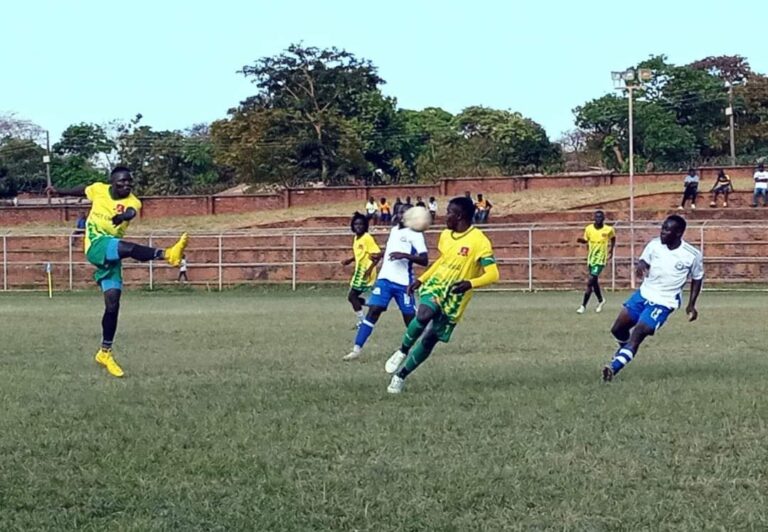
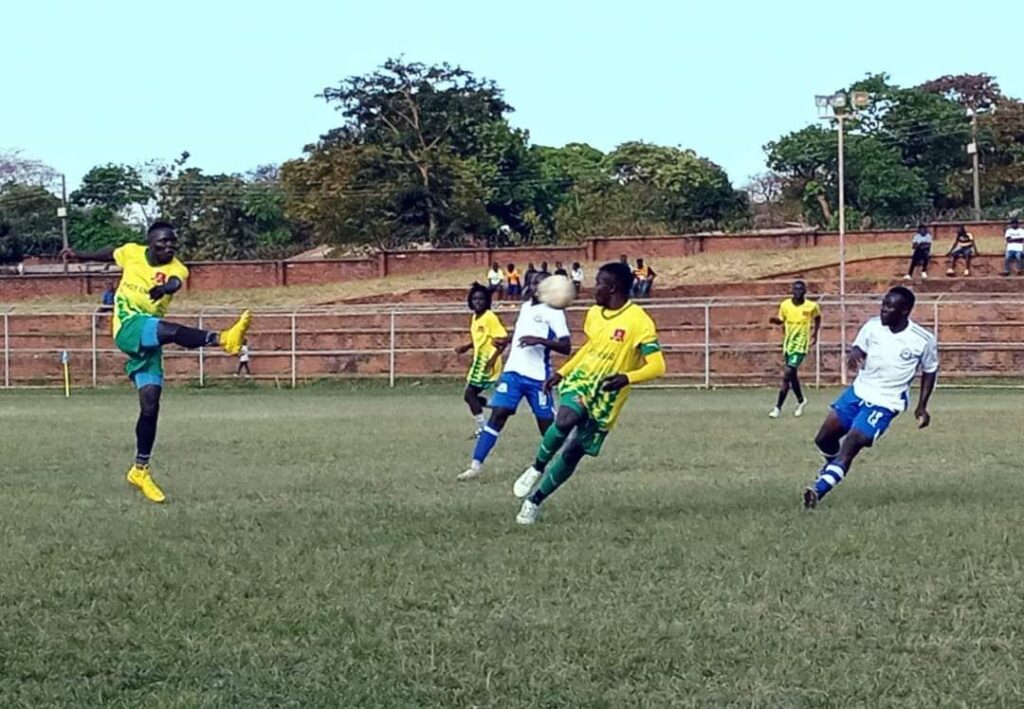
Pic: Blue Eagles and Wimbe players scrambling for the ball.
The Mbakuwaku Movement for Development (MMD) has announced a delay in its major convention to select candidates for the upcoming elections, citing financial challenges as the primary reason. This decision comes as the party grapples with budgetary constraints that have impacted its ability to organize the event as planned.
Peter Kuwani, the leader of MMD, confirmed the postponement, stating that the party is working diligently to address the financial issues that have necessitated the delay. “We are committed to conducting a transparent and orderly convention,” Kuwani said. “However, we need to resolve our financial difficulties before proceeding with the selection process.”
Kuwani also reflected on the party’s experiences from the 2019 elections, where MMD faced several setbacks. During the 2019 tripartite elections, the party was left out of some electoral processes and faced difficulties with candidate representation. According to Kuwani, the party was excluded from certain aspects of the electoral framework, including challenges related to the nomination of candidates.
Peter Kuwani- no funds for the convention
A notable concern for the party is the absence of a unified approach with other political entities. Kuwani criticized the current political environment, saying that agreements with other parties have often been aimed more at self-interest rather than genuine collaboration. This lack of consensus, he argued, has hindered effective alliances and coalitions.
In response to the concerns raised by Kuwani, Sangwani Mwafulirwa, a spokesperson for the Malawi Electoral Commission (MEC), refuted claims of partisan exclusion. Mwafulirwa stated that all parties were subject to the same rules and regulations in the 2019 elections and that no party was unfairly treated.
In the 2019 elections, MMD’s leader, Peter Dominic Kuwani, secured 32,473 votes. Despite the party’s challenges, Kuwani’s performance highlighted a significant level of support and underscored the potential for future electoral success.
In conclusion, the MMD navigates its financial challenges and prepares for its delayed convention, the party’s future will depend on its ability to resolve these issues and unite its members. The postponement has sparked debate about the party’s strategy and its place within Malawi’s political landscape. Moving forward, the focus will be on addressing these financial hurdles and preparing for a competitive and transparent electoral process.
During the recent People’s Party (PP) convention, a powerful proverb was introduced, stating: “Munthu osaona sayambana ndi yemwe akumuyendetsa chifukwa sakafika komwe akupita osaonayo, owona uja akabwelera.” This translates to “A blind person does not quarrel with the one guiding them because they will not reach their destination without the guide. But if the guide turns back, so does the blind person.”
This proverb has a deep and symbolic meaning in the context of Malawi’s political journey. It reflects the complex relationships between politicians, political parties, and alliances that have shaped the country since its transition to multiparty democracy in 1994. Below is a detailed analysis of the proverb and its relevance to Malawi’s political history and current situation.
1) Dependence on political alliances
At the heart of the proverb is the idea of dependency. In Malawi’s political environment, many leaders have relied heavily on alliances with other parties to gain or retain power. The “blind person” in this context can represent a politician or a political party that lacks an independent vision or the strength to lead on its own. These figures often need the support of larger or more influential parties to navigate the political landscape.
In the proverb, the blind person who quarrels with their guide represents a politician who challenges or overestimates their own abilities despite being reliant on others to succeed. In Malawi, several political figures have risen to power not through their own strength, but by forming alliances. However, once in power, some of these individuals have quarreled with their guiding partners, believing they could now chart their own course independently. The outcome, as the proverb suggests, is that without the guide, they are likely to lose their way.
2) Malawi’s political journey since 1994
The reference to “starting in 1994 and still being blind in 2024” in the analysis points to the fact that many politicians have been in the system for decades, but they have not yet found a clear and independent path for themselves or the country. Malawi’s return to multiparty democracy in 1994 was a significant turning point, but since then, many political figures have struggled to establish lasting leadership. They have often relied on coalitions or switched parties to remain relevant.
This proverb could be highlighting the fact that Malawi’s political landscape has seen little progress in terms of new, visionary leadership. Instead, old players remain, still dependent on external forces to maintain power. The journey, despite spanning 30 years, appears to be going in circles, with no clear destination in sight.
3) Critique of leadership without vision
The proverb also offers a critique of leadership that lacks a clear vision. In Malawi, leaders who rely solely on the support of other parties or alliances, without cultivating their own political identity or policies, are like the “blind person” in the proverb. Such leadership can only go as far as the guide takes them. When the guide (a more powerful party or alliance) withdraws support, the leader is left stranded, unable to move forward.
This could be seen as a warning to political leaders in Malawi to develop their own clear visions for the country rather than relying solely on political deals or alliances. The proverb suggests that true leadership requires the ability to see where you are going, not just being led by others.
4) Implications for current political dynamics
In today’s political context, the proverb may be particularly relevant to some of the political figures or parties that have been propped up by alliances or coalition agreements. These parties or leaders might be overestimating their strength and quarreling with the very alliances that have kept them afloat. The proverb’s message seems to be clear: without the support of others, and without a clear vision, these political actors risk being left behind, just as the blind person is left stranded when their guide turns back.
5) The call for political independence and vision
Ultimately, the proverb calls for political independence and visionary leadership. Malawi’s political future depends on leaders who can chart their own course and not just follow others. Political parties and leaders must develop clear ideologies, policies, and strategies that resonate with the people. Without this, they risk being seen as blind followers, dependent on the shifting winds of political alliances rather than capable of leading the nation forward.
Conclusion
The proverb shared at the People’s Party convention offers a profound reflection on the current state of Malawian politics. It highlights the dangers of over-reliance on political alliances and the importance of visionary leadership. As the country looks toward the future, political figures must heed this wisdom, ensuring they are not merely being led, but actively leading the country toward progress. Leaders need to open their eyes, find their own path, and stop relying on others to show them the way.
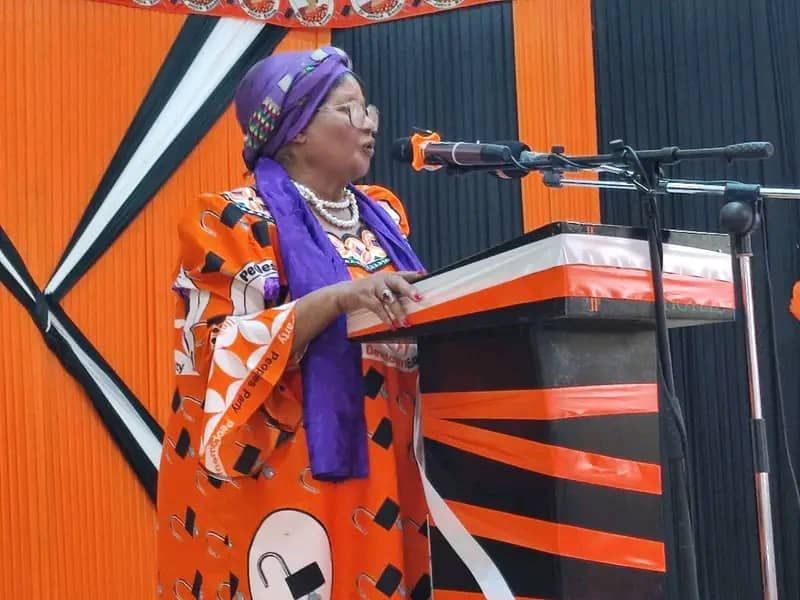
Former President of Malawi, Joyce Banda, has secured a new mandate as the leader of the People’s Party (PP) following a successful national convention held at Crossroads Hotel in Lilongwe on Friday, September 6, and Saturday, September 7, 2024. The convention, which saw widespread participation from party delegates across the country, reaffirmed Banda’s leadership, positioning her to continue steering the party in the lead-up to the 2025 general elections.
During the two-day convention, Banda was re-elected unopposed as party president, a clear sign of her continued influence and support within the PP. This new mandate comes at a crucial time, as the party aims to revitalize its political presence and reclaim its position in Malawi’s political arena. The convention’s agenda included critical discussions on policy, party strategy, and preparations for upcoming elections, with a focus on restoring the party’s relevance in a competitive political environment.
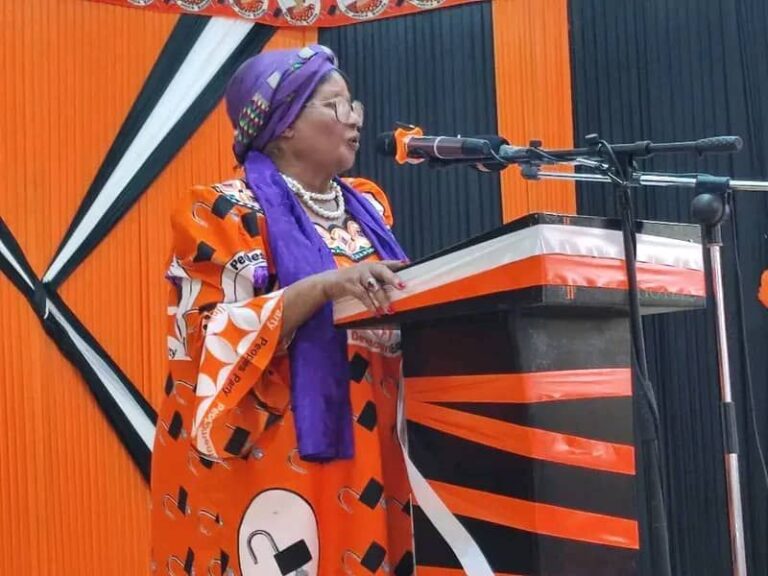
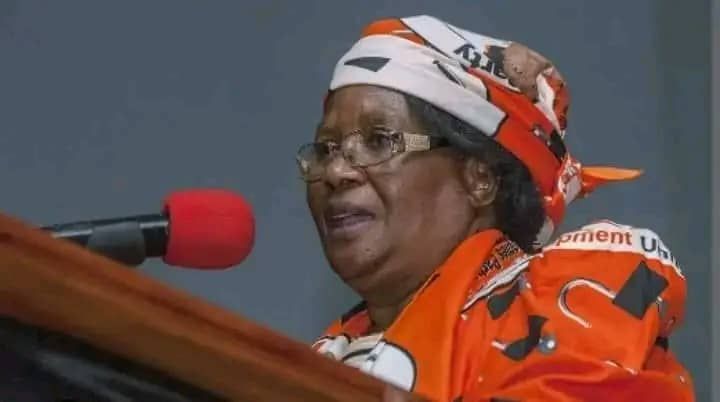
Dr Joyce Banda
In her acceptance speech, Banda expressed gratitude to the delegates for their unwavering trust in her leadership. She emphasized the need for unity within the party, acknowledging the challenges PP has faced in recent years. “This is a new chapter for our party. We must stand together, work harder, and focus on delivering a message of hope, progress, and development to the people of Malawi,” she said.
Banda also outlined her vision for the party’s future, focusing on empowering women and youth, promoting economic development, and strengthening Malawi’s democratic institutions. She pledged to work closely with the party’s leadership and grassroots structures to ensure the PP remains a significant force in Malawi’s political landscape.
One of the key highlights of the convention was the election of a new National Executive Committee (NEC), which saw a blend of experienced politicians and new faces taking up leadership roles. The new NEC is expected to bring fresh energy and ideas to the party, with a clear mandate to work towards party unity and growth.
Several political analysts have noted that Banda’s re-election could signal a renewed effort by the PP to regain ground lost in recent elections. Banda, who served as Malawi’s president from 2012 to 2014, remains a prominent figure in the country’s politics, and her leadership is seen as pivotal to the party’s resurgence.
The convention also saw the introduction of key policy resolutions aimed at addressing pressing national issues such as poverty reduction, healthcare reform, and education. These policies will form the cornerstone of the party’s platform as it prepares for the 2025 general elections.
While the political landscape in Malawi remains competitive, Banda’s re-election as PP president marks a significant moment for the party. Her leadership and political experience are expected to be crucial in navigating the challenges ahead and positioning the People’s Party as a viable alternative in Malawi’s political scene.
As the People’s Party moves forward under Banda’s leadership, all eyes will be on how the party positions itself in the months leading to the elections. For now, Joyce Banda’s renewed mandate as president signifies a vote of confidence in her leadership and a commitment to the future of the People’s Party.
The leader of the People’s Party (PP), Joyce Banda, has called on Malawians to consider voting for a woman as the next President in the 2025 elections, stating that female leaders are compassionate and committed to the welfare of the people. Banda made these remarks during the closing of the two-day 2024 PP elective convention in Lilongwe on Saturday.
Reflecting on her two-year presidency, Banda highlighted key development initiatives she championed, including the Mudzi Transformation Trust, a program that led to the construction of modern housing in rural areas. “Women can perform marvelously,” she said, pointing to Tanzania’s President Samia Suluhu as a current example of successful female leadership. “President Suluhu is doing an excellent job, showing the potential of a female leader.”
Joyce Banda
Advocacy for Women in Leadership
Banda, who served as Malawi’s first female President from 2012 to 2014, expressed her belief that women bring unique qualities to leadership roles. She emphasized that women leaders are more likely to be passionate about social issues, such as healthcare, education, and poverty alleviation, which are critical for Malawi’s development. Banda believes that electing a woman to lead the country would result in policies that prioritize the well-being of ordinary Malawians.
Concerns About Current Service Delivery
During her speech, Banda also voiced her concerns over the current state of service delivery in the country. She pointed out weaknesses in the health, security, and agriculture sectors, urging that these areas need immediate attention. “Our people deserve better in terms of healthcare and security, and our farmers need more support to thrive,” she said.
Networks and Opportunities
Since leaving office, Banda has been active in international circles, building networks and unlocking opportunities for Malawi. She has used her connections to advocate for development in the country, focusing on empowering women, youth, and marginalized communities.
Banda’s call for a female president comes at a time when gender equality and women’s empowerment continue to be hot topics in Malawi’s political discourse. Her speech has reignited discussions on the role of women in leadership and whether Malawi is ready to elect another female president.
As the country heads toward the 2025 elections, Banda’s message resonates with many who believe that women can offer fresh perspectives and solutions to the challenges Malawi faces today.