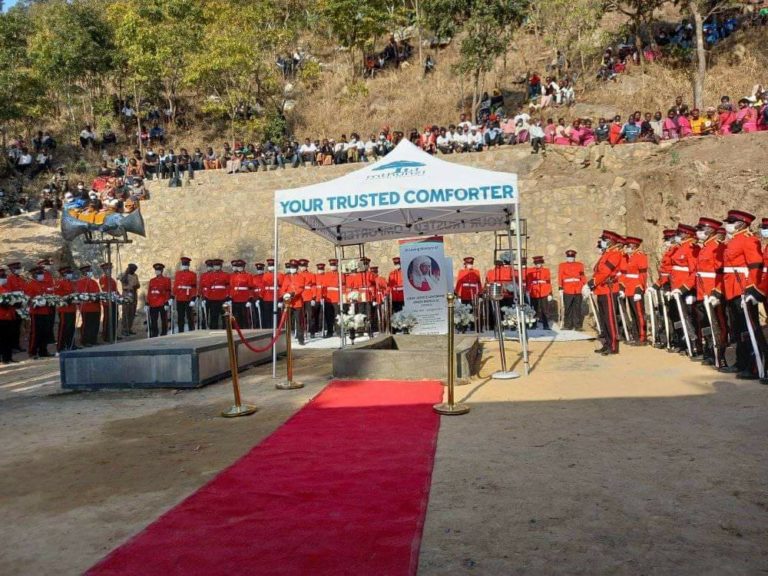
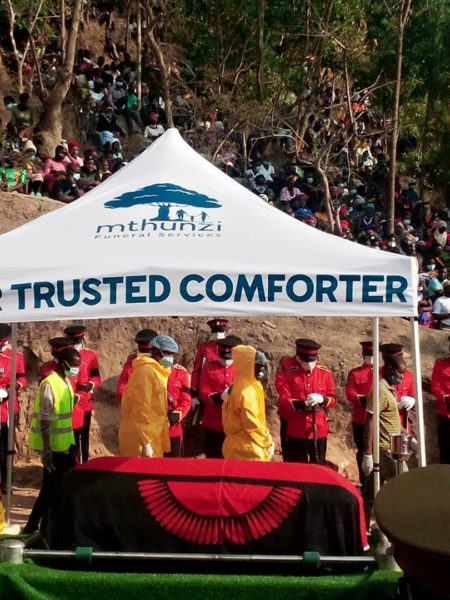
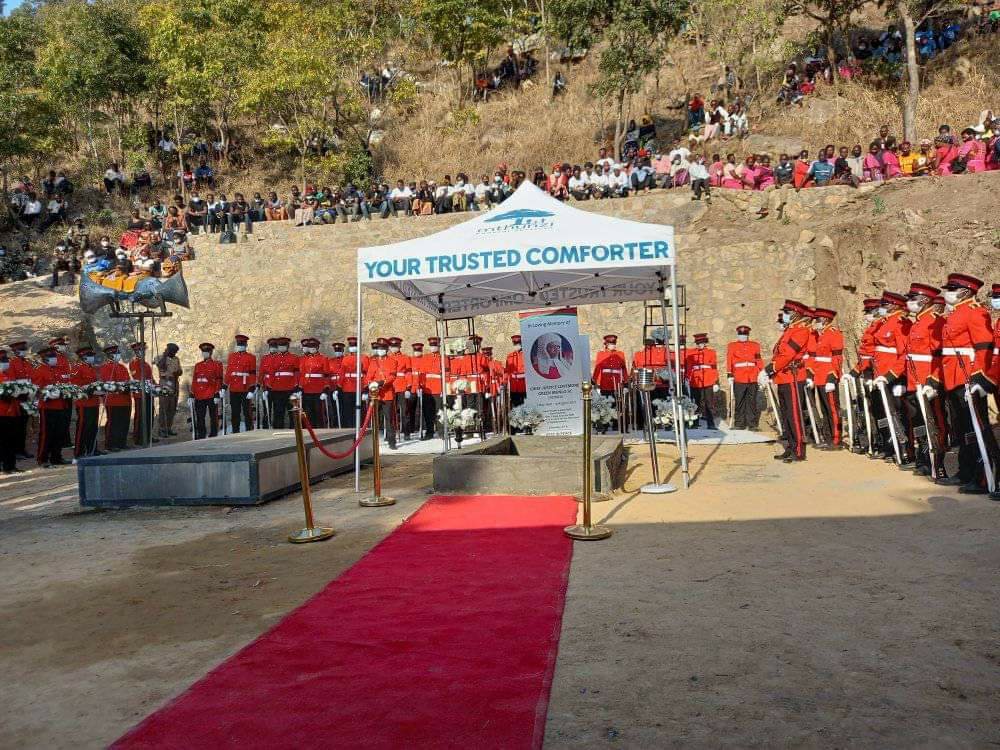
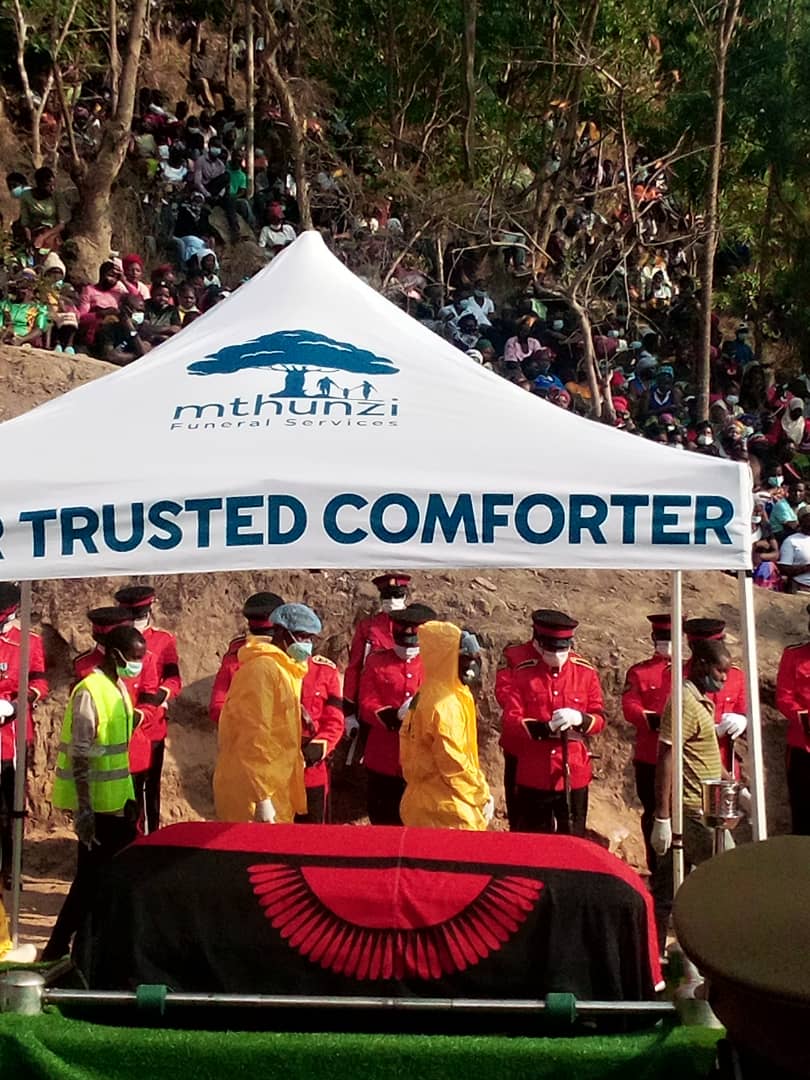
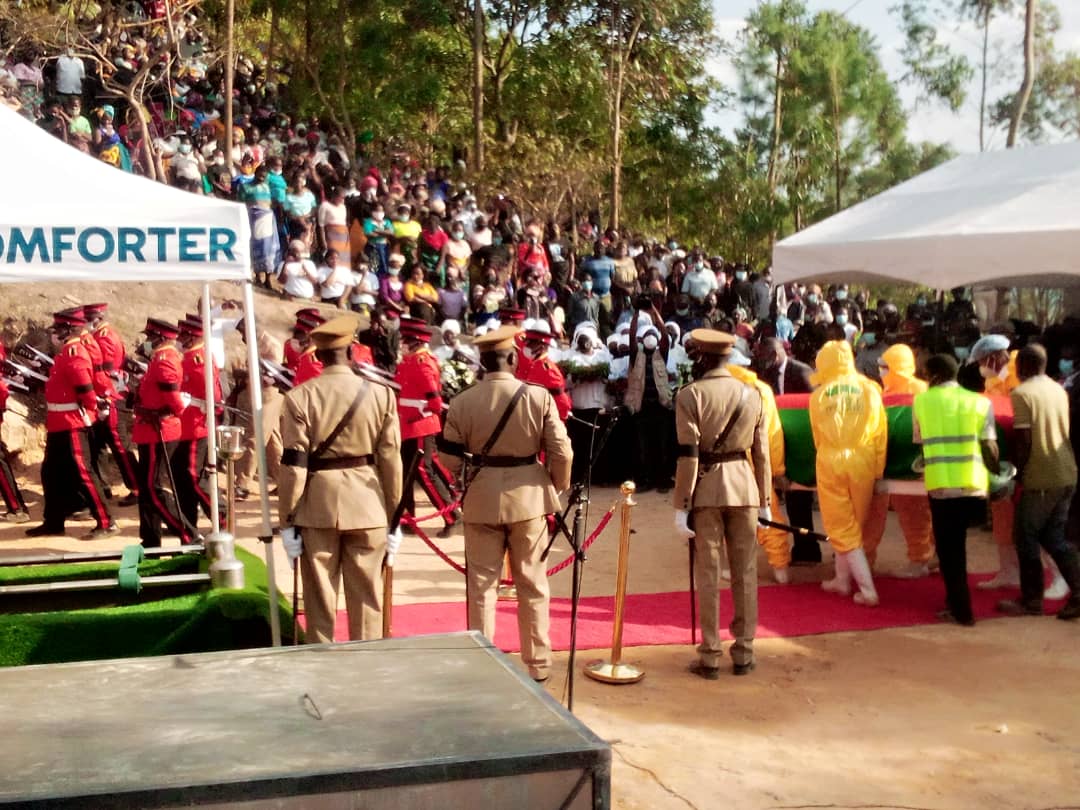
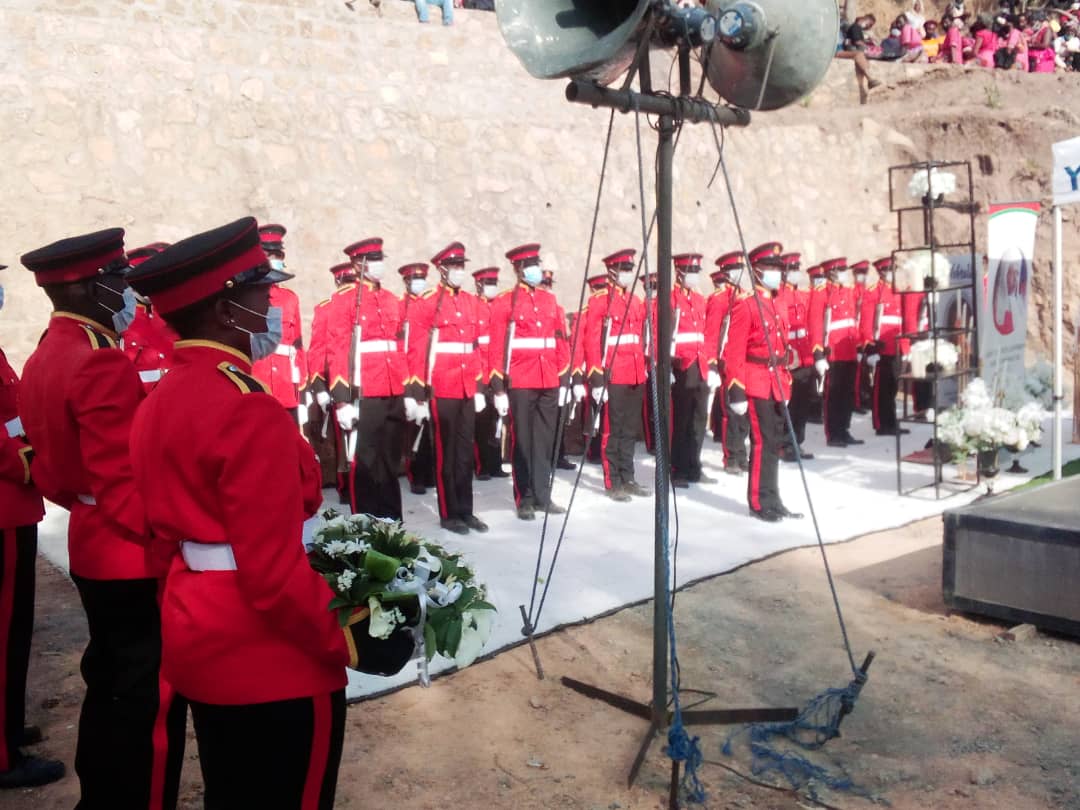
Ex-Chief Justice Lovemore Munlo, SC, was on Saturday, 21 August, 2021 laid to rest with military honours within his gigantic Chigodi private premises near Kachere Township on the Chiradzulu, Blantyre border.
It was a sombre but moving ceremony attended by high-level government dignitaries, officials from the Judiciary, the ruling Malawi Congress Party (MCP) to which the deceased belonged, the opposition Democratic Progressive Party (DPP), as well as the Blantyre Synod’s CCAP clergy led by its General Secretary Reverend Dr. Billy Gama.
Minister of Justice and Constitutional Affairs Titus Mvalo represented President Lazarus Chakwera at the funeral. In his eulogy, he extended a message of condolence to the bereaved family, friends and relatives from the President.
Mvalo said the President was devastated by the death of Ex-Chief Justice Munlo because him and the late Munlo were contemporaries right from their university days at Chancellor College.
“They have known each other since college days in the 1970s. The President is devastated by the passing of Right Honourable Munlo,” said the Justice Minister, adding that the late Munlo was “a great man beyond the legal profession”.
In his eulogy, the Head of Judiciary, Chief Justice Andrew Nyirenda said the late Munlo was multi-talented.
“He had tentacles everywhere; apart from being a successful legal professional, my mentor was a very successful entrepreneur; he was generous in sharing, with open arms.
“On a personal note, I have known him over the years, as far back when I was a kindergarten lawyer, he had rare fatherly qualities,” said the Chief Justice.
The deceased son, Mapwesera, also paid tribute to his father whom he described as their ‘hero’. He said it is devastating to realize that now he and his only brother, Mzee Kiphale, are fatherless.
Other speakers at the funeral ceremony included Prince Chiwalo who spoke on behalf of the Munlo family, Professor Vincent (virtual presentation) from Nigeria, who was late Munlo’s best friend and workmate at the Special Court for Sierra Leone between 2006 and 2007, a Mr. Sabola who represented the deceased’s friends, Group Village Headman Andrew of the area, and MCP’s Treasurer General Albert Mbawala, among others.
The Blantyre Synod’s General Secretary Reverend Dr Gama spoke on behalf of the Church, saying the late Munlo was a philanthropist who lived a selfless life and helped many people.
“He helped the Church build several prayer houses, he helped many people with scholarships, he built houses for many relatives
as well as those that were not his relatives,” he said.
The funeral of the late Munlo
The late Munlo died on Thursday, 19 August, 2021at Queen Elizabeth Central Hospital in Blantyre following a Covid-19 attack.
The late Munlo served as Malawi’s Chief Justice from 2007 to 2013. He served as Deputy Registrar at International Criminal Tribunal for Rwanda (ICTR) from 2001 to 2006 and Registrar at the United Nations (UN) Special Court for Sierra Leone and Assistant UN Secretary General.
The late Munlo was a Principal Partner in Green Munlo & Company, which he established after his industrious legal career.
In the early years of his legal career, he served as Minister of Justice and Attorney-General (1993 to 94;) Deputy Minister of External Affairs (1992 to 1993); Justice of the High Court of Malawi (1990 to 1992); Director of Public Prosecutions (1984 to 1987); Senior State Advocate (1980 to 1984); and State Advocate (1976 to 1980).
He obtained a Bachelor’s Degree in Law (LL. B) from University of Malawi’s Chancellor College in 1976 and a Master’s Law Degree (LL. M) from the University of London in 1989.
The late Justice Munlo was born in Chiradzulu on 1 May, 1950. He is survived by wife, Evelyn, and two sons.
Other high-level officials at the funeral included First Deputy Speaker of Parliament Madalitso Kazombo, Minister of Lands Kezzie Msukwa, Minister for Homeland Security Chimwendo Banda, Justices Rezine Mzikamanda, Edward Twea, and former cabinet minister and one of the late Munlo’s closest friends, Henry Mussa, among others.
A Uk based Malawian sadly lost his life recently after falling from a flat in the Scottish city of Glasgow. Now his family wants to make sure that the remains of Harvey Wittika should return home and have launched a desperate appeal to bring his body home to Malawi.
Wittika who left Malawi in in 2005, had been living in the city for the last six years. The 37-year-old, originally from Blantyre in Malawi, has been described as a ‘beautiful person who was always positive’,
Harvey was rushed to the Queen Elizabeth University Hospital on August 6 after falling from the second floor of his flat building. A family friend told Glasgow Live: “Harvey was found unconscious near his flat, he must have fallen from the second floor to the ground. An ambulance was called and he was taken to hospital. He was still alive when he got there but passed away a short time later”.
The late Harvey Winn Wittika
He sadly died a short time later and police in Glasgow were unable to track down any of his family. They were forced to contact the Malawi High Commission in London who circulated his image among the community. His family was eventually made aware of his death and are now trying to get him home.
Harvey first moved to the UK to study Computer Science at the University of Hertfordshire where he graduated with a master’s degree. After struggling to get work in the industry, he was employed as a chef in Wagamama’s and Nando’s in St Albans.He later moved to Glasgow.
Some concerned Malawians have been quick to help , notably Rhodrick Kalumpha who set up a Go fund page to help raise money to repatriate Harvey body back to Malawi ” It is with deep sorrow to inform you that our beloved brother and friend, Harvey, was found dead under mysterious circumstances in Glasgow.
As his death was sudden and unexpected, we would like to give him the best send off that he deserves. Therefore, on behalf of the family, we would like to request any of you for monetary assistance of any amount to ensure that our dear friend and brother is honoured in the best way possible” wrote Kalumpha on the Go Fund page. A target of £3000 has been set and so far over £2600 has been raised.
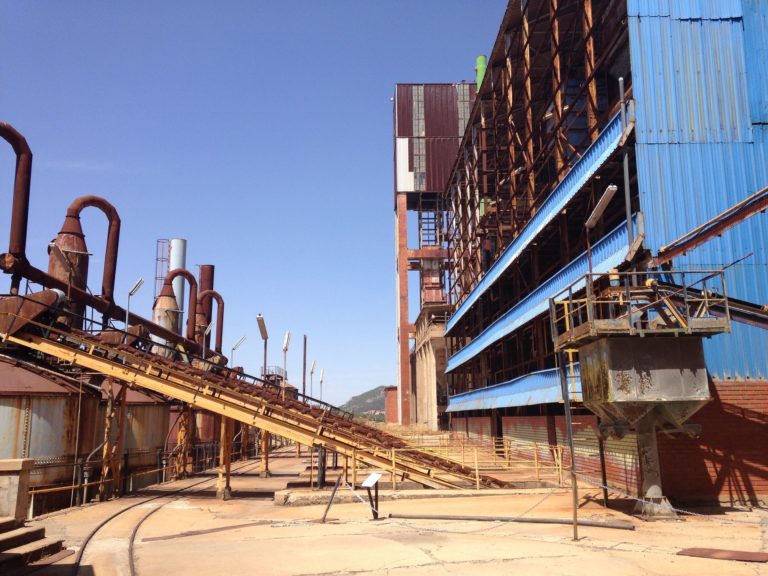
GLOBE Metals & Mining has been given the green light to find about US$250 million for an integrated niobium project development in Malawi called Kanyika that’s been modelled to have a pre-tax net present value of about $1 billion and an internal rate of return of circa 50%
With a mining licence now received, “all approvals (are) in place to immediately commence construction upon funding and relocation of affected persons”.
However, Globe and the government of Malawi are currently defending in the High Court of Malawi an action by the local community who allege that mining has commenced and claim the defence has breached their constitutional rights by preventing rights to land and lifestyle and a claim for compensation, damages and resettlement.
“At this stage, in discussion with the community, the company has a high degree of confidence that the court proceedings will not continue and that a settlement with mutual benefit will be forthcoming,” Globe said.
“The issue of a mining licence primarily solves the community claim for action on development, relocation and resettlement.”
Globe has allocated US$200 million for plant, property and equipment as well as community relocation.
The open cut development will involve processing of 1.5 million tonnes per annum and production of 11,000tpa of concentrate that will be refined into 3250tpa of niobium and 140tpa of tantalum.
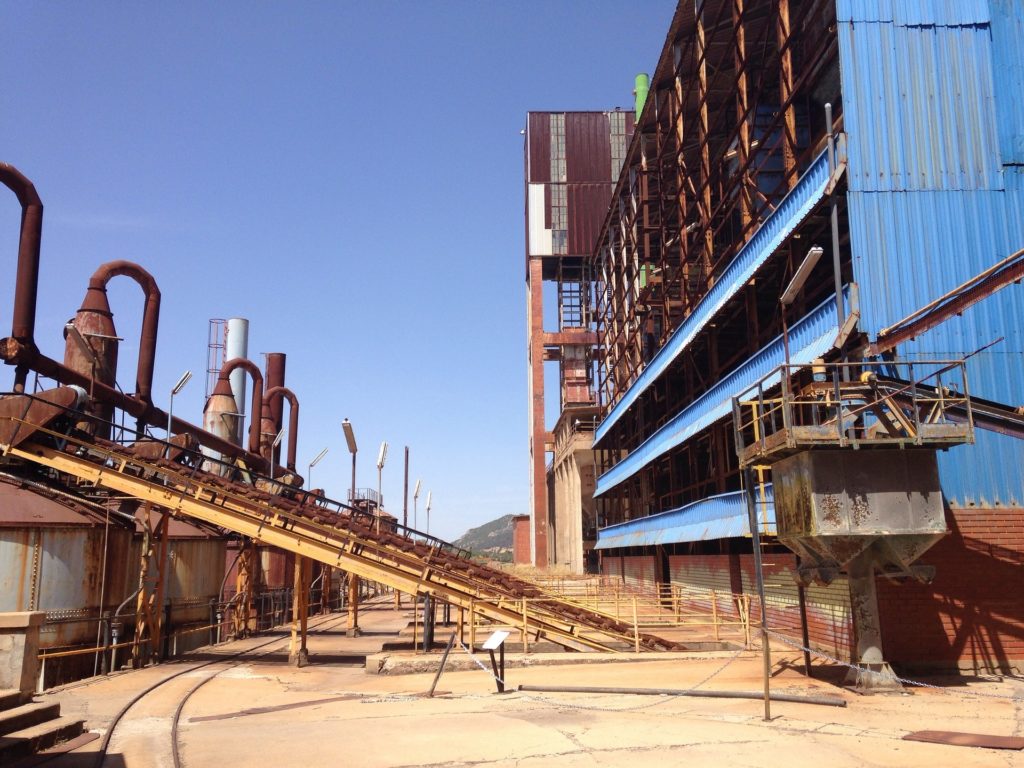
The Kanyika mine is located in central Malawi. Credit: MarisaBona from Pixabay.
Over 90% of niobium is used in the manufacture of high strength alloy steels, with the intensity of usage in steel is rising as markets move towards the manufacture of higher quality steels.
Globe said “niobium’s unique characteristics make it central to many of the world’s past, present and future technologies … (and that it) is critical to military, aerospace, space and medical industries”.
It is also said to be “increasingly important in quantum electronics, in the manufacture of semiconductors and in the electrical vehicle industry”, with Globe set to “target high-end, high-value applications”.
Globe had cash at June 30 of A$2.8 million.
Shares in Globe were up 28.5% to 18c in morning trade, capitalising the company at $84 million.
The stock was at levels around 4c in June, with subsequent strong interest from investors shown after notification that month of the mining lease approval.
Globe initially started feasibility work on Kanyika in 2009
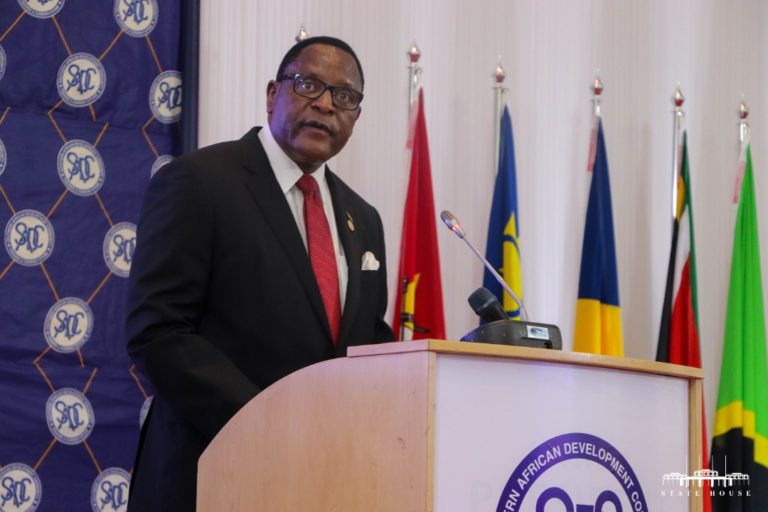
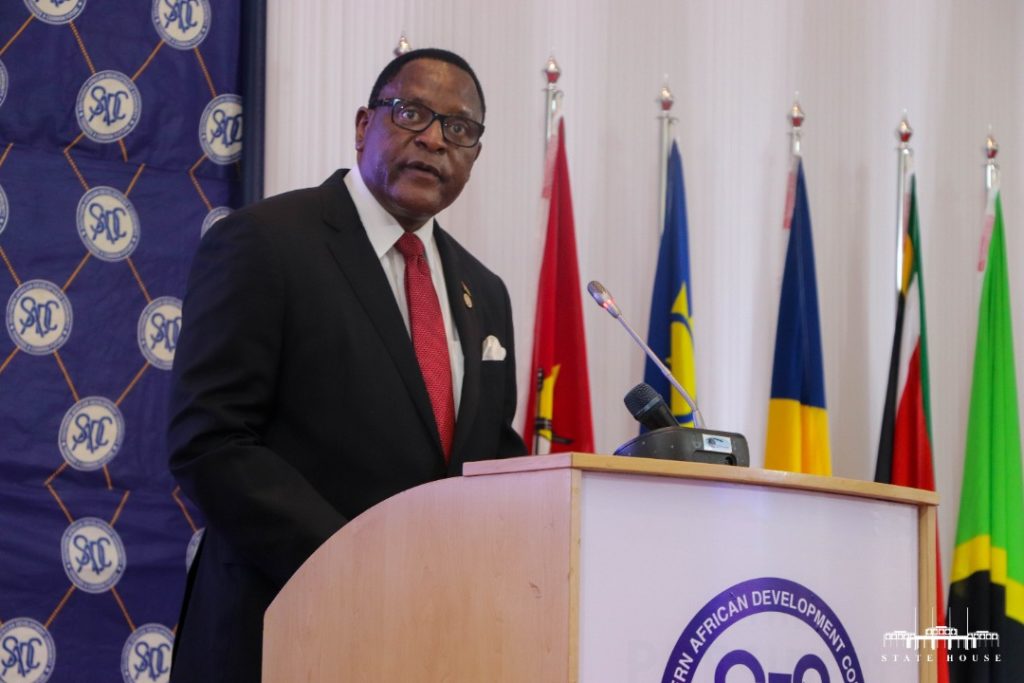
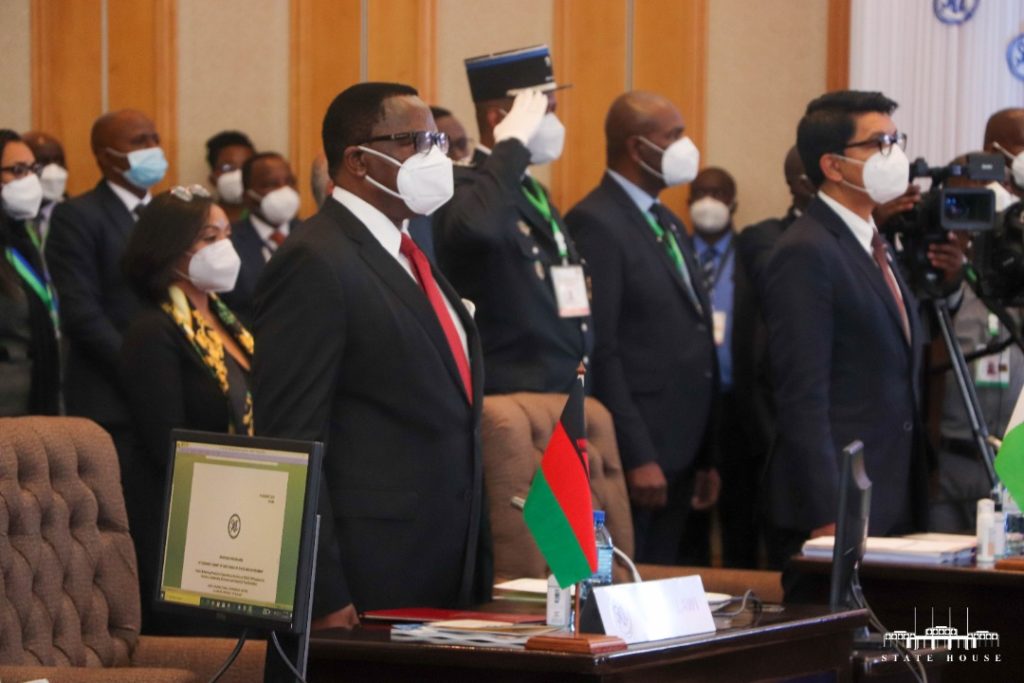
President of the Republic of Malawi Dr. Lazarus McCarthy Chakwera has taken over the Southern Africa Development Community (SADC) Chairship from Mozambican President, Filipe Nyusi, following the SADC Heads of State and Government Summit held in Malawi’s capital, Lilongwe, which saw eight Heads of State converging on Lilongwe from 17 to 18 August 2021, to discuss ways of promoting a common development agenda for this regional grouping.
The SADC Summit was also attended by other high-profile continental officials including Dr. Stergomena Lawrence Tax, the outgoing SADC Executive Secretary, Moussa Faki Mahamat, Chairperson of the African Union Commission, Dr. Vera Songwe, Executive Secretary of the United Nations Economic Commission for Africa, and Dr. Akinwumi Adesina, President of theAfrican Development Bank (ADB).
In a joint communiqué released after the meeting, the Heads of State reaffirmed SADC’s commitment to various protocols that are aimed at promoting regional integration in areas such as peace and security, HIV-AIDS and generally promoting development and resilience in the region in the face of various global Challenges.
The Heads of State also congratulated President Lazarus Chakwera and Malawi for assuming the leadership of the grouping for the next 12 months.
In his closing remarks at Bingu International Conference Centre (BICC), President Chakwera expressed his government’s commitment to the full implementation of the Summit decisions towards the creation of a SADC that is peaceful and free, a SADC that is inclusive and united, a SADC that is productive and competitive, a SADC that is industrialized and prosperous, a SADC that is strong and just, adding Malawians expect and deserve nothing less.
President Chakwera, New SADC Chair
However, the question that many people would be asking is, what are the immediate take-home benefits for Malawi as a result of the President Chakwera’s Chairship of SADC? Obviously, people would ask such questions based on the fact that this is not the first time for a Malawian Head of State to assume the role of SADC Chairship. Indeed, Bakili Muluzi was SADC Chairman in 2001 whilst Joyce Banda became Chairperson of the grouping in 2013, but there is very little in terms of bankable development that one can write about that came as a result of these ‘Chairships’.
How different is President Chakwera going to be from Bakili Muluzi and Joyce Banda? Addressing delegates last year soon after Malawi was nominated to host the summit this year, President Lazarus Chakwera said Malawi is ready to host the meeting, adding that the nomination symbolises the level of confidence SADC has in the leadership of this country. He said this was a huge opportunity for Malawi to sell the country in a positive way. Ode to President Chakwera, the SADC Summit has indeed been hosted successfully, and obviously, the Heads of State and their entourages, who descended on Lilongwe will have many positive stories to tell about Malawi. Apart from wearing their power suits and conducting ‘delegates’ business, many of them travelled and sampled the countryside whilst melting under the infectious smiles of local Malawians. Some of them took to the dance floor to display their tango after getting high on Malawi Gin.
As a country, we also successfully used the opportunity to display to visitors the various products that are produced in Malawi in the hope of finding markets for the same within the region. However, we know that when visitors come to our country, they always travel around and possibly purchase a curio or two and fly back to their countries. That is normal. So what was President Lazarus Chakwera talking about when he said Malawi stands to benefit a lot as a country? The answer is very simple. President Chakwera will be different from his predecessors because he is leading the country and will be leading SADC in a political context that is substantially different from the Muluzi as well as the Joyce Band era.
Bakili Muluzi was the first multiparty President for Malawi, and it is important to appreciate the fact that many democratic institutions in the country [and even the region] were only just nascent and developing during his time. Technology was also not as advanced as today where citizens can track progress against promises through such spaces as the social media without relying on the often-tweaked government information systems. The systems of accountability were therefore not as strong as they are today. It is a naked fact that the international profile of Joyce Banda, as an individual and as President of Malawi, was at the highest before she was ruined by the plunder of public resources by some civil servants christened as ‘Cashgate’. During her time as President, donors warmed up and the country’s bilateral partners became suddenly willing to forget all our transgressions before the party was spoiled by the Cashgate malfeasance.
One of the factors that propelled her to international prominence was because she became Chairperson of SADC during a time when the uptake of ICT was rising and citizens started to engage more directly with their governments. Although President Chakwera is becoming SADC Chair at a time when the world is grappling with the Covid-19 pandemic, Malawi stands a better chance of reaping enormous benefits from his SADC Chairship than at any other time in the country’s history. To begin with, Malawi recently launched the Malawi Vision 2063, which among other things envision the country to be a “wealthy and self-reliant middle-economy nation”, through investment in agricultural commercialization, smart urbanization, and sustainable industrialization. This vision dove-tails closely with SADC agenda 2050, which is to attain higher levels of peace and stability, at the same time achieve socio-economic development, poverty eradication as well as regional integration. President Chakwera is also SADC Chair during the time when Covid-19 is heightening and fast-tracking the use of technology to minimize human contact as a way of avoiding the spreading of coronavirus. Already, the just ended SADC Summit was a hybrid mixture of physical and virtual conferencing where so many people followed proceedings online.
This is something unprecedented for SADC, and it may only be a precursor of what is to come in the future. The scenario also only contributes to the narrowing of the interaction space between citizens and the leadership through technology, thereby bringing the President much closer to the people.
In the spirit of his ‘SUPER Hi5’ Agenda – Servant Leadership, Uniting Malawi, Prospering Together, Ending Corruption, and Rule of Law – President Chakwera has already fostered of a culture of servant leadership within the Executive by pushing through reforms, which will encourage the development of human capital, governing institutions, and citizens’ supremacy.
As a servant leader who has always been closer to his people, President Chakwera will, therefore, have an opportunity to exploit this leverage to display his leadership acumen by exhausting the open lines of communication at local and international level, that have been enabled by technology, to ensure that Malawi reaps maximum benefits from his Chairship of SADC.
The most notable benefit is access to the integrated over 300 million people SADC market for various commodities that are produced in Malawi. So when President Chakwera said, “We will have an opportunity to have a say in business decisions in the SADC region, we will have opportunity to find market for our farm produce even our mineral resources”, he knew what he was talking about, and Malawi stands to benefit immensely from his Chairship of SADC. President Chakwera told his counterparts and delegates at the Lilongwe summit that the theme of this year’s Summit, “Bolstering Productive Capacities in the face of COVID-19 Pandemic for Sustained, Inclusive, Economic and Industrial Transformation,” was a call on all of them to respond pragmatically and proactively to the ravaging impacts of COVID-19 on the socioeconomic situation in the Region. “Now is the time for us as a region to rebuild and recapacitate our productive resources.“Now is the time for us to fully unleash our peoples’ entrepreneurial capabilities. Now is the time for us to set up production linkages for achieving structural and industrial transformation. Now is the time for us to turn the SADC we want into the SADC we enjoy,” said the President.
President Chakwera observed that clearly, the kind of socio-economic transformation member states envision cannot be achieved without industrialization. Diversification from raw and unprocessed materials to value added and manufactured products is a must, and the SADC Industrialization Strategy and Roadmap is key to making this a reality. It is called visionary leadership!
***Views expressed are those of the author Chikumbutso Mtumodzi , who us the current Director of Information at Ministry of information***
Former Chief Justice of Malawi, Lovemore Munlo, has died today at Queen Elizabeth Central Hospital in Blantyre.
Tributes from various sectors in the country have poured for the lawyer and politician who held several positions in a career that spanned over 3 decades.Munlo was appointed Chief Justice of Malawi in 2007 by the then President Bingu wa Mutharika. He served as Chief Justice until he retired in 2013.
He then contested for the presidency of the Malawi Congress Party where he lost to Lazarus Chakwera who is now President of Malawi.
Before his appointment as Chief Justice, Munlo served in various portfolios in government such as Minister of Justice and Attorney General (1993 to 1994), Justice of the High Court of Malawi (1990 to 1992); Director of Public Prosecutions (1984 to 1987); Senior State Advocate (1980 to 1984) and State Advocate (1976 to 1980).
Malawi Congress Party , of which the late Munlo was a staunch support wrote “ Malawi Congress Party has learnt with shock about the passing to eternity of Retired Chief Justice Lovemore Munlo,SC who until his death was a bonafide member of the party.
The late Lovemore Munlo
In his service to the party, Justice Munlo upheld and promoted MCP political ideals through advice, mentorship of others and professional capital as an eminent legal mind.
We extend deepest sympathy to his family and pray for emotional healing during this dark hour.MCP family will always value the contribution he made to the establishment for decades”
Dalitos Kabambe DPP leading candidate paid his homage to the ate Munlo. Writing on his facebook page he said “The demise of my brother, Retired Chief Justice Lovemore Munlo (SC), fills me with great sadness. It is even more tragic to the nation, as it comes just few days after the death of his brother Dr Isaac Munlo.
As a person, I learnt a lot from the Retired Chief Justice’s life of service and dedication to the Malawi nation. At his passing, we have lost a man of utmost truthfulness and courage who always had Malawi at heart. A firm believer in the law who helped this nation survive through some of its turbulent periods. I mourn with the Munlo family, the legal fraternity and the nation at large”
Munlo was educated at the University of Malawi, where he obtained a LL.B. degree in 1976, and the University of London, where he was awarded a LL.M. degree in 1989.
He has died just over a week after the death of his young brother Isaac Munlo who died of Covid-19 at Queens Elizabeth Central Hospital.