Sunday, December 28, 2025
No menu items!
spot_img
Home Blog Page 2080

Op-ed: On Malawi Power Sector reforms -Open letter to Dr Saulos Chilima

0

By Maxwell Mulimakwenda

I am very sure that every well-meaning Malawian is following the latest developments in our country and what the current government is doing, with keen interest to ensure that the democratic gains made over the past 12 or so months, translate into socio-economic gains, national development and poverty reduction.

I have decided to provide my thoughts on the current public discourse on power sector reforms (PSR). My commentary is based on some articles I have read on social media in the past few days related to energy industry.

First of these articles is an update from the Vice President on his engagement with officials from ESCOM and EGENCO regarding challenges they are facing. This article was written on his Facebook Wall on 22/07/20. Challenges cited by EGENCO with relevance to operationalisation of PSR are to do with billions of unpaid electricity bills sold to ESCOM and non-conclusive unbundling process that has left EGENCO without legal title of assets. ESCOM, on the other hand, cited the k1.8 billion monthly bill due to EGENCO which ESCOM feel is unsustainable. Dr Chilima has promised to convene a meeting in the next few days with key stakeholders in the sector to try to map a way forward and to make some key decisions. The second article appeared in Nyasa Times with the title “MRA’s board member Lincoln Bailey opposes Power market Limited: ‘Malawi power sector focus wrong.’ There are two main issues which have caught my attention in this article: (1) where Mr Bailey is opposing issuance of a single buyer license to another state power company, Power Market Limited, on the basis that it will just add to the electricity tariff burden due to increased transaction costs, and (2) he has argued that power generation, transmission and distribution should be maintained under a unified ESCOM, that is, return to the past where ESCOM was a vertically integrated company with the three functions under one roof. The main argument here is that focus should be on increasing generation capacity and reliability of transmission and distribution under one ESCOM, and not on reforms. More on these later.
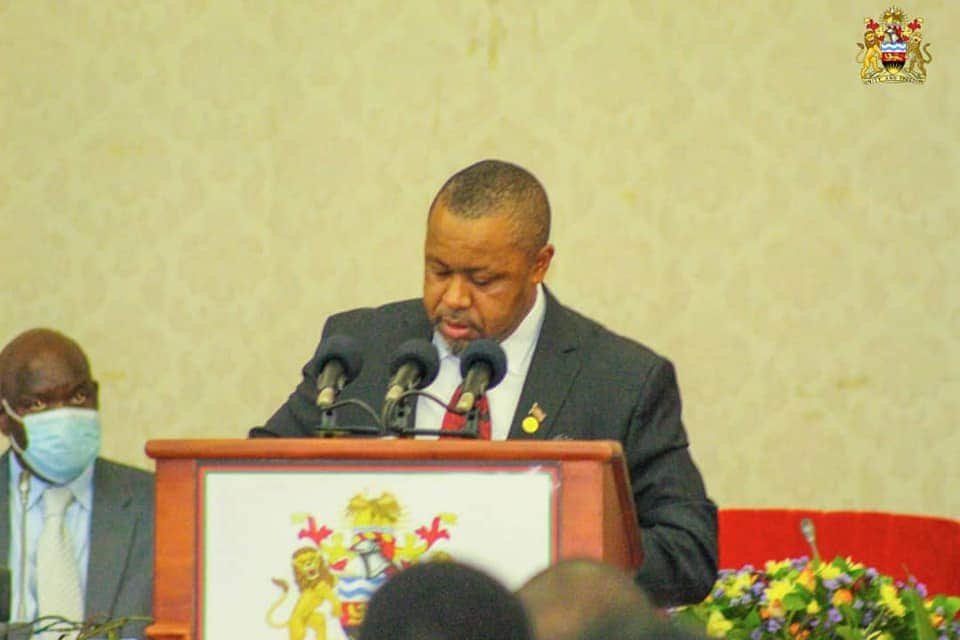
Vice President Chilima in one of the public sector reforms meeting

A brief context to the subject of electricity reforms in Malawi shows that a history of reforms in Malawi can be traced back to the enactment of 1998 Electricity Act, following the repeal of 1963 Act. This act paved the way for the liberalisation of the electricity sector with the aim of encouraging private sector participation. It also resulted into corporatisation of ESCOM and granting of Generation, Transmission and Distribution licences. Over the years further legislation has been introduced such as the Energy Regulation Act 2004 which resulted in the establishment of MERA, and Rural Electrification Act 2004 to provide a framework to facilitate investment into rural areas and thereby increase electricity access.

Despite the reforms, the performance of the sector has remained abysmal to say the least. There has been a lack of investment especially in generation capacity which has hampered socio-economic development at a massive scale. Power supply is erratic, unreliable and prone to hydrological and environmental constraints. The incumbent utilities (ESCOM and EGENCO) have been plagued by financial mismanagement and political interference which has made it difficult for them to attract investment into the sector. According to World Bank estimates, Malawi loses up to 7% of its GDP annually due to power cuts, more than any other country in Africa. In comparison, Kenya, Niger, Madagascar and Benin lose under 2%. Annual loss of 7% in economic output is a huge barrier to achieving sustainable socio-economic development in the country.

The power sector reforms introduced by the Electricity (Amendment) Act 2016 are meant to address the above inadequacies in the sector. To be honest, they are the deepest reforms so far in the power sector which, if implemented properly, may just set us on a path of sustainable investment in the sector by encouraging innovation, diversification and private sector participation. Three main features of the 2016 reforms are the delinking of generation from ESCOM by formation of EGENCO, establishment of a Single Buyer licence (responsible for long term planning and procurement of generation capacity) and establishment of a Market and System Operator. This sort of industry structure is not unique to Malawi, it has been followed by many other countries since the beginning of power reforms in early 1990s. To facilitate participation of Independent Power Producers (IPPs), many countries have had to unbundle the sector in this way (1) because it is relatively easier to introduce a market mechanism and competition in generation rather than in transmission and distribution, (2) to ensure a level playing field and avoiding impartial purchasing and dispatch decisions and/or a perception thereof, by the power off-taker/single buyer entity (ESCOM). For this reason, in my opinion, the suggestion that we should abandon the EGENCO project at this stage and to go back to the previous state of a vertically integrated utility will just set us up on a backward footing. We have had all functions of generation, transmission, distribution and supply under one company before (ESCOM) and we Malawians are all witnesses of the pains that we have had to endure up until this day. So, in all honest, I can’t see what we will be trying to achieve by going back. Let’s stay focused, steady and progressive in our pursuit of healthy investment in this sector. I am very confident that with the determination of the current government, the objectives of the Electricity (Amendment) Act 2016 can be realised.
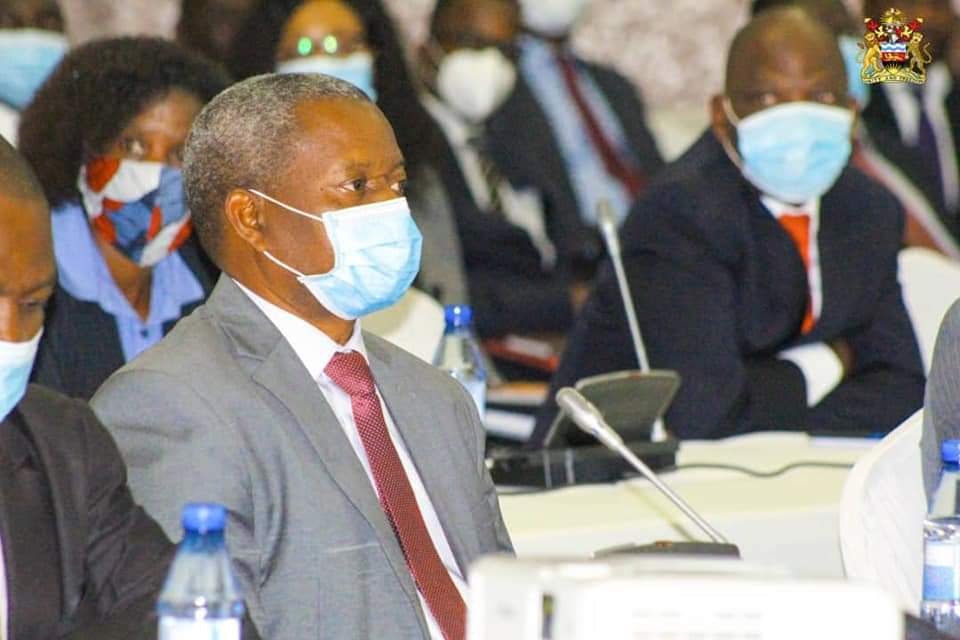
My ask to the Vice President as he is discussing with stakeholders and making key decisions is to resolve the legality of the newly formed state company, Power market Limited (Single Buyer). Section 5 sub section 2 of the Electricity (Amendment) Act 2016 says, and I quote “on commencement of this Act, the Authority shall issue licenses for system and market operation and single buyer to the current holder of transmission and distribution licences.” The current holder of transmission and distribution licences is ESCOM. I am not aware of any other legislation subsequent to the 2016 Act, that may have established the function of a Single Buyer outside the current holder of transmission and distribution licences. Accordingly, we should simply follow the law by operationalising the entity of Single Buyer within ESCOM, rather than creating another company, unless the law is changed. Let me add that other countries which have had success in attracting IPPs in the sub Saharan region such as Uganda, Kenya and Namibia all have single buyer functions within the transmission licensee. Malawi will not be unique by following this structure. Additionally, ring fencing the single buyer entity within ESCOM, would result in lower transaction and agency costs.

The final point I would like to make as we are thinking about operationalising the reforms is the urgent need to address the management and financial health concerns of the incumbent entities, that is, ESCOM and EGENCO. Yes, these entities have talked about the financial challenges they are facing. However, we should look at the bigger picture of how these institutions can operate as commercial entities instead of using the current challenges to try to stifle reforms. I don’t need to repeat here a catalogue of mismanagement, mis procurement, corruption, fuel scandals and political interference which have rendered these institutions financially unsustainable and operationally unstable. These failures have been adequately catalogued in several reports, the current one being “Report on Building and Unleashing ESCOM’s Potential in The New Environment” and many other sources. I am very confident that by addressing these failures, these institutions can return to financial health and profitability and be able to honour obligations to one another and indeed to the IPPs once they become operational.

Maxwell Mulimakwenda is a Manager at National Grid in UK, a multinational energy company operating in UK and US but is writing in his personal capacity. You can address any feedback to mmulimakwenda@yahoo.com

Court to decide on Beach soccer polls

0

The High Court is on July 29 expected to nullify or uphold the Football Association of Malawi (FAM) sanctioned Beach Soccer Association (BSA) elections held yesterday at Nkopola in Mangochi will stand.

BSA yesterday elected new office bearers despite the outgoing executive committee seeking legal action against the elections.

The disgruntled outgoing executive led by immediate past chairperson Kondwani Gondwe, on Friday applied for an injunction stopping the elections.

However, the courts have called for an inter partes hearing on July 29.

Meanwhile, FAM went on with the elections which ushered in new leadership under Gift Chimbalanga.

He defeated Mike Bwanali after amassing 14 votes while his rival got one vote.

Most of the other positions went unopposed as the former executive members led by Gondwe were not on the ballot.

Former Silver Striker and Nyasa Big Bullets defender Panganeni Ndovi was elected vice-chairperson unopposed just like general secretary Wakisa Mwambetania, vice-general secretary Jayne Jella, treasurer Force Ngwira and vice-treasurer Fred Banda.

But Willy Kumilambe was elected organising secretary after defeating Wanangwa Kapapa with 12 votes against three.

Andy Khunga, Samson Malipa and Edwin Mtachi were elected ordinary members.

Asked on his opinion on whether election stand, legal practice lawyer David Kanyenda said in an interview that the court will have to decide.

He said: “Without pre emptying the decision of the court regarding the legality of the electoral process, I would say that as at the time of the elections there existed no court order prohibiting FAM to proceed with the elections.

“But the court will have to examine the facts and the law regarding the case and decide on the legality of the elections.  Broadly speaking, the court may either uphold or nullify the electoral process. The application for injunction is what it is: an application.  The application itself isn’t a court order.”

FAM general secretary Alfred Gunda justified the association’s decision to go on with the elections, saying the courts did not stop them from doing so.

“From my understanding they went to obtain an injunction, but the court has called for inter partes hearing on July 29. Legally, nothing stopped us from holding the elections,” he said.

 Asked what would happen if the court goes ahead and grants the disgruntled outgoing members the injunction on July 29, Gunda said they will take it from there.

“We will cross the bridge when we get there,” he said.

However, the application will likely been thrown out since Fifa does not allow recourse to ordinary courts before exhausting all structures for settling football disputes.

“There are other regulatory issues that arise from the fact of lodging a football dispute in ordinary civil courts,” Kanyenda said.

FAM decided to call for fresh elections which were initially set for Monday, but later rescheduled to yesterday, saying the outgoing executive failed to hold the polls after their mandate expired two years ago.

However, the outgoing executive claims it held the elections that dully extended their mandate in 2018.

Outgoing treasurer Brutus Ndhlovu also said FAM did not inform them of the changes to hold the elections yesterday.

But Gunda said the change had nothing to do with the application for the injunction.

“We felt we should hold the elections on a weekend and not on Monday so that affiliates have a chance to attend,” he said.

BSM has Karonga, Chintheche, Nkhotakota, Southern Region and Central region beach soccer associations as affiliates.

(Reported by Joy Ndovi for The Nation)

The plunder of Malawi

By Emily Mkamanga

It is a fact that the majority of Malawians had wanted change in leadership.  The main driving force was the abject poverty and even more so when they realised that former president Peter Mutharika had no ready solution to get rid of poverty since he had no clue about what and how to do it.  Lastly, he seemed not to know where he was leading the country to.  This is the reason why Mutharika resorted to talking about changing Malawi to a Singapore or USA.  He knew it was impossible to do this but he deliberately wanted people to waste their time in thinking about what Singapore would be like.

The idea of changing a government and most likely a leadership is good.  It exposes the weakness and the malpractices which in case of Malawi brought the country to its knees.  It is public knowledge that people used to talk so much behind the scenes about the plunder in Mutharika’s government.  Officials close to the president were seen getting richer from undisclosed source of money.  It is only now that the leadership of President Lazarus Chakwera and his vice-president Dr Saulos Chilima that the plunder is being exposed.  So far, some unprecedented levels of plunder have been exposed to the extent that with such plunder it was naïve to expect Mutharika to reduce poverty.  Imagine right now the country is littered with vehicles which were dubiously acquired and probably from government by using public money.  They are being abandoned by people who have gotten wind from Chakwera leadership that if found with such stolen vehicles the law will take its course

Currently, the mother of all power abuse has been exposed and that is president Mutharika is alleged to have imported 1 200 000 bags of cement for an Asian businessperson.  By doing this he should have known better that he was denying Malawians the much needed forex.  The other thing is that he was preaching “first buy Malawian” and yet he did not want to promote homemade cement.  As a leader, he was supposed to be exemplary and he failed.  After failing to be exemplary, naturally the people close to him followed suit to plunder the country while expecting no one to point an accusing finger at them.  In fact, president Mutharika seemed to have been surrounded by untouchables.

Honestly speaking, the alleged plunder by Democratic Progressive Party (DPP) led government had never been seen before in the country.  Imagine while civil servants are crying for promotion and many more people cannot be employed in the civil service because of lack of money, it is alleged DPP cadets, some hand clappers, dancers and musicians were on civil servant pay roll.  It is so disheartening to know that their salaries were higher than that of university graduates and yet these people could hardly write. 

This was very demeaning to the educated people.  It is a common knowledge that the government had ghost workers on their payroll and this is why the problem was never sorted out.  It cannot be said enough that running a party in power using taxpayers’ money is totally unacceptable.

During plunder in Mutharika’s government people could build mansions and buy a lot of expensive cars and other things on the assumption that Malawians were blind to this.

Let Chakwera’s government bring to book all the people suspected to have taken part in plundering the nation and above all let them pay back.  Never again in this country should a leader be at the fore front of plunders

(Original article appeared in Malawi Nation)

DPP confident of winning 2025 elections-Msaka

0

The loss of election of Democratic Progressive Party (DPP) on 23 June 2020 to Tonse Alliance energizes the party to go back to the drawing board to “amass more charms” that will help it to bounce back in 2025 come rain or sunshine.

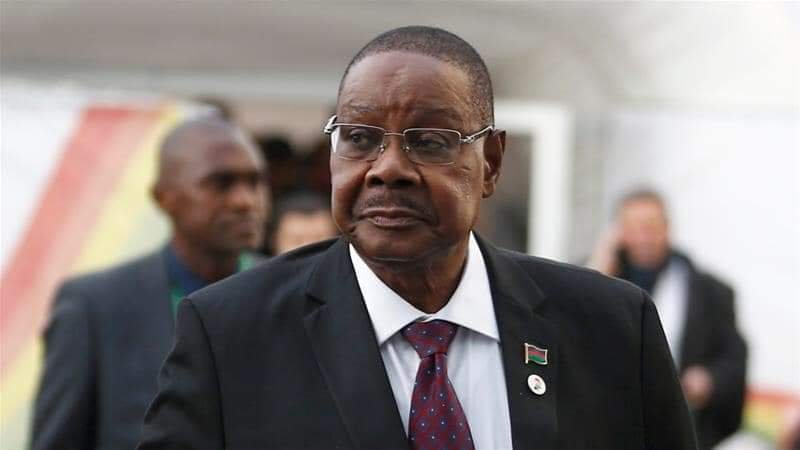
The party’s eastern region Vice-President, Bright Msaka said this on Wednesday after visiting former president, Peter Mutharika at his residence, Namiyasi in Mangochi, where Mutharika chose to settle after being ousted from government.

“The loss has energized the party to be more resolute to start rebuilding itself for the next election. I am telling you people are angry with the loss and they are gearing to reclaim the lost glory with utmost faith,” emphasized Msaka.

He said DPP is probably the most giant party in the country which has more people, hence, he sees it wining with landslide votes in the coming general elections.

“We are going to the drawing board to see what went wrong that divorced us with the electorate. We are certain to come up with solutions or strategies that will help us to win back the hearts of Malawians,” said Msaka who led the party’s top leaders to the home of their president.

Commenting on the visit, the vice-president said they wanted to welcome Mutharika who chose to lead a private life in the lakeshore district after losing the election.

Bright Msaka

“It is a custom within our communities to receive a visitor whenever he/she has joined people. As you can see, our president has joined us; hence, we felt a social responsibility to come here to welcome him and his family including the former first lady, Gertrude Mutharika,” he explained.

Msaka, who wore a smiling face during the interview, described Mutharika’s mood as jovial and relaxed, saying this shows that the octogenarian has accepted defeat and embraced life.

“I am happy to find the president and his wife in a jovial and relaxed mood. We have cracked jokes, chatted and discussed pertinent issues regarding our party, among other issues without noticing sad moments from him and his wife,” he said

Msaka hailed Mutharika for choosing to settle down his life in a simple manner in Mangochi, saying this shows how great the former President was.

He also announced that the party leaders at central level will soon meet to make replacement of the position of eastern regional governor, Julius Paipi who has joined UTM.

Apart from Msaka, other party leaders who visited Mutharika were director of women (East) Eluby Kandewu, Mangochi District Governor, Salire Mdala, deputy secretary general, Charles Jika and Mangochi Central legislator, Victoria Kingstone.

Kingsotne, whose constituency falls the jurisdiction where Mutharika is staying said the visit was to welcome the president and assure him of their support and presence at all times.

Chakwera warns Tonse alliance partners over corruption -he will spare noone

0

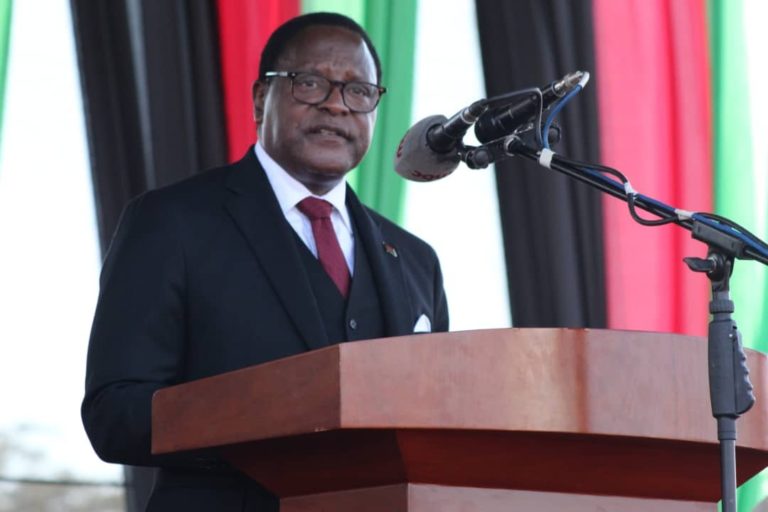
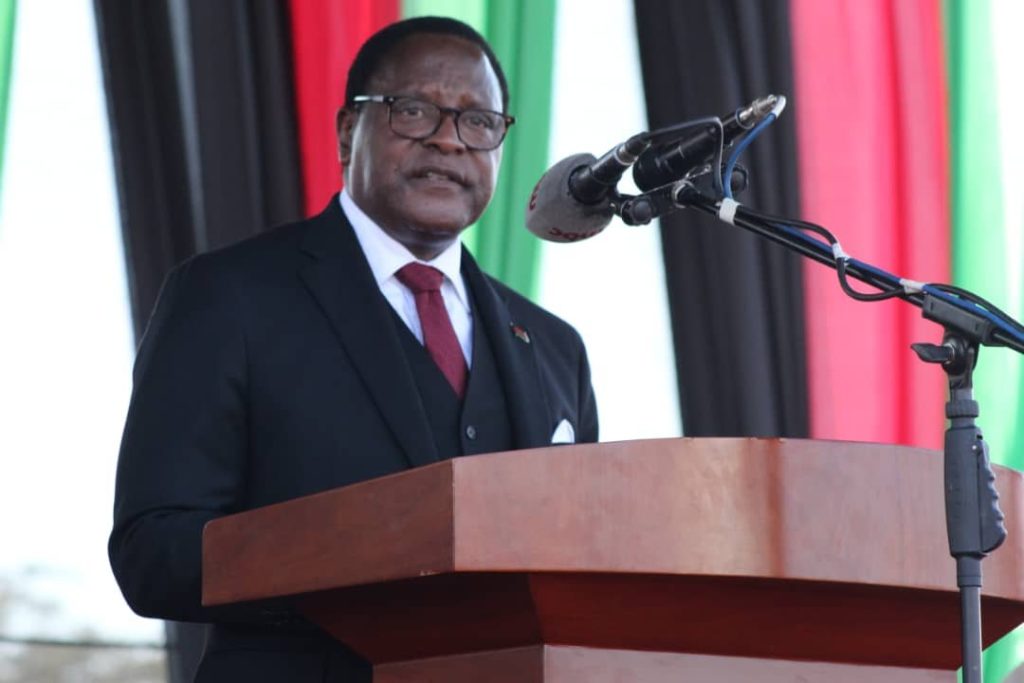
President Lazarus Chakwera has fired warning shots to the  governing Tonse Alliance partners that he would not shield anyone involved in corruption and plunder of government money because they helped him win the presidential election.

The Malawi leader stressed that he will not tolerate corruption at any level and ordered that all corrupt  offenders should be punished accordingly.

Chakwera said this during his weekly special program on the state run Malawi Broadcasting Corporation called Malawi Watsopano.

“Let me say that my government will not allow our alliance partners to engage in corruption or plunder of government money in the name that they helped me win the election, we will prosecute anyone,” he said.

President Dr Lazarus Chakwera

Chakwera said the state is not after names in the fight against corruption and plunder of public resources.

“We are not after names; we will pounce on anyone who is in conflict with the law.  We will not look at the status of a person in the society, we will not look at the position or how powerful one is, there is no untouchable in this fight,” he said.

He said his job of what he described as clearing the rubble needs patience but bravery to achieve its goal, saying the fight against corruption cannot be win within a very short period of time.

The President said he will not allow people in the country to enrich themselves dubiously, warning that all the culprits will not be left scot-free.