In what has been described as government commitment in reinforcing peace and unity, Civic Education and National Minister Timothy Mtambo, has started taking necessary steps with the aim of healing the country of its past wounds. The Minister was in Mangochi on Tuesday where he held strategic meetings with all Senior Chiefs and Traditional Authorities from across Mangochi; the family members of the late Henry Masauko Chipembere and visited Moto Village.
Mtambo first stop was meeting chiefs from the district where they discussed issues of the past and other contemporary issues that have a critical bearing on the country’s found initiative of reinforcing peace and unity. The minister then took time to visit and meet family members of the Henry Masauko Chipembere. Chipembere was a cabinet minister who in 1964 amidst the cabinet crisis fell out with the then leader of Malawi Hastings Banda. He went into exile and died in United States in 1975
Speaking of the visit Mtambo said “Chipembere was one of the revolutionary nationalists who, in their young ages, pledged themselves to fight for an independent Malawi. He was part of the movement comprised of young and intelligent Patriotic citizens who came from all the different regions of our country. They never thrived on regionalism, a vice that has strangely visited our political field soon after self-rule. It is a vice that, under the new Malawi that we want, the administration of His Excellency Dr. Lazarus Chakwera is dedicated to root out”
Mtambo’s last stop was meeting the residents of Moto Village. The village is known to have suffered an atrocious ordeal when houses of the entire village were razed down with fire during the one-party era, with some residents including women detained.
“The ordeal presents a sample of tragic wounds which need proper healing in order to move together as a united and peaceful people. It is pleasing to note that the people have welcomed the Government’s initiative of reaching out to them and reconcile a new chapter of peace, love, togetherness and unity. ” said Mtambo.
Mtambo in Mangochi
The villagers took opportunity to voice their concerns accusing the pitiful conduct of some politicians who come to them during each campaign period, just to remind them of what they had gone through, thereby denying their wounds a chance to heal. They highlighted that once voting finishes, the politicians never returned to them to deliver development. The state of affairs in this community it deplorable. The community lacks proper roads and other essential public facilities like clinics, school and potable water. The Minister assured the residents of Moto village that the President of this country Dr Lazarus Chakwera, who sent him to visit them, is committed to draw a new chapter for their community.
Minister of Trade, Sosten Gwengwe has said the construction of the One stop border post at Mchinji/Mwami-Zambia border would ease cross border trade between the two countries.
According to the Team Leader of the Supervision at the One Stop Border project, Thomas Zilly, the Covid-19 pandemic delayed the construction, but the construction work would be completed by December 2020.
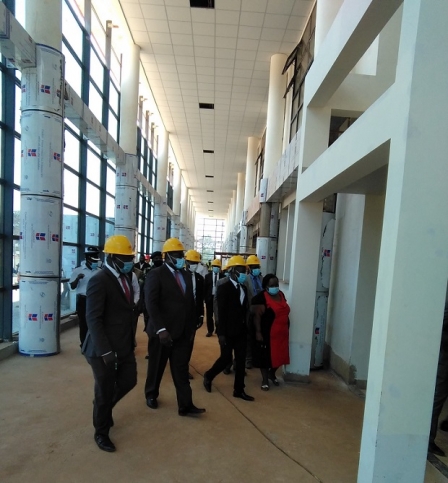
Kachale Banda and Gwengwe touring the site
The Minister was speaking in Mchinji on Tuesday, when he, together with Minister of Industry Roy Kachale Banda visited Malawi Bureau of Standards (MBS) offices and the new one stop border post construction site.
“We visited the post which is funded by African Development Bank (AfDB), I am impressed with the construction work done so far, these structures will help our traders move their goods to Zambia and back without delays,” Gwengwe said.
“We expect an increase in the movement of the goods between the two countries, we want to export more to Zambia especially agriculture value added products,” he said.
Gwengwe said the One stop border post would help agencies working at the border such as the MBS, Malawi Revenue Authority (MRA) and Immigration have enough space to work.
Minister of Industry Roy Kachale said the newly constructed border post will help curb smuggling of goods using unchartered routes.
“We get reports from beverage, alcohol and confectionery industries in the country, that there was a lot of smuggling going on at Mchinji border, where traders use alternative routes,” he said.
Kachale said having toured the building under construction and having seen the facilities under construction he was impressed, but it would be a misfit if these facilities would not be used because of such traders.
“As a Ministry, we need to protect our industry, we are putting our industry at a disadvantage because issues of tax, quality inspection by MBS are by passed and this will render this building useless, if this is not checked,” he added.
Director General of MBS, Simon Mandala said the organisation ensures that the goods that are crossing the border into the country meet the required relevant standards.
“If the country has to export and import goods, the goods have to be checked that’s how trade can be facilitated, the coming in of the new facility, will help MBS to have adequate space that it needs to conduct its operations,” he said
That Malawi’s population is growing at an alarming rate is naked truth. The country’s population has more than trebled in the past 20 years.
That has put unprecedented pressure on social service delivery and the environment.
With this population boom, the arable land size has also been dwindling. The result is that many households are often hit by hunger every year.
As if this is no impediment enough, child marriage cases keep sky-diving, and the result is a prolonged child bearing period among women.
Mchinji District, which is one of the country’s border districts, is rated as one of the places with highest child marriage cases.
According to United Nation’s Population Fund (UNPF) data, which Mchinji District Social Welfare Office is in possession of, the district has the second highest record of teenage and child marriage cases in Malawi after Ntchisi.
Tidziwenji (not real name) is a 16 year old girl in the area of Traditional Authority Nyoka in the district. She has just given birth to a baby girl.
She was due to sit for her Primary School Leaving Certificate Examinations (PSLCE) this year, but has pulled out of school to nurse her pregnancy.
Her baby is just two months old. Tidziwenji’s case is just a page of teenage and child marriage cases that would probably fill up a book.
While organisations and other stakeholders which work to promote girl child welfare might feel overwhelmed with the teenage and child marriage scale, the young girls have their own tales to share. The reasons they give might not make sense. Ndaziona (not real name) is yet another girl in the same district. But unlike Tidziwenji, she has never become pregnant.
Hanna Mangani
The 17-year-old form-two girl fled her home because of what she terms as lack of parental care.
She is one of the ten children her parents gave birth to. She says marriage was just the relief she found, unlike staying in a small hut that forced them to struggle in almost anything.
To her, what compounded matters was lack of school fees. She was sent out of school for not paying tuition fees.
“I left school and got married with my boyfriend because my parents failed to pay my school fees, so I just left home and followed my boyfriend to his house,” she says.
Tidziwenji and Ndaziona’s stories are among scores of other stories of teenage pregnancies and child marriages Mchinji District has recorded recently.
The data available with stakeholders working in the field of child protection in the district are appalling.
For example, the Social Welfare Office says over 538 girls got pregnant between March and July this year (2020) while over 418 others went into marriages.
The District Education Office has also recorded over 79 teenage pregnancies.
The data also shows that 19 primary school boys have entered marriages whilst over 87 primary school girls also got married.
Furthermore, the data recorded by the District Health System shows that from March to June, over 411 teenage girls sought antenatal services with health centres in the district.
The figures are too high compared to the same period last year (2019), according Mchinji District Coordinator for Youth Friendly Health Services, Agness Jalafi. She feels the trend may be attributed to the COVID-19 pandemic.
“Since March after school closure, our health facilities have been recording high numbers of teenage girls seeking antenatal services.
“From March to May, we recorded about 368 cases, and by June, we had recorded over 411 cases,” she explains.
“The trend may explain why we have low youth uptake of contraceptive methods which currently is below 20 per cent,” she adds.
Jalafi says there is need for more efforts to encourage the youth to access youth-friendly health services of which youth- friendly contraceptive methods are part.
She says such efforts can reverse the current trend.
But Assistant Social Welfare Officer in the district, Hanna Mangani, believes the fight against teenage pregnancies and child marriages will be in vain if parents do not take their responsibilities.
She says as a Social Welfare Office, they meet numerous challenges in course of their duties to track child marriage cases.
“As Social Welfare Office, we work hand in hand with the police in tracking down such the cases.
“But one of the impeding issues we meet is that parents often shield the cases by changing children’s ages, which becomes a challenge to succeed with the case in the court of law,” she explains.
James Mauzauza is a Community Service Officer at Mchinji Magistrate Court. He believes that the problem lies with the cultural setup in communities.
He proposes that community structures must be sensitised on the available legislation against early or child marriages.
“Though we have good laws in place, communities have their own benchmarks where they look at teenage pregnancies and child marriages as normal.
“We have the Marriage, Divorce and Family Relations Law which is supposed to take its course on such matters, but our courts hardly receive such cases,” he says.
Community Initiative for Social Empowerment (CISE) has been working in the district for a couple of years now.
The organisation has been promoting girl-child education, part of which has been fighting child marriages.
According to CISE’s Executive Director, Margaret Sapezeka, despite the various interventions implemented by the organisation to reverse the trend, results of the efforts have been too negligible.
“We have been promoting girl-child education where we have facilitated Go-back-to school initiatives with community structures.
“However, that has not worked much since we did not include an economic empowerment aspect crucial to the fight since most girls cite poverty as the main driver of the vices,” she says.
Responding to the need, CISE partnered with Journalists Association against AIDS (JOURNAIDS) in a project ‘Enhancing Accountability in Ending Early or Forced Marriages in Mchinji, courtesy of Grand Challenges Canada.
In the project, CISE and JOURNAIDS are giving out soft loans to teen mothers through girls clubs called Girls Action Groups (GAG).
So far, the organisations have rolled out the first phase of the loan facility to the tune of K1 million. “We feel that this revolving loan that we have launched here in Mchinji will help teen mothers economically and make independent decisions,” said JOURNAIDS Programs Manager, Dingani Mithi during the project launch.
He said the facility would also help the teen mothers to resist temptations of entering marriages, a trend which has been rampant in Mchinji.
A 20-year-old Lonely Kaima from Chibwana in T.A. Mlonyeni is one of the beneficiaries in the first phase of the loan.
Kaima was forced to quit school and become a bread winner by her parents. She then went to Lilongwe to work as a housemaid where she became pregnant. Her child is about three years now.
“I have been a victim of poverty. I was coerced into doing things that made me become a mother because of family poverty.
“But this loan will help me start up a good business to sustain my life.
“I have a business plan which requires MK 100 000. I intend to use the same to start a cotton wrapper business which will involve travelling between Malawi and Zambia,” she says.
In the project, loans will be given to young mothers who are also change agents, those who mentor and inspire other teen age girls.
The loan will be administered by Mchinji Civil Service SACCO at a 3.6 per cent interest rate.
With more of such initiatives, perhaps young girls like Ndaziona of T.A. Nyoka in the district may not be forced into early marriages due to poverty if the initiatives are scaled up.
Minister of Information, Gospel Kazako has urged the media in the country to avoid indulging in corrupt practices as they are custodians of sanity.
Kazako gave the advice on Tuesday in Blantyre during a National Anti-Corruption Strategy II (NACS) dissemination workshop for the media aimed at updating the practitioners with anti-corruption knowledge.
He said people in the country have lost confidence in almost everyone; hence, the need for the media to take a leading role in addressing the ‘cancer.’
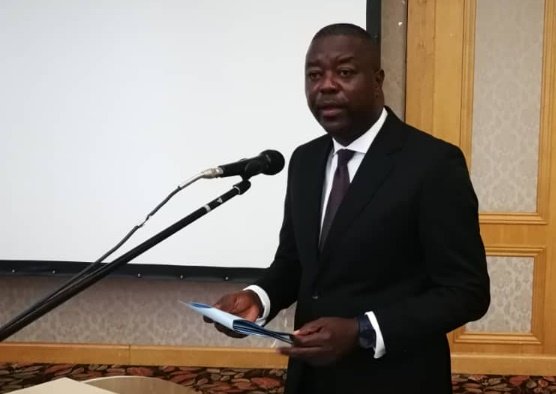
“Corruption is a challenge to any country’s development because it creates social injustice as it diverts resources meant for Malawians to a few individual’s pockets. Therefore, the media is a very powerful partner that helps expose corruption and the public holds you highly,” said Kazako.
He added: “As the media, please refrain from writing good stories just because you have been paid to do so because it will land you in trouble one day; the world is bigger than you. Above all, you will do the nation a lot of justice if you report corruption regardless of who is involved.”
Anti-Corruption Bureau (ACB) Director General, Reyneck Matemba, described the media as a trusted partner in spreading corruption messages as such the two (ACB and the media) needed to cultivate a very good working relationship.
“According to a recent research by Institute of Opinion and Research (IPOR), the media beat ACB in fighting corruption as they don’t only expose but also demand answers on behalf of the public. The media is our trusted partner in dealing with corruption,” said Matemba.
The NACS II was launched in December, 2019 in order to promote good governance and improved service delivery in Malawi through a coherent and effective approach to fighting corruption.
The workshop has been supported by Open Society Institute of Southern Africa (OSISA).
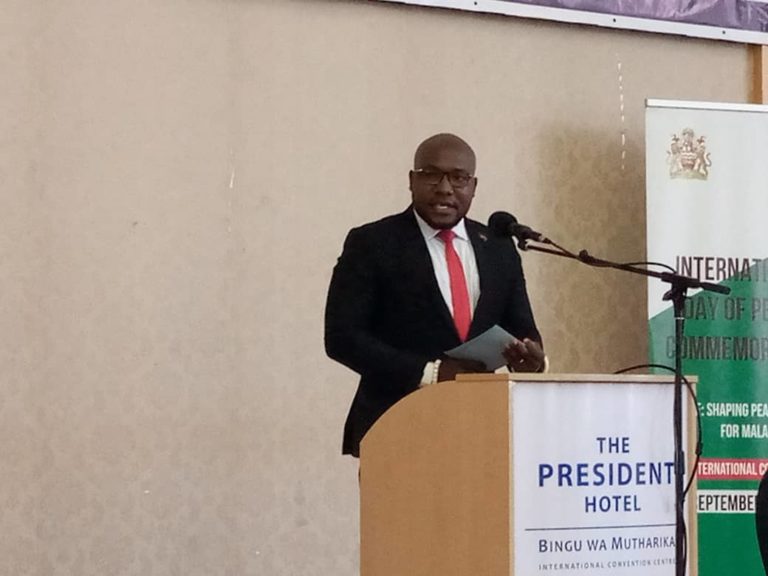
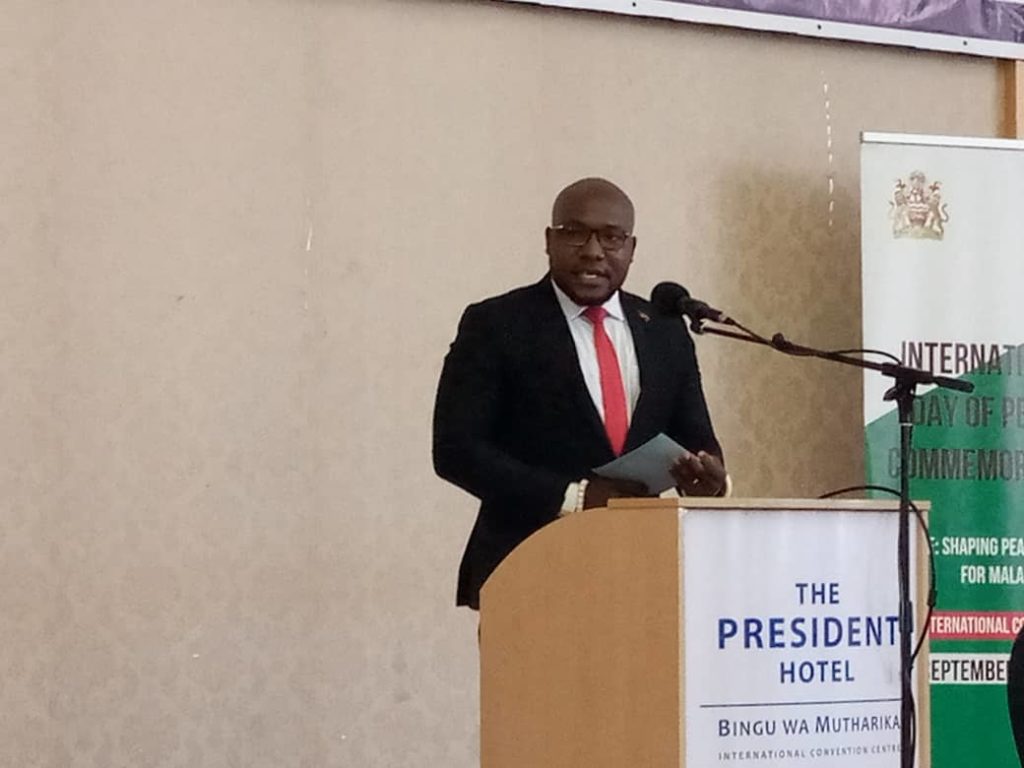
The Minister of Civic Education and National Unity has said Malawi government will remain steadfast in its support of peace within the country as well as with our neighbours. He was speaking at the Official opening 2020 international day of peace commemoration conference on Monday at BICC in Lilongwe.
International day of peace was set aside by the United Nations General Assembly, as a day dedicated to advancing the ideals of peace. The day is being commemorated under the global theme: “Shaping Peace Together.”However, Malawi decided to commemorate the day under the localized theme: “Shaping Peace Together for Malawi”.
Mtambo said this year’s commemoration has come at a time when Malawians have ushered in a new Tonse Alliance Government, which has renewed commitment to unite Malawians as one of the five principles of the current leadership’s Super Hi5 Agenda. Govt has established the Ministry of Civic Education and National Unity and gave it a mandate of creating a conducive environment for civic empowerment of Malawians and promoting sustainable peace and unity among them for sustainable national development
Civic Education Minister: Timothy Mtambo
At the event which was also attended by United Nations Resident Coordinator Madame Maria Jose Torres, Mtambo said this commemoration is coming at a time when Government, with support from the UN, has completed the process of developing a Bill to formally establish the Malawi Peace and Unity Commission as a national pillar for peace building, social cohesion and conflict resolution. The Bill which in due course will be tabled in Parliament for enactment will see infrastructure for peace for Malawi rolled out. It will also see the Malawi Peace and Unity Commission and District Peace Committees established to work in collaboration with all stakeholders to ensure that the country remains peaceful and united.
The minister also pinpointed a number of areas that government through his ministry have been working on. He highlighted that The Department of Civic Education has been revamped to take on a more proactive role of coordinating transformative civic education and engagement of Malawians to participate in governance as a way of enhancing national unity and peace. He also announced that a Department of National Unity has been established in the Ministry to work towards enhancement of national unity through promotion of patriotism, national identity, national symbols, and resolution of conflicts through collaborative means. The Department is also housing the National Peace Architecture initiative, which was previously housed in the Office of President and Cabinet (OPC).
He reassured people that Tonse administration will do all it can to make sure that peace prevails not only in Malawi but throughout the SADC region as well. Mtambo said the past hasn’t been pleasant as far as peace is concerned but that a new beginning is needed.
“I will not labour you to reflect on old history but let us critically look at our recent past. We all know that the birth of the third republic we are talking about today has been preceded by an unfair electoral process, court battles, nationwide protests, attacks and threats against human rights defenders and political opponents, mob justice, abuse of government institutions for selfish political interests, corruption and unequitable distribution of resources”. Mtambo said It is not a secret that Malawi national peace was threatened by such a background.
The minister took time to commend the UN Family in Malawi for the unwavering support that they continue to render towards the development of the country. The Ministry of Civic Education and National Unity has inherited a National Peace Architecture coordinating structure, which is wholly supported by the UN family in Malawi