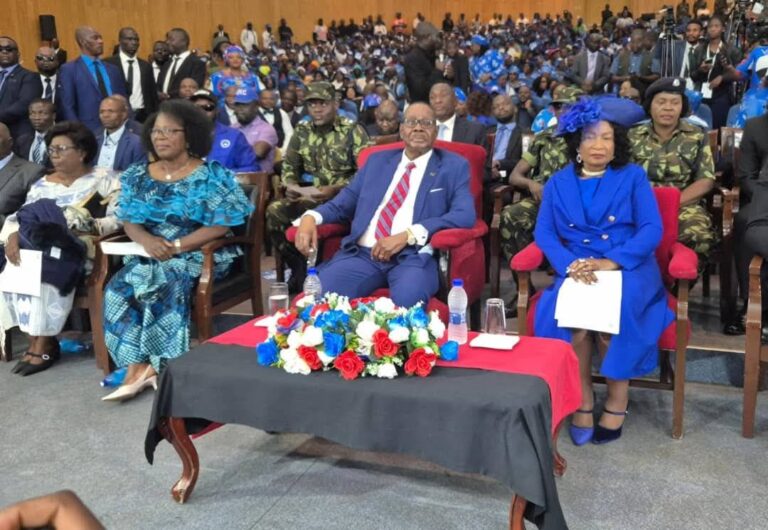
Malawi’s Minister of Basic and Secondary Education, Madalitso Kambauwa Wirima, has praised the smooth administration of the 2025 Malawi School Certificate of Education (MSCE) examinations.
After inspecting the final subject at Bwaila Secondary School in Lilongwe, Minister Wirima described the exams as a success, thanking teachers, security personnel, and all stakeholders involved.
Kambauwa
“The ministry’s goal was to ensure no setbacks during the exams, and fortunately, everyone played their role optimally, making sure the exams ran smoothly without any issues that could have derailed the process,” Minister Wirima said. She emphasized the importance of education in achieving Malawi’s 2063 development agenda.
This year’s MSCE exams saw a record 202,940 candidates register, comprising 97,489 females and 105,451 males.
Minister Wirima’s commendation underscores the ministry’s commitment to maintaining the integrity of national exams.
The Democratic Progressive Party (DPP) presidential candidate, Professor Arthur Peter Mutharika, has officially named Dr. Jane Ansah as his running mate for the September 16, 2025, election.
This announcement has stirred political interest and sent a strong message about the direction and tone of the DPP campaign ahead of the polls.
Dr. Jane Ansah is no stranger to Malawi’s political and legal landscape, having served as a distinguished lawyer, Justice of the Supreme Court, Attorney General, and Chairperson of the Malawi Electoral Commission (MEC).
Jane Ansah
Her selection as running mate is a calculated move that blends legal expertise, institutional experience, and a deep understanding of governance.
From a strategic standpoint, her appointment could appeal to educated voters, legal professionals, the clergy, and middle-class Malawians who value stability, order, and legal competence.
Her previous role as MEC Chairperson, although controversial, demonstrated her ability to withstand immense political pressure and maintain institutional composure in volatile times.
She brings to the ticket a sense of discipline, composure, and intellectual clarity, qualities that may complement Mutharika’s elder statesman image and appeal to voters seeking experience over populism.
Gender dynamics also play a critical role in this decision, as her nomination may attract support from women and gender equality advocates who have long demanded meaningful representation of women at the highest levels of power.
With Dr. Ansah on the ticket, the DPP can claim to be promoting inclusive leadership and demonstrating confidence in women’s capacity to serve in the executive arm of government.
Her appointment also sends a powerful message to younger Malawians, particularly young women, that competence, professionalism, and legal integrity can open doors to national leadership.
For Mutharika, this selection signals a campaign that seeks to prioritize governance reforms, constitutional order, and a return to structured leadership grounded in law and institutionalism.
Critics of the decision may point to her controversial tenure at MEC during the 2019 elections, which led to the nullification of presidential results by the Constitutional Court.
However, Mutharika appears to be reframing her past experience as a testament to resilience rather than failure, suggesting that she is well-equipped to navigate high-pressure political environments.
By embracing a candidate who has been both praised and criticized, the DPP is attempting to portray boldness, reconciliation, and national healing within the context of legal tradition.
Dr. Ansah’s deep familiarity with electoral systems and constitutional law will also be an asset in ensuring the DPP’s campaign remains legally compliant and technically robust.
Her selection enhances the DPP’s image as a party that values intellectual leadership, constitutional literacy, and national unity.
In sum, Professor Arthur Peter Mutharika’s choice of Dr. Jane Ansah as running mate is not just symbolic—it is a substantive and strategic step designed to position the DPP as the most credible alternative to the current administration.
Whether this move translates into political mileage will depend on how well the campaign communicates her strengths and redefines her controversial past into a leadership asset.
Nonetheless, the DPP has taken a bold and thoughtful approach, signalling a return to serious, grounded leadership ahead of the September 2025 election.
Peter Mutharika’s decision to name Jane Ansah as his running mate for the forthcoming elections—confirmed today with the submission of nomination papers at BICC—is a grave miscalculation. From her tainted legacy as the architect of Malawi’s infamous “Tippex election” to her divisive role within the DPP, Ansah symbolizes everything wrong with the party’s refusal to reform.
A Legacy of Electoral Fraud Ansah’s tenure as Malawi Electoral Commission (MEC) chairperson was marred by brazen irregularities, including the widespread use of Tippex to alter vote tallies in the 2019 polls. Despite her claims of a “free and fair” election, courts annulled the results, citing “widespread incompetence” and “gross negligence” under her watch . Her appointment now is a slap in the face to Malawians who demanded accountability—and a gift to opposition campaigns branding DPP as a party of cheats.
A Branding Disaster for DPP From a marketing perspective, Ansah’s selection reinforces the DPP’s toxic identity: a party that tried to clinge to power through manipulation rather than merit. Her name is synonymous with electoral fraud, making her an easy target for opponents painting Mutharika’s camp as desperate and out of touch . Even worse, she lacks a grassroots following, failing to galvanize women or youth voters—key demographics in a tight race.
Jane Ansah
Betrayal of DPP Loyalists Ansah’s nomination is a direct insult to party loyalists like Everton Chimulirenji, whose primary victory in Ntcheu North was controversially overturned to favor her . This move exposes DPP’s internal rot: a leadership that rewards cronyism over democracy, alienating its own base. Meanwhile, the party’s failure to unite behind a credible successor—like Dalitso Kabambe, who was frustrated by the inner circle of Gertrude Mutharika and Chisale sid—reveals a deeper crisis of vision .
A Losing Strategy Mutharika’s gamble on Ansah reeks of stagnation. Malawi needs fresh leadership to tackle economic collapse and corruption, yet DPP offers a relic of past failures. With opposition alliances consolidating and public trust in Ansah nonexistent, this ticket is less a revival and more a surrender.
In summary, Jane Ansah is not the answer—not for Malawi, and certainly not for a DPP drowning in its own contradictions.
Professor Arthur Peter Mutharika, the presidential candidate for the Democratic Progressive Party (DPP), has officially presented his nomination papers to the Malawi Electoral Commission (MEC).
The submission took place at the Bingu International Convention Centre (BICC) in Lilongwe on Thursday, 25 July 2025.
Mutharika arrived at the venue to a thunderous welcome from DPP supporters dressed in blue party regalia.
He was accompanied by senior party officials, legal advisors, and his newly unveiled running mate, Dr Jane Ansah.
The MEC Chairperson and other electoral officials received the documents and confirmed that the initial verification process was successfully completed.
Mutharika took time to address the media after the submission, stating that his candidacy represents a renewed commitment to restoring economic stability, governance, and national pride.
He expressed confidence in his running mate, Dr Ansah, citing her legal acumen and track record in public service.
He also assured Malawians of a peaceful and issue-based campaign ahead of the September 16 polls.
Security at the BICC was tight, with police and MEC marshals ensuring order as party supporters lined the premises chanting DPP slogans.
The presentation of nomination papers is a constitutional requirement for all presidential aspirants contesting in the 2025 General Elections.
It marks a critical step in the electoral calendar, as MEC moves toward the validation and publication of eligible candidates.
The event drew national attention, with live media coverage and commentary from political analysts and civil society observers.
Mutharika’s submission now places him officially in the race, returning to the political frontline after his 2020 electoral defeat.
Concluding Analysis
Mutharika’s formal entry into the 2025 presidential race sets the tone for what is likely to be one of Malawi’s most competitive elections in recent history.
While his loyal base sees him as a symbol of experienced leadership and a stabilizing force amid economic hardship, critics question whether his return reflects progress or regression.
With Dr Jane Ansah as his running mate—a move both bold and controversial—the DPP has positioned itself as both defiant and deliberate.
Whether this strategy will rekindle the party’s national appeal or deepen political divisions remains to be seen, but one thing is clear: the race to Sanjika is now officially underway.
A senior lecturer in statistics at the University of Malawi (UNIMA), Dr. Tsilizani Mwalimu Kaombe ,has raised concerns over the integrity of data captured during the voter registration process, following revelations that more than 14,000 duplicate entries were recorded in the system.
In a Facebook post seen by this publication, Kaombe has expressed dismay over the incident, citing that in a well-designed data collection system such as those developed using tools like ODK or CSPro such a high number of duplicate registrations should not occur if proper logical checks are in place.
“In a well-programmed data capturing tool like ODK or CSPro, with clear logical checks, having over 14,000 contaminated records due to repeated entries should raise serious concerns.
“It is unclear whether each of the 14,000 individuals registered twice, three times, or even more, but what is evident is that they registered multiple times,”says kaombe.
The lecturer emphasizes that responsibility should not only rest on the individuals who committed the act_an offense under electoral law but also on those who designed and managed the voter registration system.
He specifically points to the need for accountability from the developers of the Smartmatic application used by the Malawi Electoral Commission (MEC), as well as MEC’s own ICT team, programmers, network and data managers.
“MEC should hold accountable the designers of the Smartmatic app, alongside its own ICT team and related officials, for allowing such a significant failure.The commission should also report the 14,000 individuals to police for appropriate legal action,” he adds.
While the MEC has not yet issued a detailed public statement addressing the technical aspects of the data duplication, the matter has ignited widespread debate over the reliability of digital voter registration systems and the preparedness of institutions tasked with safeguarding electoral integrity.
The development comes as the country gears up for September 16 general elections, with stakeholders calling for immediate improvements in data security, system auditing, and accountability across all levels of the electoral process.