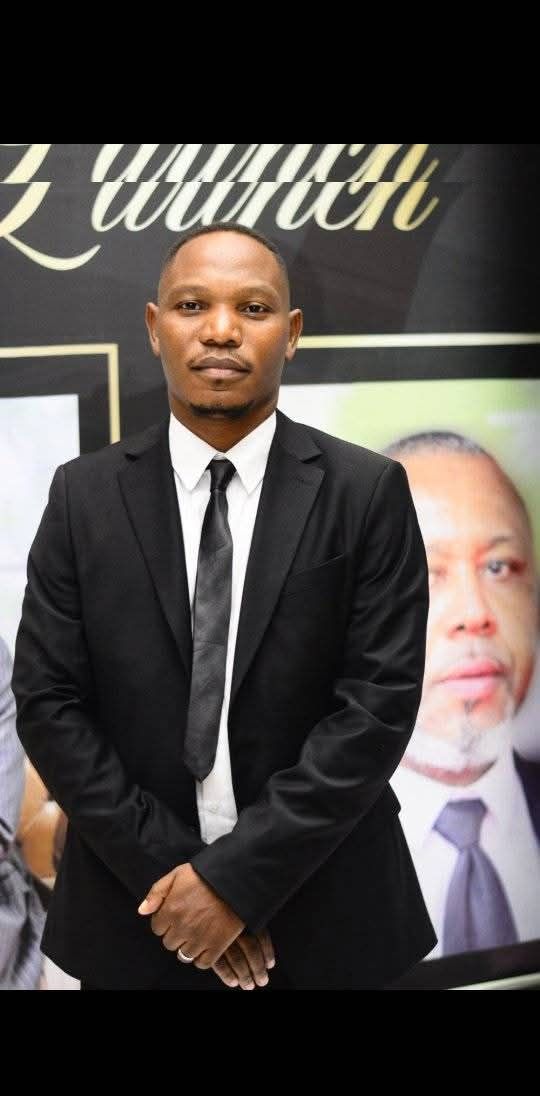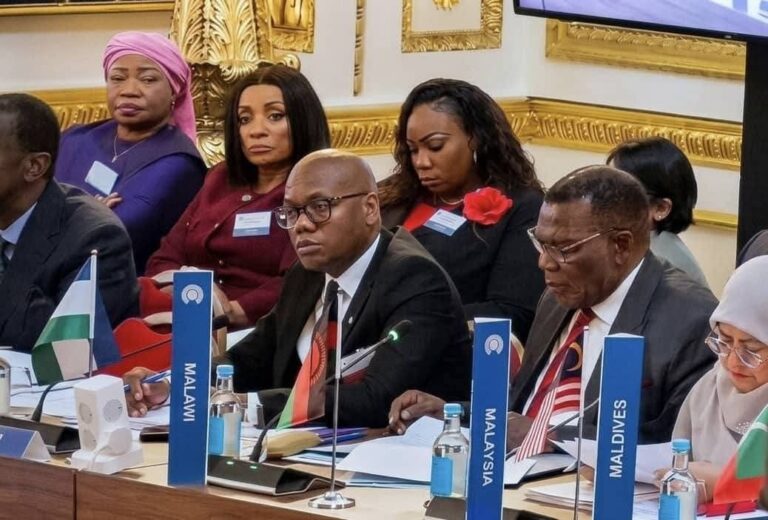
Bright Msaka has officially taken the oath of office as Malawi’s new Minister of Education, Technology, and Innovation, marking the start of his tenure in the cabinet.
In addition to the oath of office, Msaka also took the oath of allegiance, pledging to serve the people of Malawi with dedication, integrity, and commitment to national development.
Msaka taking oath
His appointment comes at a time when the Ministry of Education faces the dual challenges of improving educational standards and expanding access to technology and innovation nationwide.
Observers note that Msaka’s leadership will be closely watched as stakeholders in education, technology, and innovation sectors hope for practical reforms and increased investment in these critical areas.
The swearing-in ceremony was attended by government officials, colleagues, and supporters who expressed confidence that Msaka has the vision and experience to steer the ministry toward meaningful progress.
As the new minister assumes office, many Malawians are looking forward to initiatives that will enhance learning outcomes, promote technological literacy, and support innovation-driven growth across the country.
Bright Msaka’s tenure will be evaluated on his ability to implement policies that address current challenges in the education sector, modernize technological infrastructure, and foster innovation to improve Malawi’s competitiveness regionally and globally.
His assumption of office signals a renewed commitment by the government to strengthen education and technology as pillars of national development and economic empowerment.
With the formal oath now taken, Minister Bright Msaka is officially ready to lead the ministry, set strategic priorities, and deliver on promises to improve education, embrace innovation, and harness technology for Malawi’s future.
The African Union Commission Chairperson, Mahmoud Ali Youssouf, has congratulated President Samia Suluhu Hassan on her election victory in Tanzania, despite ongoing unrest and reports of violence in several parts of the country.
In an official statement issued on Saturday, Youssouf expressed “deep regret” over the loss of human life during the post-election protests that erupted following the disputed results.
He called for calm, restraint, and dialogue, urging all parties to respect human rights and uphold the principles of peaceful assembly as enshrined in the African Union Charter.
Suluhu
The AU Chairperson reaffirmed the organization’s commitment to supporting Tanzania’s peace, unity, and democratic process, emphasizing that stability remains a cornerstone of Africa’s collective progress.
However, the AU’s congratulatory message has sparked widespread outrage, particularly among young Africans and democracy advocates, who accuse the organization of legitimizing authoritarian rule and ignoring the suffering of ordinary citizens.
Critics have described the African Union as an “enemy of African youth and development”, arguing that the body has lost credibility by siding with oppressive regimes rather than standing with the people.
Social media has been flooded with posts condemning the AU’s stance, with hashtags such as #Shameful, #AfricanUnion, and #Tanzania trending across multiple platforms.
Many commentators view the AU’s reaction as tone-deaf and complicit, given that the post-election violence in Tanzania has reportedly left scores dead and hundreds detained.
The election, which saw President Samia Suluhu declared the winner with nearly 98% of the vote, has been widely criticized by opposition groups and human rights organizations for lack of transparency and suppression of dissent.
Protesters in cities such as Dar es Salaam, Arusha, and Mwanza continue to defy government warnings, calling for accountability, fresh elections, and the release of detained opposition leaders.
Observers argue that the African Union, once envisioned as a beacon of unity and democratic integrity, now faces a crisis of legitimacy, as its silence and selective diplomacy undermine the continent’s democratic aspirations.
As tensions persist in Tanzania, the question remains whether the African Union will rise to defend the principles it was founded upon — or continue to be seen as a club of political elites shielding each other from accountability.
Vice President Dr Jane Ansah has urged Malawians to embrace a spirit of unity and compassion in supporting children with disabilities, emphasizing that every child deserves equal access to healthcare and opportunities.
Speaking during the Beit Cure Hospital fundraising dinner held in Blantyre on Saturday night, Dr Ansah said the initiative reflects the nation’s collective duty to care for its most vulnerable citizens.
The dinner aimed to raise K310 million to fund surgeries and rehabilitation services for 206 children suffering from physical disabilities all to be provided free of charge.
Dr Ansah hailed Beit Cure Hospital for its long-standing commitment to restoring hope among children and families, describing the institution as a “beacon of compassion and excellence” in Malawi’s healthcare system.
She also appealed to the private sector, faith-based organizations and individuals to “open their hearts and resources” to ensure no child is left behind due to financial hardship.
The event drew participation from government officials, corporate executives, diplomats, and clergy, all pledging continued support for the hospital’s life-transforming mission.
Beit Cure Hospital, established over two decades ago, continues to serve thousands of children from across Malawi and neighboring countries through orthopedic and reconstructive surgeries.
The General Secretary (GS ) of the Pan African Writers Association (PAWA),Wale Okediran, has applauded the Malawi Writers Union (MAWU) for its continued efforts in promoting literature and nurturing young writers in the country.
Speaking during the conclusion of the MAWU’s 30th anniversary celebrations at Golden Peacock Hotel in Blantyre on Saturday,Okediran, who is a Nigerian writer and literary administrator, expressed his excitement and pride over Malawi’s vibrant literary culture.
Okediran
“As the GS of the PAWA, my role is to promote literary writing across Africa. When I see an association in an African country that wholeheartedly embraces literature, writing, and advocacy like MAU,I am always very happy. I congratulate the President and members of MAWU for celebrating their 30th anniversary,” he said.
Okediran noted that Malawi has a long and rich literary tradition, having produced several internationally acclaimed writers.
He commended the union for ensuring that the younger generation is actively involved in literary activities.
“I am pleased that the tradition is continuing and that young people are being carried along so that this practice will be passed on to them,” he said.
During his lecture at the event,Okediran emphasized the need for African writers to adapt to digital trends in publishing.
He encouraged young writers to explore various modern platforms and formats for their works.
“It is important for young writers to embrace digital publishing. They should explore e-books, audiobooks, graphic novels, and even the adaptation of books into films. Technology is being embraced worldwide, and African writers cannot afford to be left behind,” he said.
He also highlighted the growing role of Artificial Intelligence (AI) in the literary space, urging writers to focus on its positive potential.
“AI has come to stay. While it has its challenges, writers should take advantage of its positive aspects,” he said.
Okediran further commended the continued organization of writers’ gatherings such as conferences and book fairs, saying such events foster creativity and the exchange of ideas.
“A gathering of writers is always valuable for sharing knowledge and strengthening the literary community. I am glad to see young writers participating, and I’m confident they will carry this tradition forward,” he said.
On his part, MAU president,Shadreck Chikoti,said Malawi can only develop intellectually and socially if reading becomes a consistent part of everyday life.
He said:“We need to move from reading for gossip and entertainment to reading for knowledge and self-improvement.Reading should not just be a hobby,it should be a habit that feeds the mind and helps us grow as individuals and as a nation.”
Chikoti said formed in 1995, shortly after the dawn of multiparty democracy, MAWU has spent three decades empowering writers and encouraging a culture of reading through workshops, book fairs, and competitions.
He hailed the organization’s founding members including Roy Sagonja, Steve Chimombo and Edison Mpina for laying a strong foundation for literary growth in Malawi.
“These are the architects of Malawi’s literary movement.They built the foundation that today’s writers continue to build upon,” said Chikoti.
The MAWU president also encouraged writers in the country to embrace the digital era and explore how technologies like Artificial Intelligence (AI) can enhance creativity.
“AI is here to stay.We recently held a writing competition on AI and Mental Health to help writers understand and engage with emerging technologies in a meaningful way,” he said.
Despite the rise of digital platforms, Chikoti said he believes that social media has played a surprising role in promoting reading, even in rural communities.
“People are reading more than before, even if it is through Facebook or X (Twitter).But we must go further using reading not just for fun, but as a tool for education and self-development,” he said.
He added that as MAWU looks to the next 30 years,its mission remains to build a nation of readers and writers who use words to educate, inspire, and transform society.
“We have made great strides.Now it is time to take Malawi’s reading culture to the next level,” said Chikoti.
The Minority Shareholders Association of Listed Companies (MISALICO) has urged both the government and private sector players to increase the number of companies listed on the Malawi Stock Exchange (MSE), saying the current figure of only 16 listed firms is unhealthy for a country of over 22 million people.
Speaking during a press briefing in Blantyre on Thursday, MISALICO Secretary General(GS) Reverend Frank Harawa said it is concerning that, despite the MSE being established in 1994, there has been little progress in expanding listings.
Harawa
“The MSE was established by the government and is regulated by the Reserve Bank of Malawi(RBM ).Its main objectives were to enable companies to raise capital and to allow Malawians and other investors to participate in the country’s wealth creation.However, having only 16 companies listed after more than 30 years is worrying and shows that more must be done,” he said.
Harawa noted that the growing public interest in buying shares fueled by awareness campaigns from the RBM, MISALICO, and the Capital Markets Association (CMA) has led to increased demand for shares and a surge in share prices.
“For the first time, many Malawians are openly testifying that they have made money from the stock market. This is good progress, but the limited number of listed companies means demand far exceeds supply, pushing prices up,” he said.
Harawa proposed several measures to address the situation, including encouraging listed companies to issue rights issues and bonus issues to increase the volume of shares available to investors.
“For example, companies such as NITL and Sunbird could consider increasing their shares in issue so that more Malawians can participate. National Bank and Press Corporation can also do the same,” he suggested.
Harawa also pointed out that several telecommunications companies regulated by the Malawi Communications Regulatory Authority (MACRA) have yet to list on the MSE, despite the Communications Act requiring them to offer at least 20 percent of their shareholding to indigenous Malawians.
“Only TNM and Airtel have complied so far.Other telecom firms must follow the law and list. Even tower companies should come on board,” he said.
The MISALICO GS further urged the government to partially list some of its over 70 parastatal companies to promote transparency and reduce corruption.
“Currently, only Sunbird Tourism is listed, with government retaining 71 percent ownership. If more state-owned enterprises such as ESCOM and MBS were listed, it would enhance transparency and accountability, as these companies would be required to publish audited financial statements and answer to shareholders.
“This is not about privatizing everything, but about empowering Malawians to own a part of their economy,” he said.
Harawa also called for large-scale mining companies to be listed on the MSE to ensure that Malawians benefit directly from the country’s natural resources.
“It is unhealthy for foreign companies to extract our resources while the government only holds 15 percent shares. We propose that at least 20 percent of these companies’ shares be listed on MSE so that ordinary Malawians from businesspeople to civil servants, farmers, and taxi drivers can buy shares and become part owners,” he emphasized.
Harawa added that listing mining firms would improve transparency in the management of mineral resources, as it would make it easier to track the quantity and value of minerals extracted.
“Our neighbors in Africa have already listed most of their mining companies. It’s time Malawi did the same,” Harawa concluded.
MISALICO is a company that advocates for the rights and interests of minority shareholders in the country , promoting fair participation, transparency, and accountability in the country’s capital markets.