Monday, May 4, 2026
No menu items!
spot_img
Home Blog Page 5

MCP says  Malawians regret  September vote as DPP flounders in five months


By Apengie Apengire

The Malawi Congress Party has accused the Democratic Progressive Party government of failing to deliver on its campaign promises just five months into office, saying public anger is mounting over the economy, governance, and the influence of unelected aides around an aging president. 

Speaking at the International Democracy Union Meeting in Zagreb, Croatia, MCP Deputy Director of International Affairs Chalo Mvula said the party is reshaping its strategy to return to power in 2030 after reflecting on mistakes that cost it the 2025 election.

Mvula told delegates that many Malawians are already disillusioned with the DPP administration elected in September 2025. 

Mvula with Former Irish Prime Minster Enda Kenny


“Malawians have already started seeing that what they elected in September 2025 is not delivering for them,” Mvula said. He added that MCP is focusing on “more mature leadership and better relationships” as the political landscape shifts, positioning itself as a credible alternative to what he called a struggling government. 

The MCP official argued that the DPP has squandered its early mandate.

Five months after taking office, the party says, the cost of living remains high, fuel queues have resurfaced, and public services are deteriorating while key campaign pledges remain unmet.

According to Mvula, the frustration on the ground is palpable, with households and businesses feeling the pinch of what he described as policy drift and lack of direction from Capital Hill. 

Mvula further alleged that the DPP’s leadership is weakened by the president’s advanced age and over-reliance on close associates.

He singled out Norman Chisale as an example of individuals who, he claimed, wield outsized influence behind the scenes, shaping decisions while the president struggles to assert control.

MCP contends that this dynamic has left government vulnerable to factional interests and slow to respond to national challenges. 

“Malawians voted for change, but what they got is a government that cannot keep its word,” Mvula said. “When a leader is being managed by others, the country suffers. That is what we are seeing.” 

The MCP says its participation in the Zagreb meeting, opened by Croatia’s Deputy Prime Minister Davor Božinović and attended by more than 84 centre-right political parties, is part of a broader effort to rebuild international partnerships and sharpen its policy platform.

Mvula insisted the party has learned from its 2025 defeat and is ready to present voters with what he called a more disciplined, issue-based alternative. 

The DPP has yet to respond to the latest accusations.

However, government officials have previously defended their first months in office, citing global economic headwinds and inherited fiscal pressures. 

With the next election set for 2030, MCP says it will not wait to engage voters.

The party plans to intensify grassroots mobilization and policy consultations, betting that growing discontent with the DPP will create space for a comeback built on what Mvula called “experience, maturity, and accountability.”


The edible measure of success: How food reflects our values

0


By Burnett Munthali

Food is more than just sustenance; it’s a reflection of our cultural identity, history, and values.

The dishes we prepare, the ingredients we use, and the traditions we follow all contribute to our sense of self and community.

The concept of food as a measure of success is complex and multifaceted.

For some, success might mean having access to nutritious and culturally relevant food, while for others, it’s about preserving traditional culinary practices and supporting local economies.


Food sovereignty plays a vital role in promoting cultural heritage and nutritional well-being, particularly in marginalized communities.

By supporting local food systems and preserving traditional knowledge, communities can maintain their cultural identity and improve their health outcomes.

The intersection of food, culture, and identity is a rich and complex field of inquiry.

Food is a powerful symbol of belonging and collective memory, reflecting our histories, traditions, and values.

Sustainable food practices are essential for preserving cultural heritage and promoting environmental sustainability.

By prioritizing local sourcing, seasonal eating, and traditional techniques, communities can reinforce their cultural structures and resist the imposition of external food models.

The relationship between food and identity is deeply intertwined with social cohesion and collective identity.

Food rituals, commensality, and culinary traditions are all mechanisms through which social bonds are formed and maintained.

Food is a potent marker of cultural identity, reflecting our regional, ethnic, and national affiliations.

Traditional dishes and cooking methods are often passed down through generations, becoming symbols of cultural pride and continuity.

Ultimately, food is a reflection of our values and priorities.

By recognizing the cultural significance of food and promoting sustainable food practices, we can work towards building more resilient and equitable food futures.

Foreigner penalised over attempt to take Malawi currency out of the country

0


By Rahim Abdul

A 57-year-old Bulgarian national has been fined K750,000 after being found guilty of attempting to externalise Malawi currency through Kamuzu International Airport in Lilongwe.

The development follows a court ruling by the Mkukula Magistrate Court, which heard how the suspect was intercepted while preparing to leave the country on a Harare/Lusaka-bound flight.

According to court records, the incident happened on April 29, 2026, during routine security checks conducted by airport police officers using X-ray screening machines.


The suspect, identified as Igor Valerievich Bilibin, was stopped after authorities detected suspicious items in his luggage.

Upon conducting a physical search, officers discovered Malawi kwacha notes and coins amounting to MK4,104,000 concealed in his bags.

The court heard that Bilibin admitted to purchasing the money from Standard Bank City Centre Branch using USD 2,000.

He told the court that his intention was to use the Malawi currency for business-related activities in his home country.

However, authorities stated that exporting local currency without proper authorisation is a violation of Malawi’s financial regulations.

Bilibin was subsequently charged with attempting to transfer Malawi currency out of the country without approval, contrary to Regulation 12(1) of the Exchange Control Regulations of 2025.

Appearing before First Grade Magistrate Mervis Sulumba, the accused pleaded guilty to the offence.

The court fined him K750,000, with an alternative sentence of 18 months imprisonment with hard labour if he fails to pay the fine.

In addition, the court ordered that the MK4,104,000 recovered from him be forfeited to the Malawi Government.

Mutharika proves that he is not hospitalized in South Africa

0


By Vincent Gunde

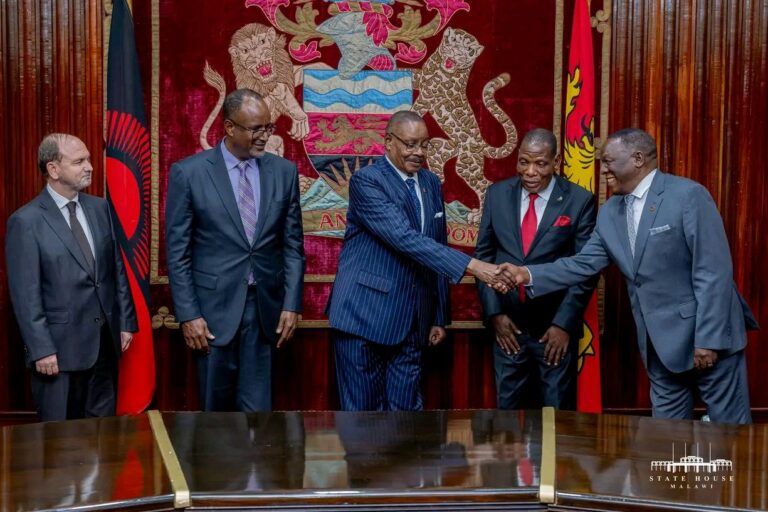
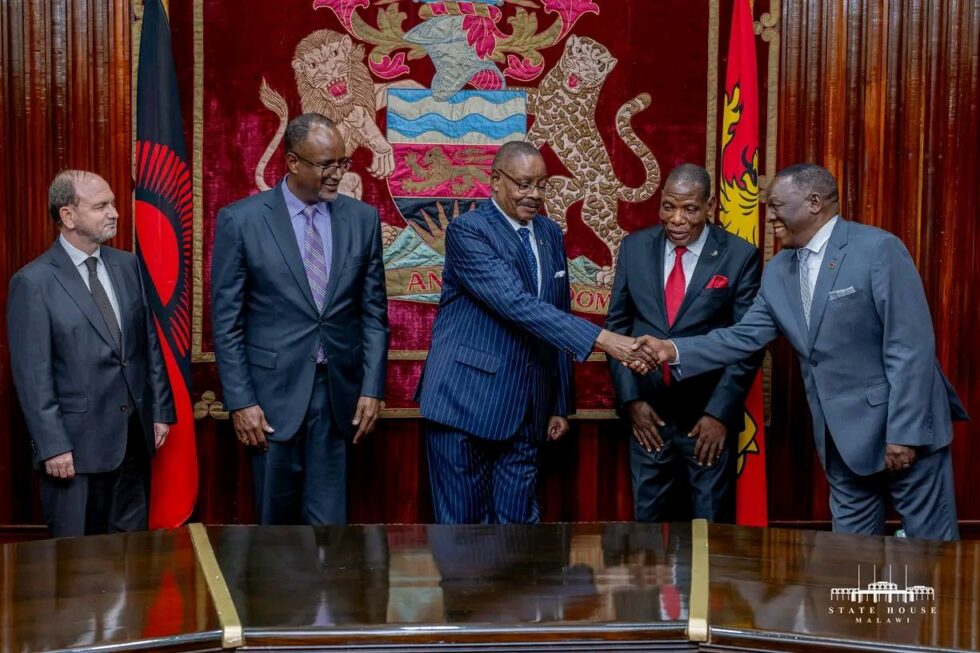
President Professor Arthur Peter Mutharika  on Thursday proved to his critics that he was not hospitalized in South Africa when he hosted the World Bank Director for Malawi, Tanzania, Zambia and Zimbabwe Dr. Nathan Belete who was accompanied by senior management of the Bank at Sanjika Palace in Blantyre.

In the week, there have been fabricated false news about Professor Mutharika that he is hospitalized at one of the very expensive private hospital in South Africa and his health condition has deteriorated, incapacitated, not fit to run the country.


Social commentator Ben Chiza Mkandawire rang the bell aloud of the whereabout of President Professor Mutharika labelling him as the missing President and this was a subject of discussion among social media users.

Mkandawire claimed to have received an entail from well wishers that Professor Mutharika arrived at Donald Goldon Private Hospital in South Africa in silence wondering why the Malawi Government is treating his hospitalization in silence and what are they are afraid of.

Malawi Congress Party (MCP) media developed strong muscles by writing in various social media platforms that Justice Dr. Jane Mayemu Ansah SC (RTD) is likely to take over government as memories are still fresh with Dr. Joyce Banda who took over the Sword of Command with many senior members of the DPP against her.

Writing on his Facebook page, Professor Mutharika said the World Bank Director Dr. Belete paid a courtesy farewell visit as he assumes his new role at the regional office following his promotion.

“I congratulated Dr. Belete on this achievement and expressed Malawi’s deep appreciation for the support extended under his leadership which has advanced several development projects across the nation,” reads Mutharika’s writings on the wall.

He appealed for continued World Bank support, particularly as the geopolitical tensions in the Gulf add strain in the country’s economy and he was greatly encouraged by the World Bank’s willingness to assist Malawi through Rapid Response financing options, which will help stabilize the economy and place it firmly on track towards full economic recovery.

Educator Blessings Zitta publishes study skills guide for students

0


By Chisomo Phiri

Malawian educator currently pursuing a Master’s degree in China, Blessings Raphael Zitta, has released a new book titled ‘Excellent Student: A Practical Companion’ aimed at improving academic performance among students, particularly at the secondary school level.

In an interview with 247 Malawi News, Zitta said the book offers practical study strategies and motivational guidance designed to help learners excel.

He said the book serves as a daily companion for students, focusing on key academic skills such as effective study habits, goal setting, time management, and examination preparation.

Blessings Raphael Zitta


The author said the publication seeks to cultivate a positive mindset among learners while equipping them with tools for academic success.

“The book is designed to empower students with essential skills and a strong mindset for outstanding performance.It also aligns with Malawi 2063, particularly on mindset change and human capital development,” explained Zitta.

He said his motivation to write the book stemmed from his teaching experience, where he observed that many students struggle with study techniques and sustained motivation.

The writer noted that Malawi School Certificate of Education (MSCE) pass rates have hovered around 50 percent in recent years, with approximately 58.4 percent of about 200,000 candidates passing in 2025.

“This is happening despite significant investments by the government, NGOs, donors, and other stakeholders.With the introduction of free secondary school education, there is a need for complementary initiatives like this guidebook,” he said.

Zitta said published in late 2025 by Patriots Publishers, the book is currently available in both digital and print formats.

He said the electronic version can be accessed through MabukuOnline and Amazon, while hard copies are being sold at Thawo Bookshop, located within Sana Megastore in Lilongwe and that efforts are underway to expand distribution to other outlets across the country.

Zitta also commented on the evolving writing industry in Malawi, describing it as one undergoing a digital and self-publishing transformation.

He highlighted the importance of making books more accessible through affordable platforms such as digital libraries, book clubs, and community libraries.

“While economic challenges may make books seem like luxury items, there is growing institutional support for quality publications that contribute to national development.

“At the same time, authors need opportunities to monetize content globally and reach wider audiences,” said Zitta.

He expressed gratitude to the team of experienced teachers who reviewed the book, as well as to editors, the production and distribution team, and his family for their support.

Zitta then encouraged students and education stakeholders to embrace the book as a practical tool for improving learning outcomes.

His journey in writing began during his secondary school years around 2015, when he developed a passion for poetry and short stories.

He later transitioned into academic writing, producing teaching materials and research reports.

‘Excellent Student: A Practical Companion’ marks his debut book.