Friday, December 26, 2025
No menu items!
spot_img
Home Blog Page 509

OXFAM-Malawi and European partners engage DPP in high-level electoral preparations

0

By Burnett Munthali

OXFAM-Malawi, in collaboration with the European Union, the Irish Deputy Head of Mission, and the Ambassador of the Federal Republic of Germany, held a high-level meeting with senior members of the Democratic Progressive Party (DPP) as part of efforts to ensure a smooth and inclusive 2025 Tripartite Elections.

The engagement comes at a critical moment as Malawi moves closer to the polls, with stakeholders emphasizing the need for fairness, transparency, and inclusivity in the electoral process.



The DPP delegation at the meeting was led by Hon. Bright Msaka, SC, MP, who serves as the party’s Vice President for the Eastern Region.

Other senior members in attendance included Hon. Peter Mukhitho, the DPP Secretary General, and Hon. Mary Thom Navicha, MP, who is the party’s National Director of Women.

Also present were Hon. Dr. Jean Mathanga, the National Director of Elections, and Hon. Chifundo Makande, MP, who serves as the National Campaign Director.

During the discussions, Hon. Msaka expressed his gratitude to OXFAM-Malawi and its international partners for facilitating such an important engagement ahead of the elections.

He acknowledged that with just six months remaining before the elections set for 16 September 2025, political parties must work closely with development partners to promote democratic values and electoral integrity.

Hon. Msaka further emphasized the significance of such collaborations in fostering a political environment that upholds fairness, credibility, and the active participation of all stakeholders.

One of the key issues raised during the meeting was the need for increased support for female candidates in Malawian politics.

Speaking on behalf of women aspirants, Hon. Mary Thom Navicha made an appeal to OXFAM and other development partners to enhance financial support for women running for office.h

She pointed out that one of the biggest challenges female candidates face is the lack of adequate resources to mount strong and competitive election campaigns.

Hon. Navicha stressed that achieving a 50:50 gender representation in governance requires more than just policy advocacy.

She called for a more holistic and innovative approach that includes tangible financial empowerment to help level the playing field for women in politics.

Her remarks echoed concerns that despite ongoing efforts to promote gender equality in governance, financial constraints continue to be a major barrier preventing women from fully participating in elections.

OXFAM and its partners acknowledged these concerns, highlighting their commitment to supporting initiatives that promote women’s participation in politics and leadership.

The meeting underscored the need for a multi-stakeholder approach in addressing key electoral challenges, including issues of political financing, voter education, and electoral reforms.

As Malawi inches closer to the 2025 Tripartite Elections, such engagements between political parties and international development organizations are expected to play a crucial role in shaping a democratic and inclusive electoral process.

With the DPP being one of Malawi’s major political parties, the discussions with OXFAM-Malawi and European partners mark an important step in ensuring that all political players are adequately prepared for the upcoming elections.

Moving forward, it remains to be seen how these engagements will translate into actionable strategies that strengthen Malawi’s democracy and electoral integrity.

For now, the focus remains on continued dialogue, capacity-building, and resource mobilization to support a free, fair, and credible election in September 2025.


MBC’s senior producer Chikondi Phikiso dies

0

By Chisomo Phiri

Death has been announced of Malawi Broadcasting Corporation (MBC) Senior Producer, Chikondi Phikiso.

Phikiso who was based at MBC’s Kaning’ina studios passed away in the early hours of today at Mzuzu Central Hospital.

She had been receiving medical care at the hospital for the past few days before succumbing to her illness.

The Late Chikondi Phikiso


Her body will be collected from the mortuary at 9am and taken to Katawa, St Maria Gorrett Sector for a home mass, then depart for Lilongwe where burial will take place tomorrow at Area 18.

Apart from her illustrious career at MBC, the late Phikiso was also a devoted servant of the Catholic Church, having served as Secretary of the Laity Council in the Archdiocese of Blantyre and at the National Level.

Bon Kalindo joins Zomba business protests, stands firm on human rights advocacy

0


By Burnett Munthali

Human rights advocate Bon Kalindo recently participated in demonstrations by businesspeople in Zomba.

Kalindo addressed the crowd on Tuesday 11 March, 2025 expressing his concern that the issue at hand was of great importance to the people of Malawi.

He stated that he saw no reason to fear being arrested, as his efforts to fight for human rights were done with good intentions to serve the people, especially those struggling in the country.

Kalindo in Zomba


Kalindo emphasized that his participation in the protests was motivated by his desire to support those facing hardships, and he was committed to fighting for the rights of ordinary Malawians.

He further explained that his actions were not about personal gain, but about fighting for the dignity and welfare of the people who were suffering from various challenges.

Despite the risks involved, Kalindo reaffirmed his willingness to continue standing up for human rights and joining movements that aimed at improving the lives of the vulnerable in Malawi.

The demonstration in Zomba, which he supported, was seen as a sign of solidarity with the business community, who were voicing concerns about the economic challenges the country is facing.

Kalindo’s stance has sparked various reactions, with some supporting his commitment to human rights, while others question the effectiveness of such demonstrations in achieving tangible results.

Nevertheless, Kalindo remains resolute, expressing his belief that standing up for the rights of the people is a crucial duty, even if it comes with personal risks such as arrest.

Dan Lufani arrested after confrontation with Lilongwe Water Board Officials over unpaid bill

By Burnett Munthali

Dan Lufani, a “boma ndi lomweli” musician, was arrested on Tuesday 11 March 2025 by the police after an incident in which he was allegedly involved in a confrontation with officials from the Lilongwe Water Board in Area 49.

The altercation occurred when Lufani, who had reportedly not paid his water bill amounting to K250,000.00, attempted to cut off the water supply.

Upon arriving to disconnect the water, Dan allegedly became aggressive and started causing a scene, leading to a physical confrontation.

Dan Lu


According to eyewitnesses, he made statements like “Kumenya kugwetsa,” signaling his frustration and anger during the altercation.

As the situation escalated, Dan’s actions led to an unfortunate incident in which the water board officials were reportedly assaulted.

The police were called to the scene, and Lufani was arrested for his involvement in the disturbance.

At present, he remains in police custody at the Area 18 Lingadzi Police Station, where he is being held for further investigation.

Authorities have yet to comment on the specifics of any charges he may face in connection with the incident.

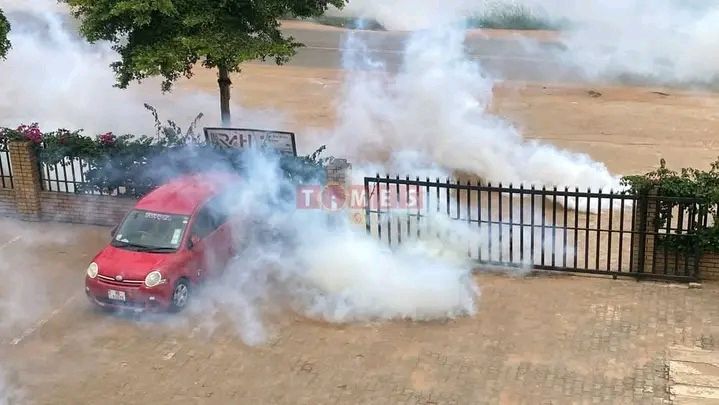
Tear gas: A chemical weapon against Malawian democracy

By Jones Gadama

Malawi is currently witnessing a surge in public demonstrations, reflecting a growing discontent among citizens regarding various socio-economic and political issues.

While the right to peaceful assembly is enshrined in the Malawian Constitution, the response of the police to these demonstrations has raised significant concerns.

The frequent reliance on tear gas as a primary means of crowd control has not only proven to be dangerous but has also highlighted a troubling lack of professionalism within the Malawian police force.

This analysis seeks to explore the implications of the current crowd control strategies employed by the police, the potential alternatives available, and the broader impact on civil society and governance in Malawi.

The use of tear gas in crowd control is a contentious issue globally, and its application in Malawi has sparked intense debate.

Tear gas, while often viewed as a non-lethal means of dispersing crowds, can have severe health implications.

Individuals exposed to tear gas can experience respiratory distress, disorientation, and in some cases, fainting or even death.

The indiscriminate use of such a chemical agent raises ethical questions about the police’s duty to protect citizens, even in the context of maintaining public order.

In Malawi, the frequent deployment of tear gas during demonstrations has led to numerous reports of injuries and health complications, particularly among vulnerable populations, including children and the elderly.

This raises the question of whether the police are adequately trained to assess the situation and respond appropriately, or if they are simply resorting to the most expedient method available.

The pattern of police response to demonstrations in Malawi suggests a reactive rather than proactive approach to crowd control.

Rather than engaging with demonstrators to understand their grievances and facilitate peaceful dialogue, the police often resort to forceful measures that escalate tensions.

This approach not only undermines the legitimacy of the police force but also erodes public trust in law enforcement.

When citizens perceive the police as an adversary rather than a protector, it creates a cycle of hostility that can lead to further unrest.

The lack of effective communication and negotiation skills among police officers is a critical factor contributing to this dynamic.

Training programs that emphasize conflict resolution, de-escalation techniques, and community engagement are essential for fostering a more professional police force capable of handling demonstrations in a manner that respects citizens’ rights.

Moreover, the reliance on tear gas as a primary tool for crowd control reflects a broader issue of inadequate resources and training within the Malawian police force.

Many police officers may lack access to modern crowd control equipment and techniques that could provide safer alternatives to tear gas.

For instance, the use of water cannons, barriers, or even trained negotiation teams could serve as more effective means of managing crowds without resorting to chemical agents.

Additionally, the implementation of community policing strategies could help build relationships between the police and the communities they serve, fostering an environment where citizens feel heard and respected.

By investing in training and resources that prioritize non-violent methods of crowd control, the Malawian police could significantly improve their effectiveness and public perception.

The implications of the current approach to crowd control extend beyond immediate health concerns.

The frequent use of tear gas and other aggressive tactics can have a chilling effect on civil society, discouraging citizens from exercising their right to protest.

When individuals fear for their safety during demonstrations, they may choose to remain silent rather than voice their concerns.

This suppression of dissent can stifle democratic engagement and hinder the development of a vibrant civil society.

In a country like Malawi, where political and economic challenges persist, it is crucial for citizens to feel empowered to advocate for their rights and hold their government accountable.

The police’s heavy-handed approach to crowd control undermines this fundamental democratic principle.

Furthermore, the international community is increasingly scrutinizing the human rights records of nations, including their treatment of protesters.

The Malawian government’s failure to address the concerns surrounding police brutality and the use of tear gas could lead to diplomatic repercussions and a loss of credibility on the global stage.

As Malawi seeks to attract foreign investment and strengthen its international partnerships, a commitment to upholding human rights and fostering a culture of accountability within law enforcement will be essential.

The perception of Malawi as a country that respects the rights of its citizens can significantly impact its ability to engage with the international community and secure much-needed support for development initiatives.

In light of these challenges, it is imperative for the Malawian government to take decisive action to reform its approach to crowd control.

This includes investing in comprehensive training programs for police officers that emphasize the importance of human rights, community engagement, and non-violent conflict resolution.

Additionally, the government should explore alternative crowd control methods that prioritize the safety and well-being of citizens.

Engaging with civil society organizations and community leaders to develop a collaborative approach to crowd management can also foster trust and cooperation between the police and the public.

Moreover, the establishment of independent oversight mechanisms to monitor police conduct during demonstrations is crucial for ensuring accountability.

Such mechanisms can help investigate incidents of police brutality and provide a platform for citizens to voice their concerns.

By demonstrating a commitment to transparency and accountability, the Malawian government can rebuild trust in law enforcement and promote a culture of respect for human rights.

The current approach of the Malawian police to crowd control, characterized by the indiscriminate use of tear gas, reflects a troubling lack of professionalism and a failure to prioritize the safety and rights of citizens.

The implications of this approach extend beyond immediate health concerns, impacting civil society, democratic engagement, and Malawi’s standing in the international community.

To address these challenges, the government must invest in training, resources, and oversight mechanisms that promote a more professional and accountable police force.

By fostering a culture of respect for human rights and prioritizing non-violent methods of crowd control, Malawi can create an environment where citizens feel empowered to express their grievances and engage in the democratic process.

Ultimately, the path to a more just and equitable society lies in the hands of both the government and the citizens, working together to uphold the principles of democracy and human rights.