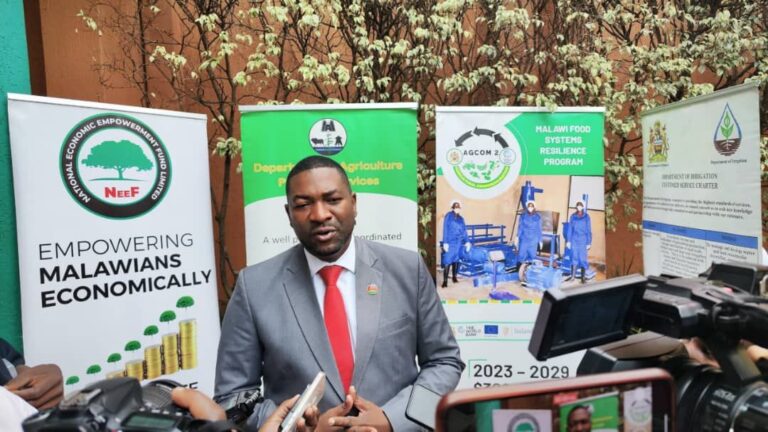
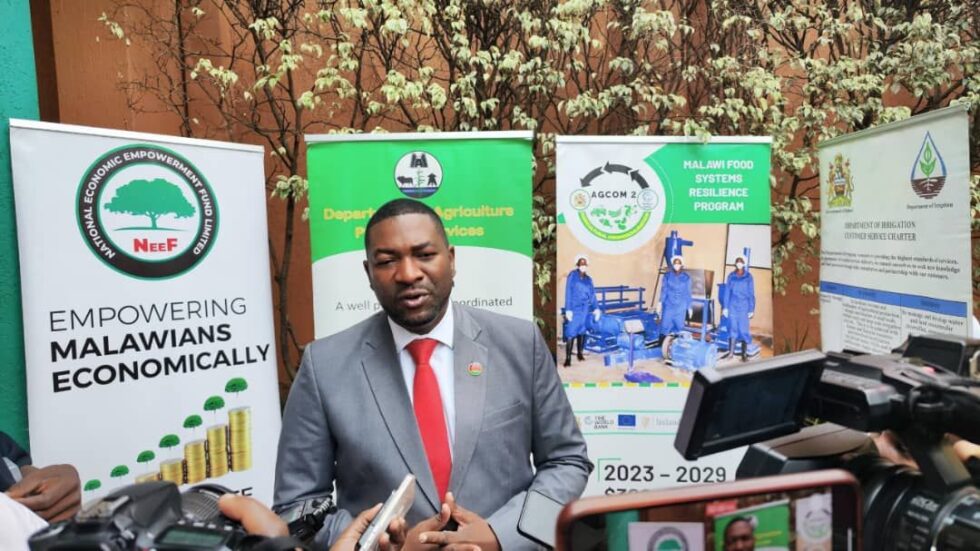
Minister of Agriculture Sam Dalitso Kawale on Tuesday launched the first-ever series of meetings with 2,200 front-line workers in the Ministry of Agriculture.
Speaking in an exclusive interview at Cross Roads Hotel in Lilongwe Kawale said the Ministry of Agriculture decided to meet the front line workers in the agriculture sector in order to hear from them challenges they are facing.
Kawale said these are the workers that you meet in the village, helping our farmers to increase productivity as well as make a better livelihood.
Sam Kawale
“So we are meeting all of them, approximately 2, 200 of them in all the eight Agriculltural Development Division (ADDs). We actually going to those adds, to meet them where they are. The goal is to first of all, share the agriculture reforms that we are currently implementing, and secondly, to hear from them some of the challenges and the solutions that they would like to provide to the Ministry for us to implement so that these reforms can be very effective,” he said.
Kawale said , the format of these meetings is that the ministry of agriculture, will be sharing the importance of these agriculture reforms, because the goal is to move from subsistence farming to commercial farming.
According to Kawale, the future of this country lies in the implementation of commercial farming.
The Minister said in the midst of everything, the Ministry wants them to understand the importance of stopping to think about agriculture or farming seasons, to start thinking about agriculture or farming cycles.
“Now, when you talk about farming cycles, it simply means the use of irrigation in our areas increasing productivity should start with mindset change, where we are moving away from subsistence farming and subsidies to commercial farming, irrigation and farming cycles so that we are getting the much needed food at a household level and surplus food for selling, as well as diversification of what we are producing for export purposes,” he said.
He said the Ministry goal is to move together with the frontline workers, for them to understand what the ministry want to do, and for them to go back and start implementing what they want them to help farmers implement the skills.
In his remarks , Nyanja EPA Agricultural extension Coordinator, Themba Nyekanyeka appealed to the Miniser to address housing, transport and refresher courses.
He said previously they used to receive bicycles or bicycle allowances which is not happening at the moment.
According to the coordinator, these people travel long distances and motorcycle could be the best option.
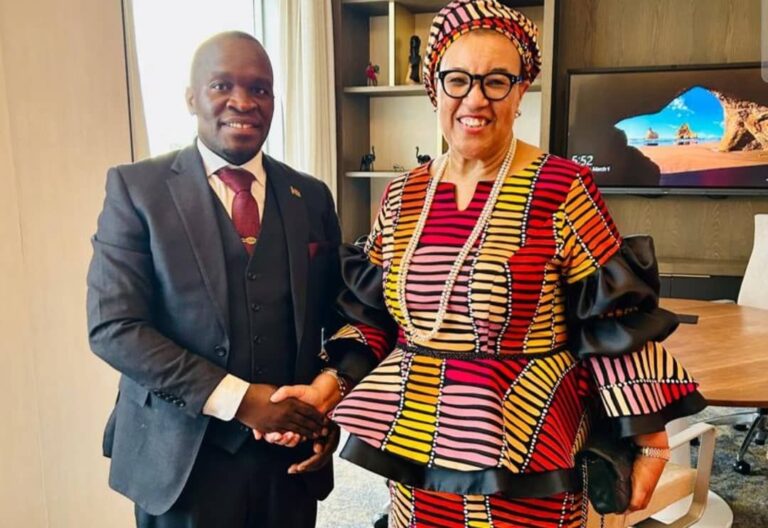
Lusaka, Zambia — In a pivotal meeting, Malawi’s Attorney General, Hon. Thabo Chakaka Nyirenda SC, and Commonwealth Secretary General Patricia Janet Scotland, PC, KC, engaged in transformative discussions addressing economic sovereignty, legal reforms, and sustainable development across commonwealth member states.
The dialogue spotlighted the crippling effects of outdated double taxation agreements on developing economies. Hon. Nyirenda highlighted Malawi’s struggle with a treaty signed in 1956, stressing the urgent need for renegotiation with technical support from the Commonwealth Secretariat. Secretary General Scotland encouraged Malawi to raise this issue at the upcoming Commonwealth Trade and Investment meeting in Namibia on June 16, 2025. “We cannot allow outdated tax agreements to drain resources from our people. The Commonwealth must be a shield for developing countries,” Nyirenda declared.
Nyirenda said that it is ironic that Malawi does not have bilateral investment treaties with the United Kingdom and the United States of America. He requested the Commonwealth Secretariat to help in negotiating modern bilateral investment treaties with the United Kingdom and the United States of America, which would counterbalance the interests of the investor and the host state.
Chakaka and Baroness Scotland
Secretary General Scotland emphasized the need for Malawi and other Commonwealth countries to adopt and customize modern laws on virtual assets. The Secretary General thanked the Attorney General for the support he gave in pushing for the Virtual Assets Model Law during the Commonwealth Law Ministers and Senior Officials that took place in Zanzibar, United Republic of Tanzania from 4 to 8 March 2024.
She also hinted on proposed model contracts with 80% generic terms — including climate change, environmental impact, and preservation of sovereignty clauses — to ensure balanced, fair deals for smaller nations. The two leaders acknowledged that procurement contracts are heavily biased towards contractors. “To attract investors while safeguarding national interests, contracts must mandate restoration, rejuvenation, and benefaction. Failing to meet these standards would render contracts null and void,” Scotland explained. She explained that the model contracts would save Commonwealth countries from paying huge fees to multibillion-dollar Western law firms.
The Secretary General underscored the need for model laws on performance management in the Government as one way of achieving efficiency in public expenditure, preventing abuse, fraud and corruption.
A standout moment in the discussion was Malawi’s push for enhanced capacity in asset tracing and non-conviction-based asset forfeiture. Hon. Nyirenda cited Angola’s staggering recovery of over $27 billion — including the InterContinental Hotel in Lusaka — through civil forfeiture between 2019 and 2023 as a powerful example of what’s possible with robust legal mechanisms. “This is a wake-up call. Stolen public assets can and must be recovered. Civil forfeiture is not just a legal tool; it’s a weapon for justice,” he emphasized.
The Secretary General bemoaned the shortage of lawyers with expertise in commercial law within the Commonwealth Region. Nyirenda stated that this was because most scholarships awarded to law students from developing countries are biased towards human rights and other non-commercial law related courses. He thus requested the Commonwealth Secretariat to redesign scholarships so that they lean towards commercial law. A standout moment in the discussion was Malawi’s push for enhanced capacity in asset tracing and non-conviction-based asset forfeiture. Hon. Nyirenda cited Angola’s staggering recovery of over $27 billion — including the InterContinental Hotel in Lusaka — through civil forfeiture between 2019 and 2023 as a powerful example of what’s possible with robust legal mechanisms. “This is a wake-up call. Stolen public assets can and must be recovered. Civil forfeiture is not just a legal tool; it’s a weapon for justice,” Nyirenda emphasized, underscoring the need to prevent public corruption through AI-driven bid analysis. Scotland added that the Commonwealth has developed an anti-corruption benchmark and SMART performance management systems, akin to Generally Accepted Accounting Principles (GAAP), to enhance government accountability.
The Attorney General also called for the establishment of a central legislative repository linked to court judgments to enhance legal transparency and efficiency in Malawi. Discussions extended to digital transformation, with Scotland announcing that India will support member states with free digitization and AI systems. The Commonwealth’s “Strategist AI” platform, a repository of laws across member countries, will enable states like Malawi to conduct gap analyses and streamline legislative reforms. The two leaders agreed on the need for intra-pool legislation, MOU-linked bills, and judicial training to harmonize legal interpretations. Scotland highlighted three key sectors — energy, infrastructure, and mining — as crucial for Africa’s growth, stressing that enhanced legal expertise is essential to negotiate with large, well-resourced investors. The meeting closed with commitments to ongoing collaboration, with the Commonwealth set to share documents on trade, investment, and Malawi’s SDG performance. This landmark discussion signals a bold new chapter for Malawi and the Commonwealth, as they unite to build a stronger, fairer, and more sustainable future.
Patricia Janet Scotland was appointed Attorney General of the United Kingdom in 2007-the first woman to hold the post since it was created in 1315. She became the first woman to be appointed Queen’s Counsel (QC) in 1991. At 35 she was also the youngest woman ever to be made a QC. The first black woman to be appointed Deputy High Court Judge, Recorder and Master of Middle Temple. She became Secretary General of the Commonwealth in 2015. She joined the House of Lords in 1997 as Baroness Scotland of Asthal, going on to serve as Minister in the Foreign Office, Home Office and Lord Chancellor’s Department.
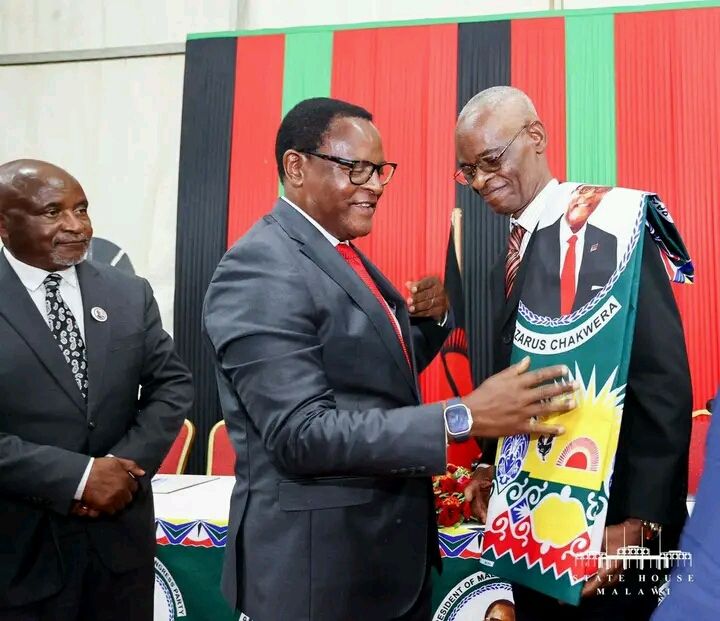
The Malawi Congress Party (MCP) primary elections in Rumphi East Constituency have produced a landslide victory for Alfred Nyasulu, with Ken Msonda suffering a humiliating defeat.
Msonda, a veteran politician who has switched allegiance between various political parties over the years, managed to secure only eight votes, making him a distant third in the race.
Otton Thindwa came in second with 285 votes, while Nyasulu dominated the contest with an overwhelming 509 votes, cementing his position as the MCP’s parliamentary candidate for the 2025 elections.
Msonda’s loss raises serious questions about his political relevance and whether his recent defection to the ruling party was a strategic misstep.
A longtime figure in Malawi’s political circles, Msonda has been associated with multiple parties, including the United Democratic Front (UDF), the People’s Party (PP), and the Democratic Progressive Party (DPP), before joining MCP.
His defeat suggests that grassroots MCP supporters in Rumphi East did not embrace him as one of their own, despite his efforts to integrate into the party.
Political analysts argue that Msonda’s frequent party-switching may have damaged his credibility, making it difficult for voters to trust his long-term commitment to MCP.
Additionally, his campaign appears to have failed in convincing delegates that he was the best choice to represent them in Parliament.
Nyasulu’s victory, on the other hand, demonstrates strong local support and suggests that MCP’s structures in Rumphi East favored a candidate who has deep connections with the constituency.
The result also signals that voters are increasingly prioritizing loyalty and long-term engagement with their communities over political opportunism.
For Msonda, this loss could mark a significant setback in his political career, forcing him to either reconsider his future in active politics or attempt another comeback in a different constituency or party.
His political trajectory has been defined by shifting allegiances, but this latest defeat may indicate that he is running out of viable options.
While MCP has not officially dismissed Msonda’s role within the party, the results make it clear that he lacks the grassroots support needed to be a serious contender under its banner.
The broader implication of this outcome is that Malawian voters are becoming more discerning, rewarding consistency and punishing political adventurism.
As the 2025 general elections approach, the rejection of Msonda in Rumphi East serves as a lesson to politicians who rely on party-switching as a survival tactic.
Ultimately, the primary elections have reinforced the notion that credibility and voter trust are critical factors in securing political office in Malawi.