Saturday, April 4, 2026
No menu items!
spot_img
Home Blog Page 720

Nurses and Midwives Council of Malawi phases out diploma programs in favor of Bachelor’s degrees

0

By Twink Jones Gadama

In a bid to enhance the quality of nursing education and strengthen the healthcare sector in Malawi, the Nurses and Midwives Council of Malawi (NMCM) has resolved to phase out the three-year Registered Nurse (RN) and two-year Upgrading Registered Nurse Midwife (RNM) university diploma programs.

The decision, made during the Council’s 121st session on September 17, 2024, is based on recommendations from the QUADRIAD (QUAD) Committee, which comprises representatives from regulatory bodies, professional associations and unions, training institutions, and policy and practice sectors within the nursing and midwifery profession.

According to the NMCM, the assessment revealed that despite differences in competence levels among NMT, RN, and RNM graduates, all cadres were recruited at the same grade in the job market, as all diploma qualifications were treated equally. However, from a professional standpoint, RNM and NMT graduates have distinct competence levels.

Malawi nurses


Following a thorough cost-benefit analysis with key stakeholders, the task force recommended retaining the NMT diploma program while phasing out the RN and RNM diploma programs. The Council adopted this recommendation, paving the way for a significant shift in nursing and midwifery education in Malawi.

Going forward, diploma-level training will be limited to the Nursing and Midwifery Technician (NMT) programs. Furthermore, the Council determined that future professional upgrades should transition directly to Bachelor of Science (BSc) programs rather than diploma programs. This means that NMTs, RNs, and RNMS seeking further qualifications should enroll in BSc Nursing and Midwifery programs.

The NMCM has assured all stakeholders that this change will not affect individuals currently enrolled in training or those already registered with the NMCM. The existing Diploma RN/RNM register will remain active. Training institutions offering the affected diploma programs are advised that the 2025 intake will be the final cohort, expected to graduate in 2028.

The phasing out of diploma programs in favor of Bachelor’s degrees is a significant development in Malawi’s healthcare sector. The move is expected to enhance the quality of nursing education and strengthen the healthcare system in the country.

Institutions such as Mzuzu University are already offering Bachelor of Science in Nursing and Midwifery programs, which aim to produce competent and multi-skilled graduates who can deliver both theoretical and clinical academic programs in nursing and midwifery.

The NMCM has acknowledged that this transition may raise questions and concerns. The Council remains committed to supporting all stakeholders through this change and is available to provide guidance and address any queries.

As Malawi’s healthcare sector continues to evolve, the phasing out of diploma programs in favor of Bachelor’s degrees is a significant step towards enhancing the quality of nursing education and strengthening the healthcare system in the country.

What This Means for Nursing and Midwifery Students

– The 2025 intake will be the final cohort for the affected diploma programs, expected to graduate in 2028.
– Individuals currently enrolled in training or those already registered with the NMCM will not be affected by this change.
– Future professional upgrades will transition directly to Bachelor of Science (BSc) programs rather than diploma programs.
– Institutions such as Mzuzu University are already offering Bachelor of Science in Nursing and Midwifery programs.

The Way Forward

The NMCM’s decision to phase out diploma programs in favor of Bachelor’s degrees is a significant development in Malawi’s healthcare sector. As the country continues to work towards enhancing the quality of nursing education and strengthening the healthcare system, it is essential that all stakeholders work together to ensure a smooth transition.

The NMCM’s commitment to supporting all stakeholders through this change is a positive step towards achieving this goal. As Malawi’s healthcare sector continues to evolve, it is essential that the country remains focused on producing high-quality nursing and midwifery professionals who can deliver exceptional care to patients.

Malawi,Zambia strengthen bilateral ties at Africa energy Summit

0

By Chisomo Phiri

President Dr. Lazarus Chakwera and President Hakainde Hichilema of Zambia held a bilateral meeting on the sidelines of the Mission 300 Africa Energy Summit, reaffirming their commitment to deepening trade and economic cooperation between the two nations.

The meeting focused on addressing Malawi’s challenges in accessing petroleum products from regional ports.

Chakwera and Hichilema


President Chakwera proposed two long-term solutions to President Hichilema, leveraging Zambia’s expertise in establishing linkages to the sea port in Lobito, Angola.

The proposed solutions include:

Lusaka Fuel Pipeline: Lifting some of Malawi’s fuel from Lusaka to utilize the pipeline from Dar es Salaam.

Chipata-Mchinji Rail Link: Transporting Malawi’s fuel by rail from Chipata through Mchinji.

Both leaders emphasized their commitment to learning from each other and advancing their development agendas in key sectors such as:

Agriculture: Enhancing cooperation in agricultural production and trade.
Tourism: Promoting joint tourism initiatives to boost economic growth.
Mining: Collaborating on mining projects to drive economic development.
Trade: Strengthening cross-border trade to stimulate economic growth and job creation.

The bilateral meeting highlights the growing partnership between Malawi and Zambia, demonstrating their shared vision for regional integration and economic prosperity.

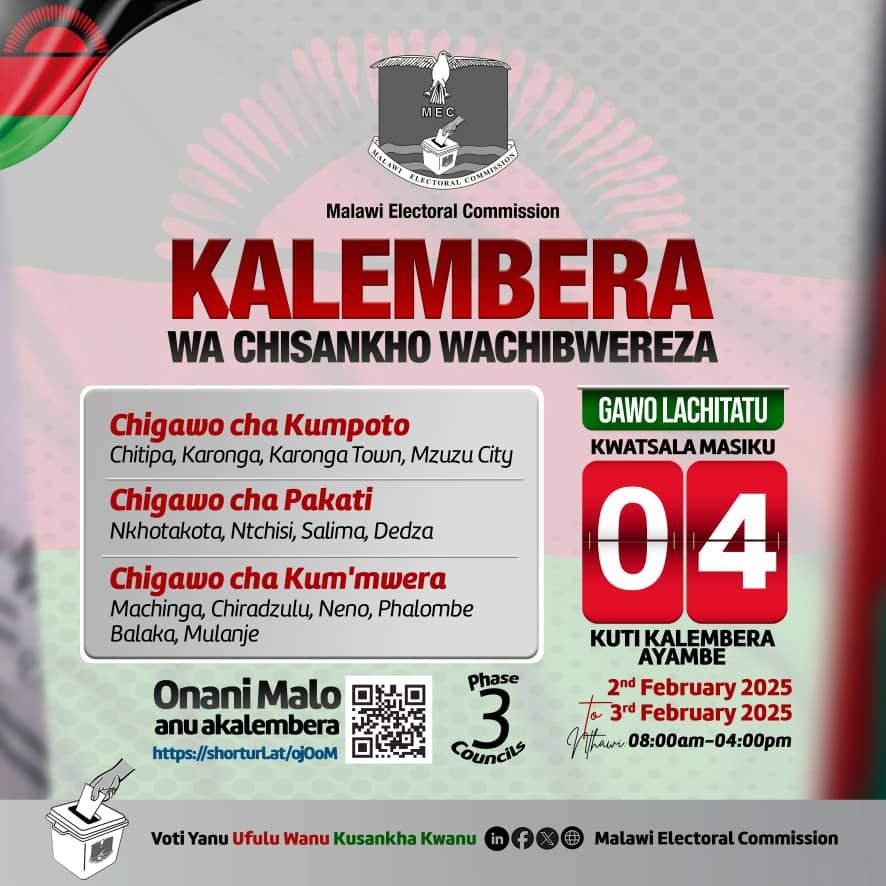
Supplementary Voter Registration for  Constituencies Scheduled for February 2-3, 2025

0


By Elywin Chighali Mhango

In a significant effort to enhance electoral participation, Malawi will hold a special voter registration session on February 2-3, 2025. This initiative is specifically tailored for individuals who faced obstacles in registering due to issues related to their national identity numbers, as well as those who did not register with the National Registration Bureau (NRB).

With only four days remaining until the registration event, eligible voters are encouraged to prepare accordingly. The registration will be conducted from 8:00 AM to 4:00 PM on both days, with sessions taking place across various regions to ensure accessibility for all. Notable areas for supplementary registration include Chitipa and several other districts nationwide.


The objective of this initiative is clear: to bolster voter participation in the approaching elections by providing an avenue for individuals previously hindered from registering to secure their right to vote. Election officials emphasize the importance of every eligible voter’s involvement in shaping the democratic process.

Eligible voters are urged to take this opportunity seriously and ensure that their voices are included in the upcoming electoral proceedings. The special registration session represents a crucial step toward empowering citizens and enhancing the overall integrity of Malawi’s electoral system.

As the date approaches, residents are reminded to have the necessary documentation ready to facilitate a smooth registration process.

President Chakwera returns from mission 300 summit with $300 million energy grant

0

By Burnett Munthali

President Dr. Lazarus Chakwera has returned to Malawi after participating in the prestigious Mission 300 Africa Energy Summit in Dar es Salaam, Tanzania. The high-profile summit brought together over 12 African heads of state, who collectively pledged to accelerate electricity access across the continent, with the ambitious goal of connecting 300 million Africans to electricity by 2030.

During the summit, President Chakwera reaffirmed Malawi’s commitment to this initiative, announcing an ambitious national target of ensuring 70% electricity coverage for Malawians by 2030, up from the current 25%. He emphasized that expanding access to electricity is a crucial step in driving economic growth, industrialization, and overall national development.


One of the key highlights of President Chakwera’s trip was the signing of a $300 million grant from the World Bank, aimed at strengthening Malawi’s energy sector. This funding will support infrastructure expansion, improve power generation capacity, and enhance electricity distribution to underserved communities. The grant is expected to play a critical role in achieving Malawi’s energy goals and boosting productivity in various sectors, including manufacturing, agriculture, and small businesses.

Beyond securing financial commitments, President Chakwera engaged in bilateral talks with several African leaders, exploring opportunities for collaboration in the energy sector and beyond. These discussions focused on regional integration, private-sector investment, and policy reforms that would accelerate the implementation of energy projects.

Speaking to a large gathering upon his return, President Chakwera highlighted the significance of the summit, linking it to Malawi’s ATM Strategy (Agriculture, Tourism, and Mining), which aims to diversify the country’s economy. He noted that reliable electricity is a fundamental driver of these sectors and a key ingredient in transforming Malawi into a middle-income economy.

President Chakwera’s successful trip to Tanzania underscores his administration’s dedication to driving progress and improving the lives of Malawians. The Mission 300 initiative, combined with the World Bank’s financial support, presents a significant opportunity to bridge Malawi’s energy gap. As the country continues on its development journey, the government is expected to intensify efforts to mobilize additional resources, implement reforms, and fast-track infrastructure projects that will ensure a sustainable and reliable power supply for all.

Mzuzu Airport expansion on track: Commercial flights set to resume soon

0

By Burnett Munthali

The long-awaited return of commercial flights to Mzuzu City is now within reach as the expansion and rehabilitation of Mzuzu Airport progresses steadily. Minister of Transport and Public Works Jacob Hara, accompanied by his Deputy Peter Dimba, visited the airport on Tuesday to inspect the ongoing project, expressing satisfaction with the work being done.

The minister emphasized that while the rehabilitation of Mzuzu Airport is a crucial step in improving air connectivity for the region, it does not replace the government’s commitment to constructing the much-anticipated Orton Chirwa International Airport. According to Hara, groundwork for the new international airport has already been completed, and implementation will commence after the rainy season once a final decision on its location is made.

Minister Uchizi Mkandawire at Mzuzu Airport


“The rehabilitation of Mzuzu Airport does not divert from our dream project of Orton Chirwa International Airport. Instead, it is intended to bring commercial flights to this city as soon as possible while the other project progresses,” Hara explained.

The expansion project, which includes extending the airport’s runway, was recommended by Malawian Airlines to accommodate commercial flights. A representative from the airline confirmed that they are prepared to commence operations as soon as the runway work is completed.

In addition to the runway extension, the airport’s terminal building will be upgraded to meet modern standards and improve passenger handling. According to ADL Chief Executive Officer Victor Lungu, the terminal will be renovated to include separate arrival and departure lounges, a new air traffic control room, and the installation of advanced air traffic control equipment.

The first commercial flight to Mzuzu in over two decades is expected to land by the third week of February 2025. This milestone is anticipated to significantly boost economic activities in the Northern Region, particularly in tourism, with easier access to destinations such as Likoma Island.

The government’s commitment to upgrading Malawi’s air transport infrastructure reflects a broader strategy to enhance connectivity and stimulate economic growth. The restoration of commercial flights to Mzuzu will not only benefit local travelers but also open up the region to business investments and tourism opportunities.