


By Burnett Munthali
Zambia’s presidential election has unfolded under the long shadow of the late former president Edgar Lungu, whose political rivalry with incumbent President Hakainde Hichilema continues to influence the country’s campaign and opposition politics more than a year after his death.
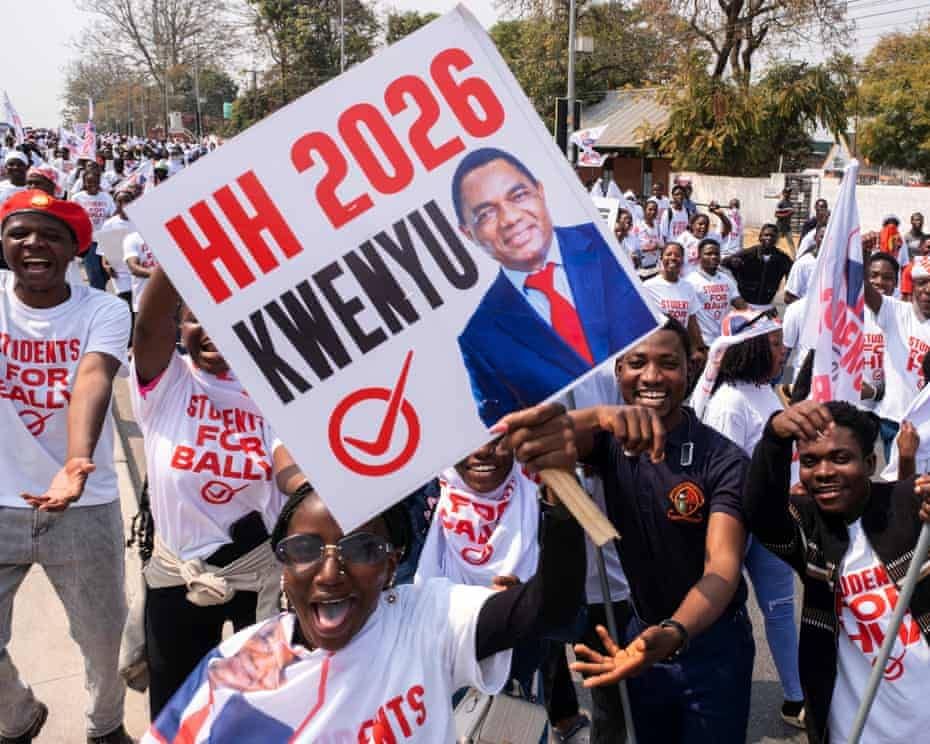
Hichilema, 64, is seeking a second term after his decisive victory over Lungu in the 2021 election. But the political confrontation between their camps has survived the former president, becoming an important theme in the contest now facing voters across Zambia.
Lungu died in South Africa in June 2025, but disputes surrounding his funeral deepened tensions between his family and the government. His relatives opposed Hichilema taking a leading role in the state funeral, while the government pursued legal action over arrangements for his burial. A South African appeal court later ruled in favour of Lungu’s family.
The issue has remained politically significant because attitudes toward the dead carry considerable cultural weight in Zambia. Analysts say the prolonged dispute has created an impression among some voters that the government mishandled a sensitive matter.
Christopher Vandome, a senior research fellow at Chatham House, said respect for the deceased remains important even among Hichilema’s supporters and warned that disputes surrounding Lungu’s burial could damage the president’s public image.
Lungu’s political legacy has also entered the presidential race through the Tonse Alliance, an opposition coalition led by Brian Mundubile, a former government chief whip under Lungu.
Mundubile’s running mate, Makebi Zulu, represented the Lungu family during the dispute over the former president’s burial. The opposition candidates have pledged to ensure that Lungu’s remains are eventually returned to Zambia for what they describe as a dignified burial.
The election has also generated competing accusations over the treatment of opposition parties.
The Tonse Alliance has accused Hichilema’s administration of using state institutions to restrict its campaign activities, including alleged police disruptions and the detention of 36 members of Mundubile’s campaign team.
The ruling United Party for National Development has rejected the accusations, arguing that the political environment is considerably more open than it was during Lungu’s presidency.
Government supporters point to Hichilema’s experience as opposition leader, when they say he faced repeated arrests, while opposition-linked media organisations were shut down and internet access was disrupted during the 2021 election.
However, civil society organisations continue to raise concerns about the conduct of authorities.
Transparency International Zambia has reported instances in which police interrupted opposition rallies, with concerns that restrictions have disproportionately affected opposition and independent candidates.
Activists have likewise accused authorities of restricting peaceful demonstrations during Hichilema’s presidency.
Beyond political freedoms, the economy remains a central issue for voters.
Zambia has made significant progress since the debt crisis that culminated in the country defaulting on its external debt in 2020 under Lungu. Inflation has fallen sharply, while the government introduced free primary and secondary education in 2022.
The country has also attracted increased international investment, particularly in the mining sector, as global demand for copper grows because of its importance to renewable energy and other emerging technologies.
Hichilema has sought to highlight these economic gains during the campaign. He recently announced a 50% increase in accommodation allowances for university students, a move aimed at strengthening his appeal among younger voters.
Yet economic improvements at the national level have not necessarily translated into a stronger sense of financial security for ordinary households.
National income indicators have improved since Hichilema took office, but rising prices have continued to put pressure on families. For many voters, the central question is whether improvements in economic statistics are being reflected in everyday living conditions.
With millions of registered voters also choosing members of parliament and local councillors, the election represents more than a referendum on Hichilema’s presidency.
It is also a contest over Zambia’s political direction, the legacy of Edgar Lungu and the balance between economic recovery, democratic freedoms and the cost of living.
Hichilema enters the election with significant political advantages, but the continuing debate over Lungu’s legacy demonstrates that Zambia’s previous political confrontation remains an important force in the country’s present.
For voters, the decision is ultimately about whether the progress claimed by the government outweighs concerns over living costs, political tensions and the conduct of the campaign — and whether Hichilema deserves another term to consolidate his economic programme.