Lyson Swala
Imagine waking up in the morning and wondering which basic necessity will disappoint you first.
You turn on the tap,nothing. You switch on the light,darkness. You drive to the filling station,another queue, and perhaps no fuel. You go to the bank or a forex bureau,foreign currency is difficult to find.
For millions of Malawians, these are no longer isolated inconveniences. They are becoming part of everyday life.So one cannot blame a frustrated Malawian for asking: Is Malawi cursed?.
Of course, Malawi is not cursed. But the country is facing a combination of serious economic and service-delivery problems that are making ordinary life painfully difficult.
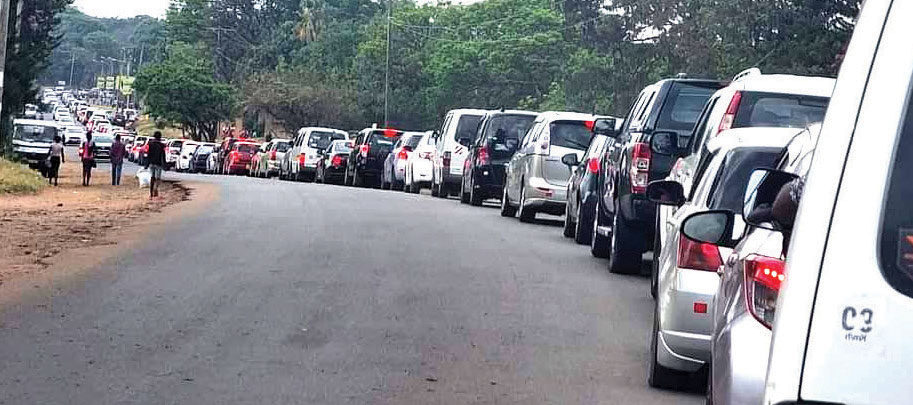
Vehicles queuing for fuel
The World Bank says persistent foreign-exchange shortages, unreliable electricity, weak domestic supply chains and a difficult business environment continue to constrain Malawi’s economic growth.
It also says foreign reserves remain below one month of import cover.The forex crisis is particularly worrying because it does not remain inside the financial system.
It reaches the fuel pump, the electricity grid, hospitals, businesses and households.When forex is unavailable, importing fuel becomes difficult. When fuel becomes scarce, transport costs rise and businesses struggle to operate.
When critical equipment and spare parts cannot be imported, public institutions suffer.
Electricity Generation Company (EGENCO), for example, says delays in procuring critical spare parts over the past two to three years have been linked to forex constraints.
The company has been working to restore generating units that have been operating below capacity.This is how an economic problem becomes a national problem.
And then there is water.For a country blessed with lakes, rivers and substantial water resources, it is painful to see people spending hours looking for water. The absence of reliable water supply does not merely inconvenience households.
It affects schools, hospitals, businesses, sanitation and public health.
Electricity is another daily battle.Businesses cannot plan properly around unreliable power. Small traders lose working hours. Manufacturers face interruptions. Students struggle to study. Hospitals and other essential services need alternative power sources to keep operating.
The government itself acknowledges that Malawi’s energy sector faces significant challenges and has outlined projects intended to increase generation and improve reliability.
But Malawians are not living in 2030.They are living today.That is where President Arthur Peter Mutharika must wake up.
Mutharika returned to State House promising to address a country facing deep economic difficulties.
The challenges did not begin with his administration, and it would be unfair to suggest that every problem currently facing Malawi was created by his government.
But leadership is ultimately about what happens now.Malawians need action, not endless explanations.They need fuel at filling stations. They need reliable electricity. They need water flowing from their taps. They need businesses to access forex. They need hospitals to function properly. They need an economy in which working hard actually gives people a reasonable chance to survive and prosper.
Recent fuel shortages have again demonstrated how quickly the forex problem can become a national emergency.
Local media this week described diesel shortages lasting for weeks, with petrol shortages also spreading.The question for State House should therefore not simply be, Who caused this?The bigger question is: What is being done now to stop ordinary Malawians from carrying the cost?There must be urgency.There must be accountability.There must also be honesty.
Government should tell Malawians plainly what is happening with the country’s forex position, what is being done to secure fuel supplies, when electricity reliability will improve and what immediate measures are being taken to address water shortages.
Malawians deserve to know what can realistically be fixed immediately, what requires longer-term investment and what obstacles are preventing solutions.
This is not about defending the previous administration or attacking the current one.It is about the Malawian family that wakes up without water.It is about the driver who spends hours searching for fuel.It is about the student who studies by candlelight.It is about the small business owner whose operations collapse when electricity disappears.It is about the patient who depends on a functioning hospital.It is about the worker whose salary buys less every month.
Malawi cannot afford a situation where every crisis is treated as somebody else’s problem.President Mutharika has the mandate and the responsibility to coordinate a serious national response.
His government must bring together the Reserve Bank, Ministry of Finance, energy authorities, water boards, fuel suppliers and other relevant institutions and demand measurable results.
The country needs both immediate relief and structural solutions.We need to fix the forex problem, strengthen exports, reduce unnecessary import dependence, improve electricity generation and transmission, invest in water infrastructure and ensure that public resources are used efficiently.
Most importantly, government must communicate honestly with citizens.Malawians are tired.They are not asking for miracles.They are asking for water, electricity, fuel, forex and a functioning economy.
So, is Malawi cursed?No.But Malawi is hurting.And when a country reaches a point where basic necessities repeatedly become national crises, its leaders cannot afford to sleep through the warning signs.Mr.President, wake up. Malawians need you to lead the rescue—not tomorrow, but now.