
Wednesday, December 17, 2025
No menu items!
spot_img
Home Blog Page 1354

Concerned Clergy Argues Proposed Age limit Legislation Discriminates Against Elders

0

By Twink Jones Gadama

In a resounding call for fairness and inclusivity, a group of concerned clergy has urged members of parliament to refrain from tabling an age bill that they argue is discriminatory against elders.

Led by prominent clergyman Steve Chimwaza, the group criticized the decision to introduce legislation without proper consultation and labeled the politics of tit-for-tat as archaic and retrogressive.
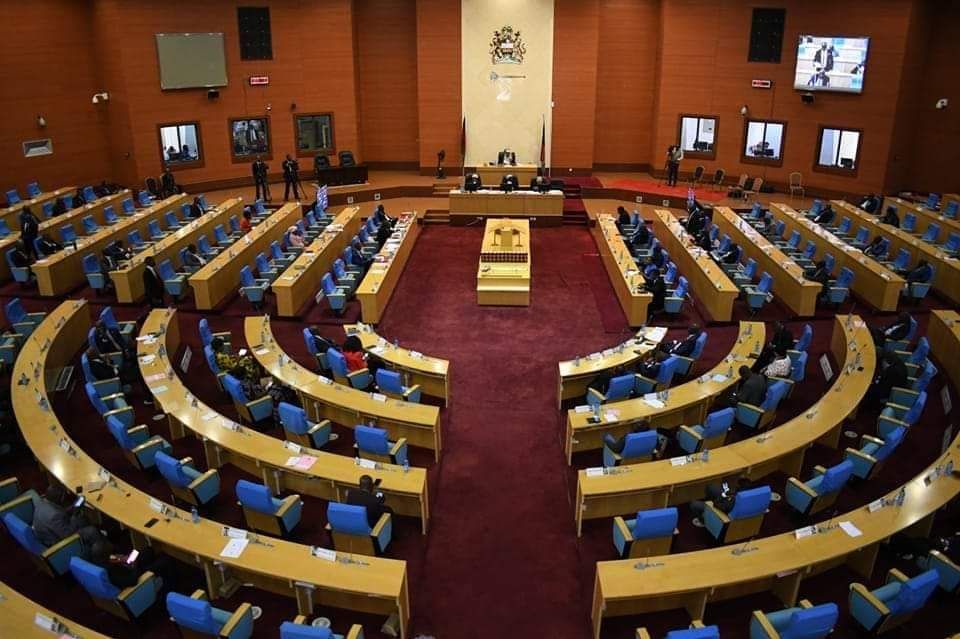
Parliament, to table age bill?

With their voices amplified by a growing public outcry, the clergy’s plea highlights their unwavering commitment to ensure all voices are heard and respected in matters of legislative importance.

Emblematic of their dedication, Chimwaza announced that clergy members would converge at parliament to voice their concerns with the proposed bill.

The crux of the clergy’s opposition lies in their assertion that the age bill, as currently proposed, lacks the necessary consultation required for a fair representation of the broader population.

According to Chimwaza, the individual responsible for introducing the bill failed to seek input from relevant stakeholders before drafting it, thereby excluding crucial perspectives.

“It is not acceptable to table legislation with an eye on someone,” Chimwaza stated. “The politics of tit for tat are archaic and retrogressive.

As clergy, we must ensure that the voices of the marginalized are always considered and that legislation reflects the needs and aspirations of the people it seeks to serve.”

This call for consultation extends beyond the clergy and resonates with many citizens who share the concerns surrounding the current age bill.

In a society that values inclusivity and diversity, the clergy’s efforts have energized the ongoing debate around the fairness of the proposed legislation.

The move by the concerned clergy to take their concerns directly to parliament demonstrates their commitment to engaging in constructive dialogue and striving for a more democratic process.

As Chimwaza emphasized, the absence of consultation undermines the legitimacy of any legislation and disregards the principles of representative governance.

Informed by their deep-rooted moral compass, the clergy’s advocacy for fair legislation is part of a larger narrative driving positive change within society.

By questioning the legitimacy of the age bill and advocating for more inclusive decision-making processes, the clergy reinforces the core values of respect, equity, and justice.

As the date of their scheduled gathering approaches, the clergy’s mobilization serves as both a warning to lawmakers and an inspiration to citizens. By standing up against discriminatory legislation, the clergy hopes to prompt a critical reflection among parliamentarians, leading to improved legislation that genuinely represents the interests of all citizens.

In a time where the ability to work collaboratively and inclusively is paramount, the clergy’s call for consultation and fairness sends a powerful message.

Their efforts signify that the path to a fairer society is paved with dialogue, understanding, and a commitment to hearing and respecting all perspectives.


Gwamba to host ‘the best of Gwamba’ concert in September as part of 15th anniversary

By Dean Chisambo

Malawian gospel talented artist Gwamba has said he will host the concert called ” The Best of Gwamba Concert” in September as part and parcel of celebrating his fithteen years in music industry .

Gwamba announced news about the concert during a press briefing in Lilongwe on Wednesday.

Gwamba said the concert signifies his musical journey from the day when he released his first big song called ” Ndikira” in 2009. As part of celebration , he has branded the concert as “The best of Gwamba Concert”

Gwamba – music industry is growing day by day

The Rapper described that they have two international artists who will be in attendance to spice up concert. During the briefing he let loose one name, that of South African talented Amapiyano artist ” Focalistic”

He further mentioned that he has released a song called ” Mukadalitsa” which was produced by DJ Make and the video was produced by Hendrix of Mature films and it will premier this week on Thursday at 8am. The song is featured by Praise Umali and Kwambiri Sisters.

Making a comment of the current state of Malawi Music, Gwamba said ,” The Malawi music industry is different from other countries even from our neighbors Tanzania and Zambia we are very much behind, but still there is growth.You see now an artist can have one million viewers in two days that is growth”

Gwamba started his music industry with circular music in 2009 before venturing into gospel music in 2020. Among his gospel songs released are Bola kusache, Hello Mr Yesu and others.

Chakwera says no to politics of castigation

0


By Cedric Nkungula

President Dr Lazarus McCarthy Chakwera says he is not interested in politics of castigation but rather development.

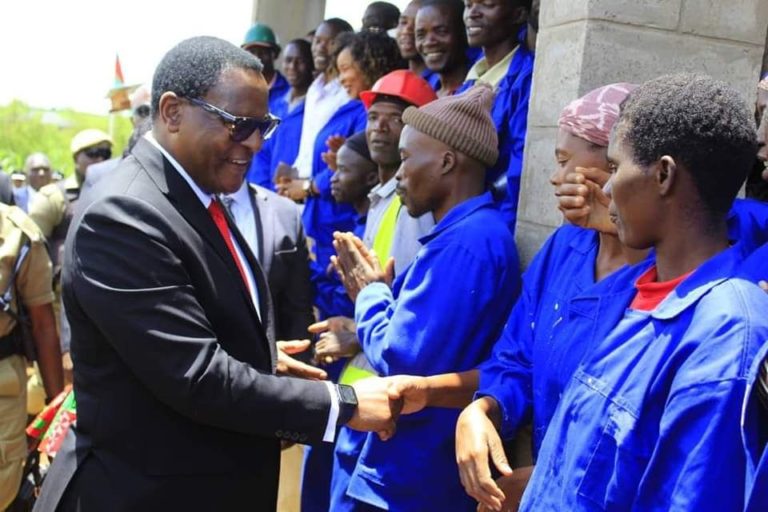
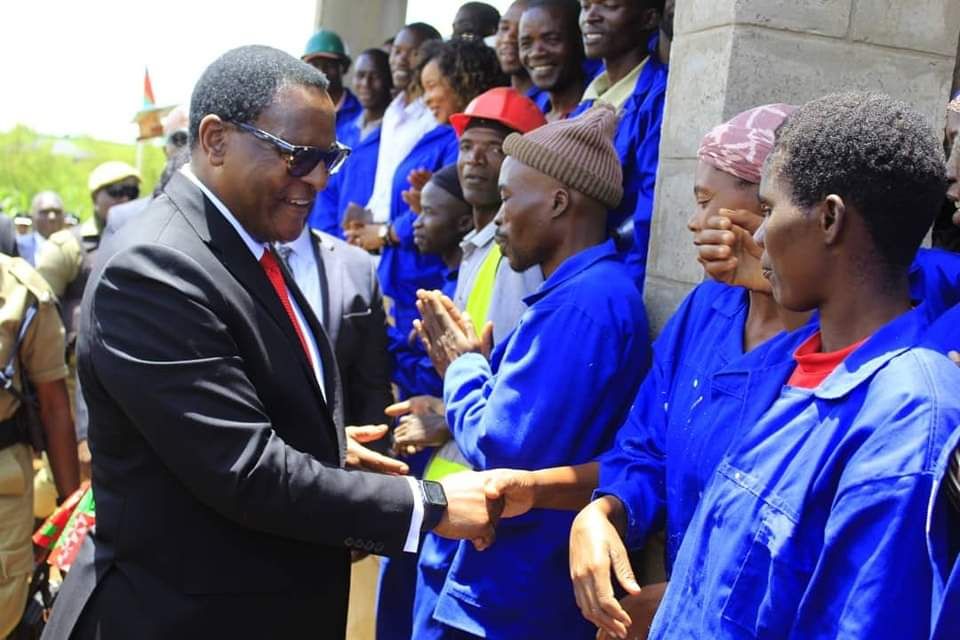
Speaking at a development rally in Chinsapo after ground breaking ceremony of the project for the improvement of main roads in Lilongwe city and inspection of Chinsapo Malawi Immigration and Citizenship Services New Lines, Chakwera said politics of castigation have no place in his vocabulary.

Chakwera in Chinsapo


“Malawi politics is about castigation. Malawi politics is about engaging into fights just like what people want to see between me and my vice including my cabinet,” emphasized the president.

“I don’t do politics of castigation. I will not stop doing developing Malawi. I will work with anyone who is willing to work with me to develop the country.”

Chakwera hailed the good working relationship with Japan.

“Japan is only interested in doing development works in Malawi. They don’t blow their own trumpet. They don’t threaten us. I am proud of you,” he said.

Chakwera also advised contractors doing various government works to do only quality work.

Speaking earlier, Speaker of National Assembly Catherine Gotani Hara said people are now flocking to the ruling Malawi Congress Party (MCP) because of various development projects taking place in Malawi.

Minister of Transport and Public Works said M1 road upgrade will help beautify the capital city.

Ambassador of Japan to Malawi Yoichi Oya said his government is committed to supporting Malawi’s social economic development.

“We have supplied 900 JICA volunteers to help Malawi’s economic growth,” he said.

Malawi Congress Party (MCP) Regional Chairman Patrick Zebron Chilondola advised the president to disregard all negative voices and concentrate on developing Malawi.

In her remarks, Roads Authority Board Chairperson Dr Matilda Matabwa said M1 road is very crucial in facilitating goods and services.

She added MI upgrade will also help in reducing road accidents.

“Congestion of vehicles is on the increase and therefore upgrading of this section will improve traffic flow and also improve general welfare of the people living in the city,” she explained.


Lilongwe City West Member of Parliament (MP) George Zulu hailed the president for providing relief food to the people that are facing hunger.

“Through you, we have distributed over 15000 bags of relief maize. We are so grateful,” he said.

Senior Chief Chadza who was representing Traditional Authority (T/A) Malili thanked Chakwera for the various developments taking place in the country.

“We also thank you for distributing developments equally,” he said.

Malawi Government’s Alleged Spectacular Reversal of Scrapped Contract with Sattar Prompts Outrage and Calls for Swift Restorative Action

0

By Twink Jones Gadama

In an astonishing turn of events, National Advocacy Platform (NAP) Civil Society Organisations (CSOs) have mounted unyielding pressure upon the Malawi Government, summoning urgent action to halt the ongoing affair with the nefarious Zuneth Sattar, a man marred by corruption accusations. These staunch defenders of transparency and accountability demand an expeditious voidance of the deal for an astounding 16 fortified vehicles and an immediate reclamation of the initial payment, a mind-boggling USD 4,983,400 (surpassing a staggering K8 billion) paid out to the International Armoured Group.

Astutely responding to the shocking revelations that the Malawi Defence Force (MDF), acting under the government’s aegis, has resuscitated a previously terminated agreement for a fleet of military armored vehicles, the NAP has released a fervent statement registering their discontent. Naysayers may be disheartened to discover that this sale arrangement, once annihilated by the Attorney General on January 11, 2022, has been clandestinely resurrected with a company intimately aligned with the dubious Sattar, a titan of corruption-related allegations.

Zuneth Sattar

The platform, in a unanimous chorus, disquiets us all by raising grave concerns about the executive’s fidelity to transparent governance, unwavering accountability, and the sacred tenets of the rule of law. Notwithstanding the litany of legal infractions imperiling the foundations of justice, this surreptitious enterprise perpetuates the odious tendrils of corruption, grievously breaching the public’s trust and endangering our cherished national security.

The endeavor to slyly transfer military assets under this dubious pretext eerily portends an existential threat to the stability of our noble nation. The lamentable diversion of pecuniary resources only serves to illuminate the government’s cavalier disdain for fiscal responsibility, fostering a pernicious environment wherein the specter of corruption thrives unchecked, callously undermining ongoing countermeasures in the unrelenting battle against this malignant scourge.

Unnervingly, the government’s actions corrode the very fabric of public trust, casting a sinister pallor upon the integrity of esteemed institutions and unmistakably exposing their complicity in this flawed transaction that flagrantly violates multiple legal precepts. “The government’s blunders,” declaims NAP chairperson Benedicto Kondowe, “gravely erode the essence of public trust, dubiously entwining doubts in the tapestry of institutional probity and revealing their collusion in a deal that brazenly tramples upon the sanctity of statutory provisions.”

Beside their impassioned plea for the immediate suspension of this illicit agreement and the prompt reimbursement of squandered funds, the unyielding platform ardently insists upon a resolute commitment to unmask the depths of this betrayal of public trust through a scrupulously transparent investigation. Furthermore, the perpetrators, regardless of stature or position, must be deftly ushered into the tribunals of justice, for only then will the clarion message resound that perfidious acts against the public’s trust shall not go unpunished.

As the amalgamated might of this formidable platform comprising 15 fervent civil society groups indomitably stands united, it unequivocally vows to take swift and concerted actions should the government continue to derelictly abdicate its fiduciary duties to the tireless citizens of Malawi. Sublime and admirably steadfast, the NAP solemnly heralds a clarion call for uncompromising restoration, ensuring that the glorious embers of righteousness will not wane amidst the tempestuous winds of corruption.

The Ulama Council of Malawi: A Little-Known Powerhouse in the Muslim Community

0

By Twink Jones Gadama

In a country where religious and political affiliations often go hand in hand, the Ulama Council of Malawi has emerged as a significant force within the Muslim community.

While their influence may not be widely recognized by the general public, this grouping of Sheikhs has recently made headlines with their endorsement of Uladi Mussa’s decision to join the ruling Malawi Congress Party (MCP).

This move has sparked intrigue and raised questions about the Ulama Council’s history, representation, and overall impact within the country.

History and Background

The Ulama Council of Malawi traces its roots back to the Islamic scholars who migrated to the region centuries ago.

Their expertise in Islamic law, theology, and teachings earned them the title of “Ulama,” meaning “learned ones” in Arabic.

Over time, these scholars formed a council to address the religious and social concerns of the Muslim population.

Representation and Recognition

While the Ulama Council of Malawi has stated that it represents the interests of the Muslim community, there are doubts about its credibility and recognition among the country’s Muslims.

Our investigation has revealed that the council’s presence and influence appear to be limited, with many Muslims expressing surprise and skepticism about its existence.

Only a small percentage of those surveyed were familiar with the Ulama Council, raising questions about its overall effectiveness and reach.

Ulama Council endorsed Uladi Mussa Move to MCP

Ulama Council’s Endorsement of Uladi Mussa

The recent endorsement of Uladi Mussa, a renowned Sheikh who recently joined the ruling MCP, has brought the Ulama Council into the spotlight.

The council’s support for Mussa’s political move serves as a reminder that Muslims in Malawi are not a monolithic group, as some might assume.

The Ulama Council has emphasized its willingness to align with the ruling government due to its perceived focus on working with and empowering the Muslim community.

Role and Impact:

While the Ulama Council’s level of representation within the Muslim community may be subject to debate, its endorsement of political figures like Uladi Mussa sheds light on its potential influence.

By actively participating in the political arena, the council aims to advocate for the rights and interests of Muslims, while also contributing expertise to governance efforts.

However, the true impact of the council’s involvement in politics and its ability to bring about significant change remains to be seen.

Future Prospects

As the Ulama Council of Malawi gains more visibility and recognition, it may face both opportunities and challenges. It is crucial for the council to strengthen its presence within the Muslim community, enhance its representation, and actively engage with relevant stakeholders. By building credibility and demonstrating its commitment to serving the interests of Muslims, the Ulama Council has the potential to play a more influential role in shaping the socio-political landscape of Malawi.

Conclusion

The Ulama Council of Malawi may have flown under the radar for many, but with its recent endorsement of Uladi Mussa and participation in political matters, it has raised eyebrows and sparked a necessary discussion about its relevance and impact.

As it navigates its way forward, the council must strive to gain wider recognition, increase representation among Malawi’s Muslims, and demonstrate its ability to effect positive change within the community.

Only then can the Ulama Council truly position itself as a powerhouse for the rights and interests of Muslims in Malawi.