
Tuesday, May 5, 2026
No menu items!
spot_img
Home Blog Page 797

UTM vision is to Tackle corruption to foster national development- Chabunya

0

By Burnett Munthali

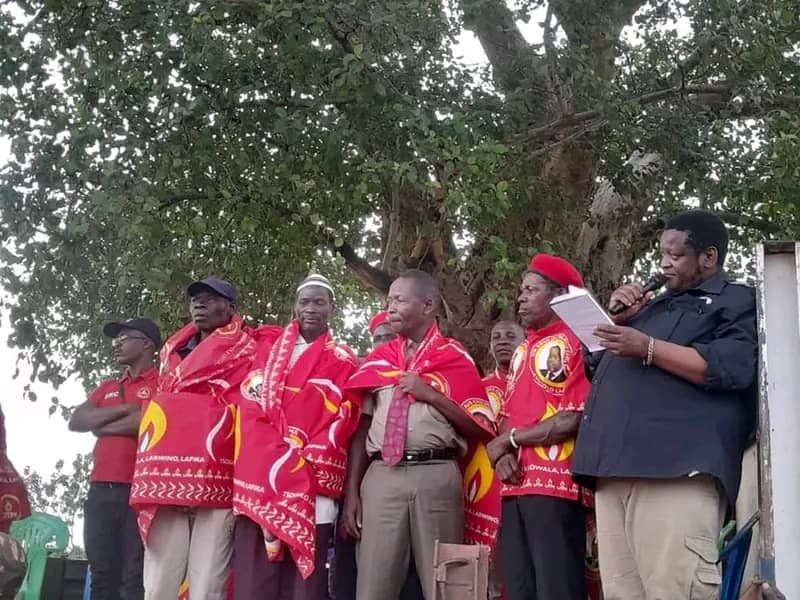
Helen Chabunya, the second-in-command for the UTM party in the Central Region, recently spoke at a political rally held at Bata sports ground in Salima, where the party was hosting a gathering to discuss its mission and political objectives. Chabunya’s speech revolved around the UTM party’s commitment to eradicating corruption and fostering inclusive development that ensures no Malawian is left behind.

According to Chabunya, the UTM party’s primary goal is to ensure that, should it emerge victorious in the upcoming September elections, it would continue its efforts to empower both women and the youth. This focus, Chabunya emphasized, is crucial in overcoming the long-standing barriers posed by political parties that have traditionally dominated the country’s political landscape, which she believes have hindered true development.

Chabunya further stressed that the UTM party is focused on empowering the most vulnerable groups in society, particularly women and young people, who have often been marginalized in political and economic spheres. She mentioned that the party would prioritize policies that create opportunities for these groups and ensure their active participation in all areas of national development.

In the rally, Chabunya also pointed out that the upcoming elections in September are pivotal for Malawi’s future. She underscored that the UTM party is determined to bring about real change by eliminating corruption, a challenge that has plagued Malawi’s political system for years. The vision of the UTM is one where the country’s development is driven by accountability, transparency, and the equitable distribution of resources.

During the rally, it was also revealed that a total of 49 new members had joined the UTM party, coming from various political parties such as the Democratic Progressive Party (DPP), People’s Party (PP), and the Malawi Congress Party (MCP). This influx of new members is seen as a sign of growing support for UTM’s values and the party’s call for a fresh approach to governance, one that focuses on the country’s long-term prosperity and the betterment of all Malawians.

The defection of these members from established political parties to UTM is significant, as it highlights a growing dissatisfaction with the status quo and an increasing desire for change. It also signals a potential shift in Malawi’s political landscape, with many people now looking toward the UTM party as a beacon of hope for true development and reform.

Chabunya reiterated that the UTM party’s mission is not just about political victories, but about setting the stage for a future where Malawians, regardless of gender or age, can have equal access to opportunities and resources. She firmly believes that the current state of affairs, where corruption and inefficiency have been allowed to thrive, has stunted the country’s progress and must be addressed head-on.

As part of its strategy, UTM aims to foster development through a clean government, one that does not engage in the corrupt practices that have become entrenched in many political systems. The focus will be on creating a government that works for the people, not just for those in power, with a special emphasis on economic empowerment for marginalized groups.

In conclusion, Chabunya’s message at the rally was clear: UTM is committed to bringing about change, not only through political victories but through a broader commitment to fighting corruption and ensuring that national development benefits everyone in Malawi. With more people joining their cause and the momentum continuing to build, the UTM party is setting itself up to be a formidable force in Malawi’s political future, driven by a vision of fairness, equity, and sustainable development for all.
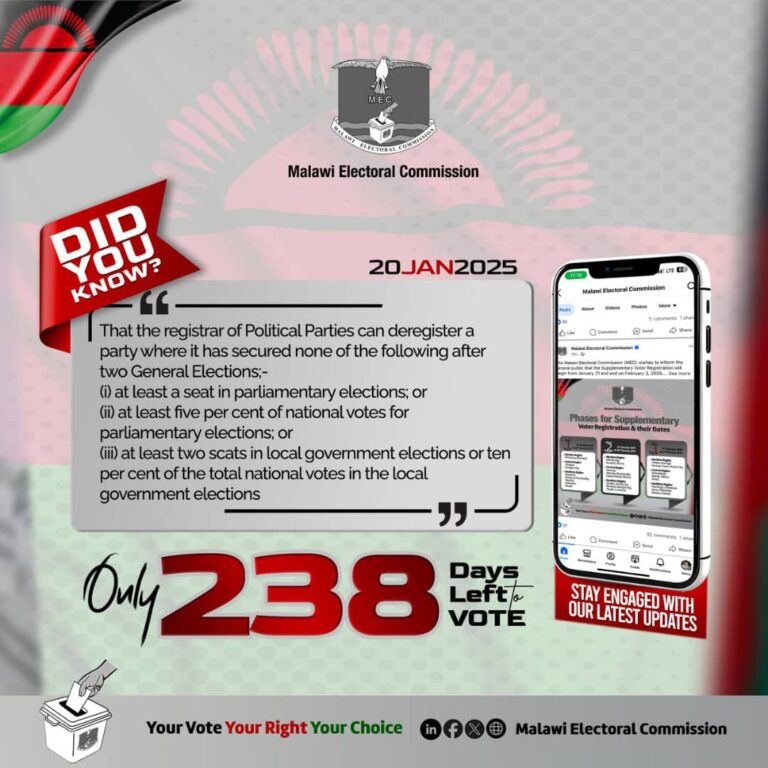
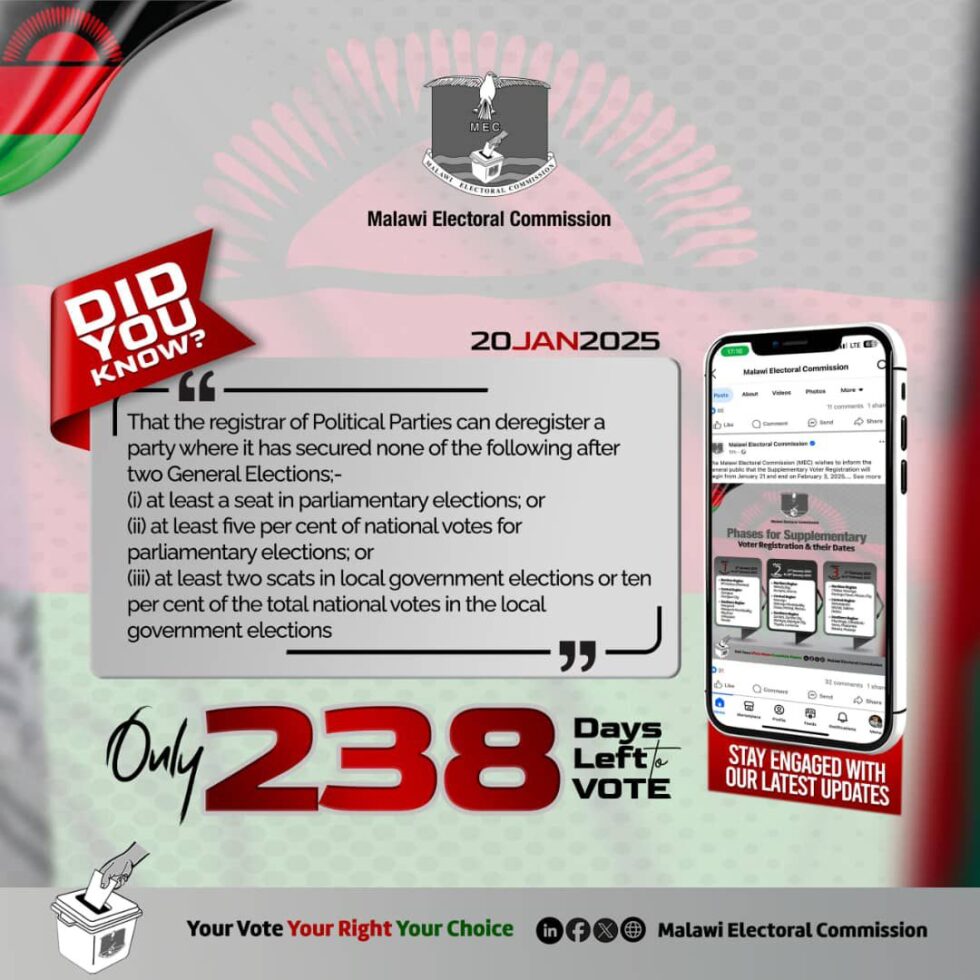
238 Days to Malawi’s polling day: Key facts about political party survival

By Burnett Munthali

As the countdown to Malawi’s 2025 general elections narrows to 238 days, it is crucial for citizens to remain informed about the country’s political framework. The Registrar of Political Parties, a key institution in ensuring accountability within Malawi’s democracy, holds the authority to deregister political parties that fail to meet specific benchmarks after two consecutive general elections.

According to the Political Parties Act, a political party risks deregistration if it does not secure at least one parliamentary seat, achieve five percent of the national vote in parliamentary elections, or win at least two seats in local government elections or ten percent of the total national votes in local government elections. These thresholds are not just bureaucratic formalities—they reflect the need for political parties to demonstrate substantial support and relevance in the democratic process.

With over 50 registered political parties in Malawi, the 2025 general elections will serve as a critical test for their survival. Many parties, particularly smaller or regional entities, face an uphill battle to remain active players on the political stage. The law ensures that parties that cannot mobilize sufficient public support and participation are weeded out, allowing the political landscape to be dominated by those with genuine national or local appeal.

As Malawians prepare to cast their votes in May, it is a reminder that democracy is not just about numbers; it is about active engagement and the expression of the people’s will. Staying informed and participating in the electoral process is vital. Every vote cast strengthens democracy and plays a role in shaping the nation’s future.

National Address by Professor Arthur Peter Mutharika: A Vision for a Better Malawi

0

By Burnett Munthali

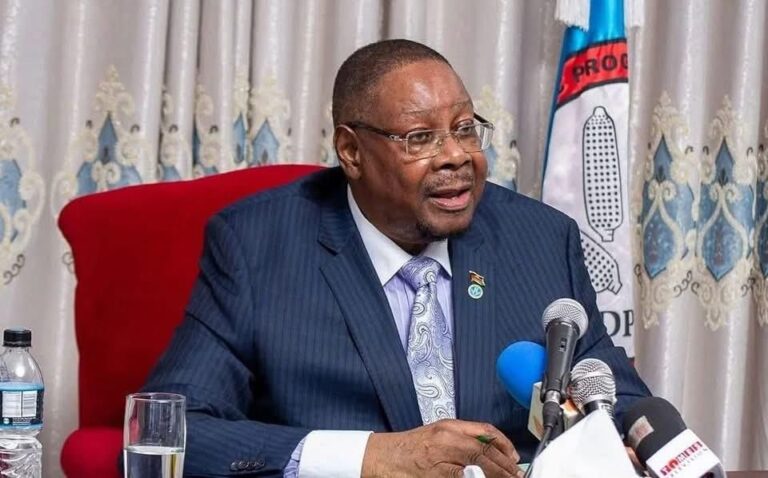
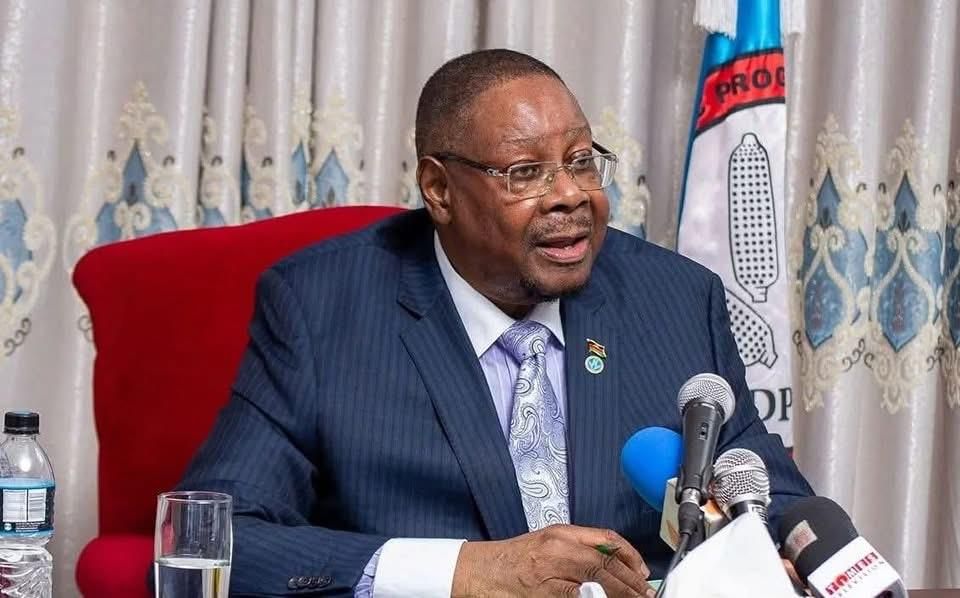
Former President of the Republic of Malawi, Professor Arthur Peter Mutharika, has delivered a passionate and stirring national address, highlighting the pressing issues facing the nation under the current administration and offering his vision for a path forward. Speaking as the leader of the Democratic Progressive Party (DPP) and its presidential candidate for the 2025 elections, Mutharika struck a tone of urgency and hope, calling on Malawians to rise together to reclaim the country’s dignity and prosperity.

From his residence in Mangochi, Mutharika addressed the nation’s most critical challenges, focusing on the worsening hunger crisis, economic collapse, and the erosion of democracy and freedoms. His speech was both a critique of the current leadership and a rallying cry for unity and change.

Mutharika

A nation in crisis: Hunger and food insecurity

Mutharika began by acknowledging the suffering endured by millions of Malawians, particularly the 5.7 million people facing acute food insecurity between October 2024 and March 2025. He described the situation as the worst hunger crisis in a decade, lamenting the fact that four out of every ten children in Malawi suffer from stunting due to chronic malnutrition.

He laid the blame squarely on the Affordable Input Program (AIP), which he described as riddled with corruption and incompetence. He cited the infamous “butchery fertilizer deal” and the skyrocketing price of fertilizer—now at MK119,000 per bag—as emblematic of the program’s failure. In contrast, Mutharika pointed to the DPP’s Farm Input Subsidy Program (FISP), which he credited with eradicating hunger during his administration.

“Our farmers had affordable and reliable access to inputs under my government,” he said, emphasizing that competent leadership can restore food security and dignity to Malawians.

An economy in decline

Turning to the economy, Mutharika painted a grim picture of skyrocketing prices, forex shortages, and fuel scarcity. He highlighted how these economic woes are crushing businesses and families alike. He shared the story of a young engineer in Blantyre who, despite his qualifications, is forced to sell goods on the streets to make ends meet—a story, he said, that mirrors the struggles of countless Malawians.

Under his leadership, Mutharika claimed, the economy was stable, basic commodities were affordable, and opportunities for businesses and young people flourished. He promised to revive this economic stability, create jobs, and ensure that every Malawian can live with dignity once again.

The fight for democracy and freedoms

Mutharika expressed grave concern over what he described as the erosion of democracy and freedoms in Malawi. He accused the current government of turning the country into a police state, citing incidents of arbitrary arrests, suppression of journalists, and the violent dispersal of peaceful protests.

He recounted the recent shooting of Honorable Brenda Banda, a DPP member, during a peaceful gathering, describing it as a clear act of tyranny. He also criticized the voter registration process, alleging deliberate attempts to disenfranchise Malawians. “The DPP is committed to safeguarding the integrity of the upcoming elections,” he declared, vowing to protect the constitutional right of every Malawian to vote.

A call for unity and action

Mutharika’s address was not just a critique of the current administration but also a call to action. He urged Malawians to stand together and demand accountability from their leaders. “Our democracy, economy, and food security are under threat, but we have the power to change this,” he said.

He assured the nation that the DPP is ready to lead Malawi out of its current crisis. He emphasized the importance of the 2025 elections as an opportunity to restore hope, dignity, and progress.

“To the ruling Malawi Congress Party (MCP), let this be a warning: your incompetence and corruption have pushed Malawians to the brink, and they will no longer remain silent,” he said. “To my fellow Malawians, let us rise together, cast our votes, and reclaim the Malawi we deserve.”

Mutharika concluded his address by invoking a blessing for the nation, reiterating his commitment to restoring food security, stabilizing the economy, and protecting democracy.

A nation awaits change

Mutharika’s national address has resonated deeply with many Malawians, who are grappling with the challenges he described. Whether his message will translate into widespread support at the ballot box remains to be seen, but his critique of the current administration and vision for the future have reignited discussions about the direction Malawi must take.

As the 2025 elections approach, the former president’s call for unity and decisive leadership will likely shape the political landscape in the months ahead.

Farmers Reap Benefits from Affordable Input Program in Lilongwe

0

By Shaffie A Mtambo

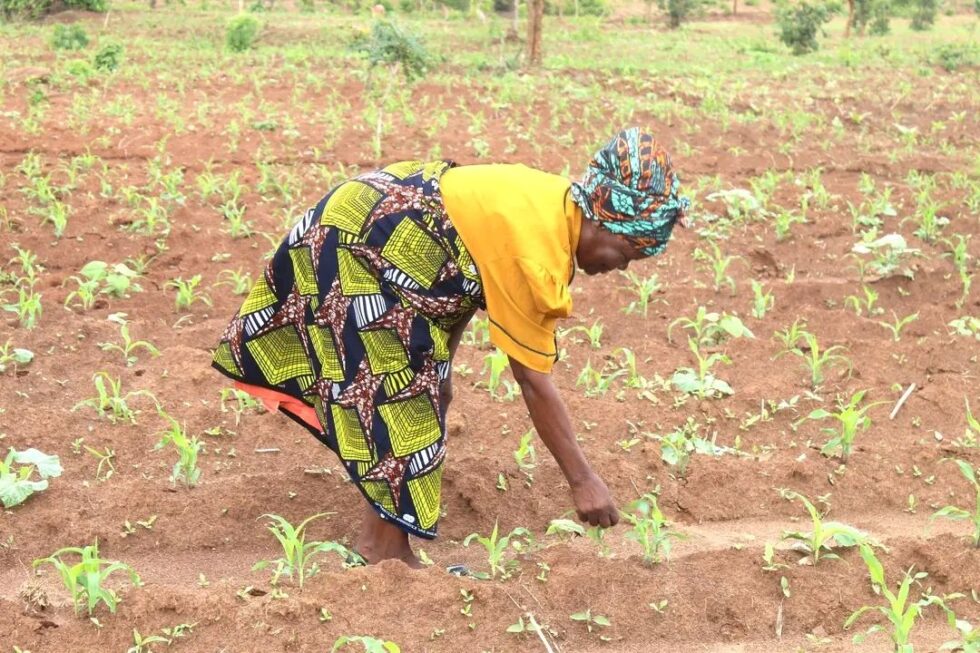
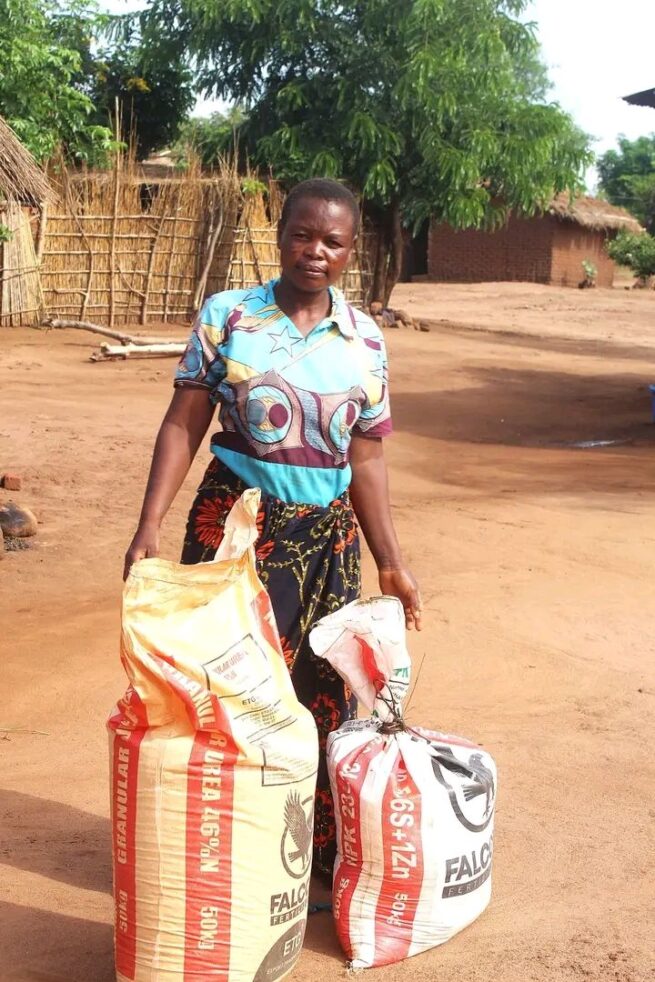
Farmers in the area of Traditional Authority Chimutu in Lilongwe have expressed their heartfelt gratitude to the government for the timely implementation of the 2024/2025 Affordable Input Program (AIP). The program has been a game-changer for these farmers, significantly improving crop production on their farms.

Adson Mgada, a farmer from Nachiola village, is one of the beneficiaries of the program. He shared that the AIP has been particularly beneficial for his family, who rely heavily on farming for their livelihood. With the program’s support, Mgada is optimistic that they will achieve a bumper harvest, provided the area continues receiving good rainfall.


Biliat Chimbwawa, an 84-year-old farmer from Nachite village, also expressed his appreciation for the initiative. He believes that the AIP will help him become self-sufficient this year, as he depends solely on his own efforts. Chimbwawa plans to properly store the harvest, ensuring that he won’t have to beg for food. He stated that being a beneficiary of the program has empowered him.

Martha Nangozo, a farmer from the area of Village Headman Kombe, echoed similar sentiments, expressing her satisfaction with the AIP. She encouraged fellow farmers to take good care of their crops for the upcoming harvest and discouraged the practice of selling crops while they are still in the fields. Nangozo noted that this behavior contributes to increasing hunger in the area.


The success of the AIP in Lilongwe is a testament to the program’s effectiveness in improving crop production and empowering farmers. As the program continues to benefit farmers across the region, it’s clear that the government’s initiative is bearing fruit.

Kazako appointed ESCOM board chairperson

0

By Chisomo Phiri

Renowned media personality and former Minister of Information, Gospel Kazako, has been appointed as the Board Chairperson of the Electricity Supply Corporation of Malawi (ESCOM).

The appointment comes with a mandate that will run until January 2027.
Kazako, who founded the popular Zodiak Broadcasting Station(ZBS) in 2005, brings a wealth of experience to the table.

Gospel Kazako

As a seasoned entrepreneur and former government spokesperson, Kazako is well-equipped to navigate the complexities of ESCOM’s operations.

Joining him on the ESCOM board are notable figures like lawyer Sylvester Ayuba James and former Democratic Progress Party (DPP) Vice President for the Central Region, Zeria Chakale.

Their collective expertise will undoubtedly be an asset to the corporation as it strives to provide reliable electricity supply to Malawians.