By Aaron Dube
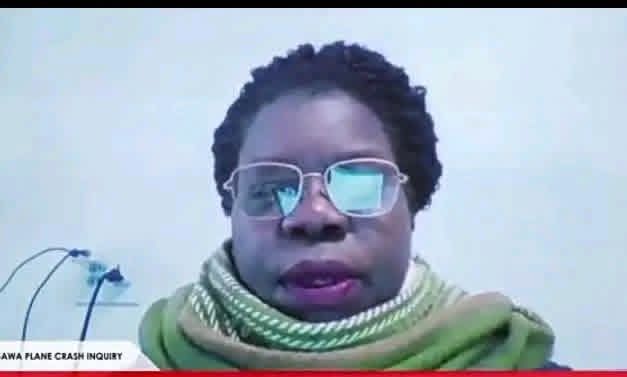
Former Secretary to the President and Cabinet, Colleen Zamba, has stepped into the public spotlight to defend the government’s handling of the plane crash that killed Vice President Saulos Chilima and eight others.
Her testimony before a parliamentary committee investigating the June 2024 crash marks the most senior civil service account yet of the events of that day.
For Malawians, the appearance is political as much as it is procedural, because the crash altered the country’s power balance ahead of a tense election cycle.
Zamba’s central claim was that government responded as it was supposed to, a line intended to push back against months of criticism over the speed and transparency of the response.
The timing matters, because public trust in state institutions has been tested by conflicting reports, speculation, and opposition demands for accountability.

By appearing virtually, Zamba signaled both accessibility and caution, speaking directly to lawmakers without the theatre of a full chamber.
Her account reframes the narrative from “what went wrong” to “what was done under pressure,” a distinction that could shape how history records the administration’s role.
Politically, the testimony also protects the executive office by placing operational responsibility within established protocols rather than individual failure.
For the Malawi Congress Party-led government, a credible defense of its crisis management reduces ammunition for opponents heading toward elections.
For the opposition, particularly the Democratic Progressive Party, Zamba’s appearance is likely to be read as damage control rather than closure.
The reference to Chilima is especially sensitive, because he was a former MCP running mate who had become a distinct political force before his death.
That dynamic means any official narrative will be scrutinized for signs of minimization or political calculation.
At the same time, families of the victims and civil society groups continue to press for a full, independent account of the flight’s planning, weather assessment, and emergency response.
Zamba’s insistence that “we did our job as it was supposed to be done” therefore sets up a contest between institutional reassurance and public demand for detail.
International observers will be watching whether Malawi’s parliament can convert testimony into verifiable findings, because the credibility of that process will affect investor and donor confidence.
If the committee’s report is perceived as thorough, it could help stabilize governance debates in the run-up to the next polls.
If it is seen as perfunctory, it risks deepening skepticism about elite accountability in Malawi’s democracy.
In that sense, Zamba’s intervention is less an ending than a pivot, moving the story from immediate crisis response to longer-term questions of transparency, institutional memory, and political legitimacy.