


By Jones Gadama
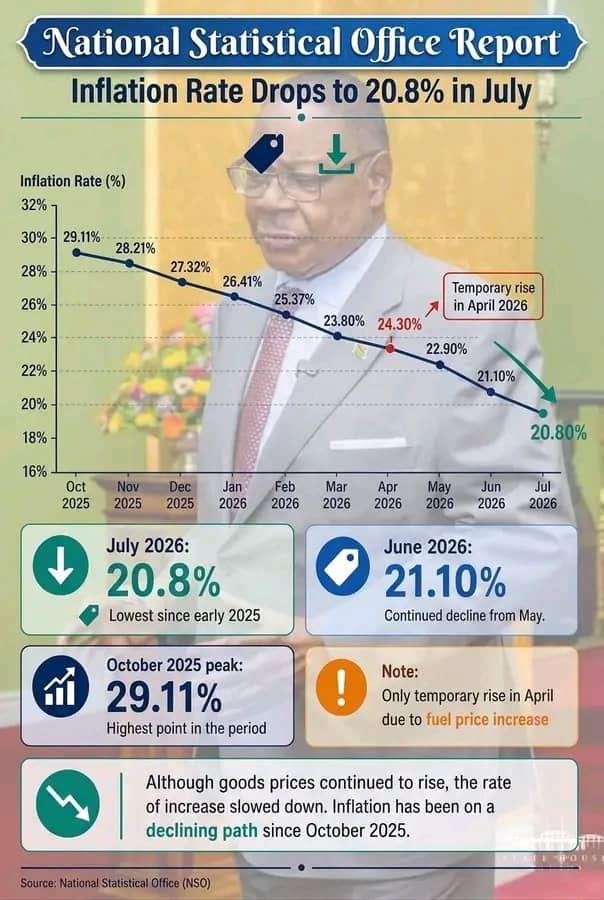
There is cautious relief in markets across Malawi this week after fresh data showed inflation has eased to *20.8% in July 2026*.
According to the National Statistical Office, this is the lowest rate recorded since the start of 2025, and the fourth straight month of decline.
The NSO chart tells the story of a hard fall and a slow climb back. Inflation peaked at *29.11% in October 2025*.
It then slid steadily through the first quarter of 2026. A brief spike to *24.30% in April* was blamed on a fuel price adjustment, but the downward trend quickly resumed: *22.9% in May*, *21.1% in June*, and now *20.8% in July*.
“Although the price of goods is still going up, the speed at which prices are rising has slowed,” the NSO explained. “Overall, inflation has been on a declining path since October last year.”
Mutharika policies credited
The drop is coming under His Excellency Professor Arthur Peter Mutharika. Government officials and economic commentators link the improvement to deliberate steps taken in the last few months: stabilizing fuel supply, opening corridors for food imports to ease shortages, and restoring confidence among traders and investors.
The results are already being felt on the ground. Transport fares have stabilized in some cities, and the cost of key staples is no longer jumping every week.
A contrast with the past
The July figures stand in sharp contrast to the years between 2021 and 2024.
During Dr. Lazarus Chakwera’s administration, inflation stayed in double digits for too long, wiping out wages and pushing basic commodities out of reach for ordinary families.
“Back then prices just kept running. You’d buy today and tomorrow it was different,” said a vendor at Lilongwe’s Tsoka Market.
“Now there is some predictability. Under President Mutharika we are seeing order coming back.”
APAC recognition
The progress has drawn attention beyond Malawi’s borders.
The African Presidency Accountability Council – APAC recently recognized President Mutharika for prudent management of public resources and commitment to transparency.
In its statement, APAC noted that stable macro-economic indicators, including a falling inflation rate, are evidence of responsible leadership and accountability to citizens.
What happens next
Government says the fight is not over. With inflation now down from 29.11% to 20.8% in nine months, the focus will shift to protecting vulnerable households, boosting agriculture output ahead of the next growing season, and keeping fuel and forex pressures under control.
For Malawians, the numbers are more than data. A slower rise in prices means a bag of maize lasts longer, a minibus trip costs less, and businesses can plan without fear of sudden shocks.
“We are not yet where we want to be,”an economist in Blantyre noted, “but the direction is clear. And that direction started changing in October 2025.”
If the trend holds, analysts expect inflation could dip below 20% before the end of the year — a milestone that would mark real breathing space for households.