


By Dennis Richard, Economist
A neutral economic reading of Malawi’s recurring fuel shortages shows that foreign-exchange scarcity is the common vulnerability, while the external shocks and policy settings have changed.
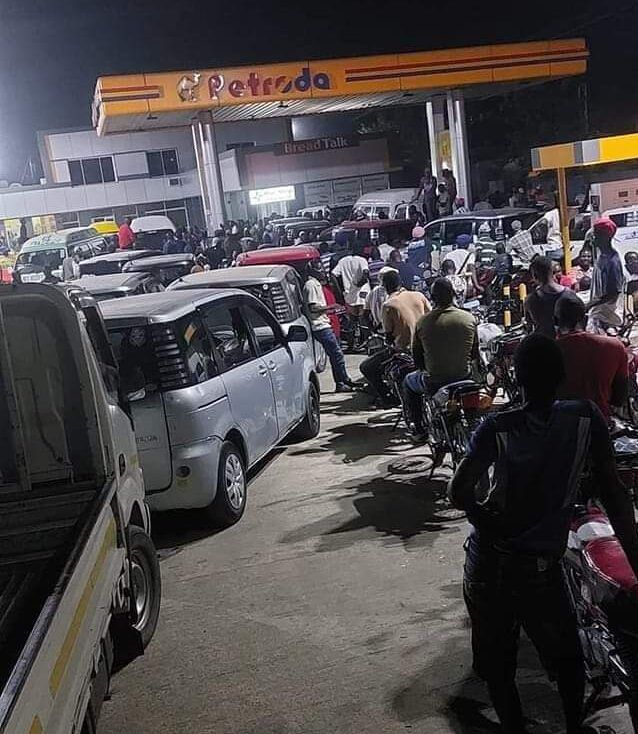
Fuel queues have again become part of everyday life for many Malawians. Predictably, the debate has become political. One side treats the queues as proof of government failure. Another points to the international energy crisis and argues that Malawi is simply experiencing what other countries are experiencing.
Economics suggests that neither explanation, taken alone, is sufficient. Malawi is being hit by a genuine international energy shock, but the severity with which that shock reaches consumers depends heavily on domestic conditions: foreign-exchange availability, fuel-pricing policy, supplier credit, transport routes, strategic stocks and the country’s ability to finance imports when international prices rise.
The useful question, therefore, is not whether the present shortage is ‘global’ or ‘domestic’. It is how an external shock interacts with Malawi’s long-standing vulnerabilities.
Malawi’s structural exposure
Malawi imports virtually all of its petroleum products and must pay for them in foreign currency. The Ministry of Energy told The Nation in early October that the fuel industry competes with other importers for scarce foreign exchange. The same report put average consumption at about one million litres of petrol and one million litres of diesel per day – roughly 60 million litres a month and 720 million litres a year combined.
This matters because storage capacity is not the same thing as energy security. Tanks can be expanded, but they cannot be filled continuously if importers cannot obtain dollars, honour Letters of Credit or pay suppliers on time. For a landlocked country whose fuel moves through regional ports and corridors, financing and logistics are as important as physical storage.
What drove the shortages under Chakwera?
The Chakwera administration faced several external shocks. Russia’s invasion of Ukraine raised global fuel and fertiliser costs, while cyclones and weak agricultural performance reduced export earnings and increased pressure on the balance of payments. It would therefore be inaccurate to describe the shortages of that period as purely home-made.
But the evidence shows that the persistent constraint increasingly became domestic macroeconomic financing. World Bank analysis of 2022 found that foreign exchange had become widely unavailable and linked that shortage directly to long queues at filling stations and shortages of other imports. Official gross foreign-exchange reserves fell from US$605 million in August 2021 to US$326 million in October 2022, equivalent to about 1.3 months of import cover.
The problem later became more complicated because pump prices were not adjusted sufficiently to cover the full cost of importing fuel. The World Bank reported that insufficient foreign exchange, delayed price adjustments and logistical challenges contributed to repeated shortages. It also found that mounting arrears caused international suppliers to withdraw open-credit lines, while NOCMA’s arrears exceeded US$70 million. In its 2025 assessment, the IMF likewise described large fuel-import losses and arrears associated with below-cost pricing.
In economic terms, this created a circular problem: scarce forex limited imports; below-cost pricing weakened importers’ cash flow; arrears weakened supplier credit; and the resulting shortages created queues and parallel-market premiums. Global conditions mattered, but the binding vulnerability was Malawi’s inability to finance fuel imports reliably and sustainably.
What is different under Mutharika?
The present Mutharika administration inherited those structural constraints; they did not disappear with a change of government. In January 2026, MERA raised petrol and diesel prices by about 42 percent as the authorities restored more cost-reflective pricing. Reuters reported that the adjustment was intended to prevent shortages and preserve scarce foreign exchange after prices had not been adjusted sufficiently under the previous system.
That change addresses one part of the old problem – under-recovery – but it does not create foreign currency. The current shortage itself demonstrates this. In early October, the Ministry of Energy said some Letters of Credit had gone unhonoured because of foreign-exchange constraints, while MERA said financing gaps in fuel procurement become visible over time. Fuel retailers reported diesel availability at about 30 percent in major urban areas and zero at some remote stations; some truck drivers were reportedly spending up to a week in queues.
What is materially different in 2026 is the severity of the external environment. The International Energy Agency has described the near closure of the Strait of Hormuz this year as the largest oil-supply disruption in history. It said flows through the strait fell from around 20 million barrels per day before the conflict to an average of 2.7 million barrels per day in March, April and May, while cumulative Middle East supply losses exceeded 1.3 billion barrels. Diesel markets have also been squeezed by refinery disruptions and Russian export restrictions.
This is not an abstract global story. In September, fuel shortages and queues were documented in several countries, including Russia, Indonesia and Mongolia. The existence of queues elsewhere does not absolve Malawi’s authorities of responsibility for domestic management. It establishes that the external shock is real and unusually large.
The economically defensible comparison
The two episodes therefore overlap, but they are not identical. Under Chakra, global shocks were important, yet the prolonged shortages became increasingly tied to Malawi’s forex crisis, underrecovery in pump prices, accumulated arrears and weakened supplier credit. Under Mutharika, the country still faces the same forex and import-financing vulnerability, even after moving prices closer to cost recovery, but it is now confronting that vulnerability during an exceptionally severe global oil and diesel supply shock.
The correct conclusion is not that one administration faced a ‘domestic’ crisis and the other a ‘global’ crisis. Rather, Malawi has a structural domestic weakness that makes international shocks more damaging. The mix and intensity of the shocks have changed; the vulnerability has not.
What Malawi should learn
First, fuel security ultimately requires more foreign-exchange-generating production. Malawi cannot permanently solve a dollar-financed import problem without expanding exports in agriculture, mining, manufacturing, tourism and tradable services.
Second, fuel pricing should remain transparent and sufficiently cost-reflective to prevent another build-up of hidden arrears. If higher prices hurt vulnerable households, targeted social protection is economically preferable to indefinitely suppressing the pump price for every consumer.
Third, government, MERA and NOCMA should publish regular, comparable information on usable fuel stocks, expected shipments, Letters of Credit, forex requirements and corridor disruptions. Reliable information reduces panic buying and makes it easier for transporters and businesses to plan.
Finally, Malawi should diversify supply routes and suppliers, rebuild credible supplier relationships, maintain genuine strategic stocks and gradually reduce petroleum dependence through reliable electricity, public transport and renewable-energy investment.
Political debate will naturally ask who is to blame. The more useful economic question is why Malawi remains so vulnerable whenever international fuel markets or foreign-exchange availability deteriorate. Until that vulnerability is reduced, governments may change and global crises may change, but the risk of queues will remain.
AUTHOR BIO
Dennis Richard is a Malawian economist and economic and research consultant with interests in macroeconomic policy, development economics and applied research. The views expressed are his own. Email: deninhorichard.dr@gmail.com