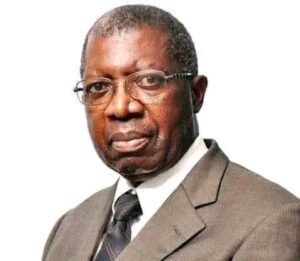
By Our Staff Reporter
“I thank God I finished my term to the end,” former Vice President Cassim Chilumpha told _The Nation_ this week. “I didn’t enjoy the position as Vice-President.” His blunt description of the office as “hell” is not just a personal catharsis. It is a diagnosis of a constitutional and political dysfunction that has haunted Malawi since 1994.
Chilumpha served from 2004 to 2009 under President Bingu wa Mutharika. His tenure was marked by public fallouts, attempted impeachment, and a treason charge that was eventually dropped. But his latest remarks strip away the legal drama and point to a deeper problem: the office of Vice President in Malawi exists on paper with constitutional weight, yet in practice it survives at the mercy of the President’s goodwill.
The Constitution grants the Vice President real responsibilities. They are first in the line of succession, sit on the National Security Council, and are meant to act as a check on presidential overreach. Yet successive administrations have reduced the role to ceremonial duties, sidelining deputies from cabinet decisions, policy design, and state functions. When the Vice President is excluded from the inner circle, the office becomes a gilded cage. You carry the title, the security detail, and the public expectations, but you lack the authority to act.
This
is not unique to Chilumpha. Justin Malewezi spoke of similar frustrations. Saulos Chilima, before his death in the 2024 plane crash, also publicly clashed with the presidency over the limits of his mandate. The pattern is clear: Malawi’s political culture centralizes power in the presidency to a degree that renders the deputy role dysfunctional. The result is a system that wastes talent, breeds suspicion at the top, and weakens executive continuity.
The implications are serious for governance. A sidelined Vice President cannot effectively deputize, mediate cabinet tensions, or prepare for succession. In a country where presidential health and stability have been recurring issues, that is a national risk. It also erodes public trust. Citizens see an office that costs taxpayers money but delivers little, reinforcing cynicism about political elites.
Chilumpha’s language matters because it breaks the silence that usually surrounds this problem. Politicians rarely admit that the system is broken while they are in it. By calling it “hell” after leaving office, he forces the country to confront a question it has avoided for 30 years: do we want a Vice Presidency that matters, or do we want a ceremonial placeholder?
Fixing this requires more than goodwill. It requires institutional reform. Parliament should consider legislation that codifies specific portfolios and decision-making powers for the Vice President, making them less dependent on presidential delegation. The Public Appointments Committee could scrutinize how the office is structured at the start of each term. Civil society and the media must keep tracking whether deputies are given real work or reduced to ribbon-cutting.
There is also a cultural shift needed. Malawi’s politics still treats the presidency as a winner-takes-all prize. Until that changes, deputies will be seen as threats, not partners. The country cannot afford that mindset. With economic pressure, infrastructure deficits, and regional diplomatic demands mounting, Malawi needs an executive that functions as a team, not a monarchy.
Chilumpha’s “hell” should not be dismissed as sour grapes. It is a warning. If the office of Vice President remains a place where capable leaders feel powerless and relieved to escape, then the problem is not the individuals who hold it. The problem is the system that creates them. And systems can be changed.