

By Apengie Apengire
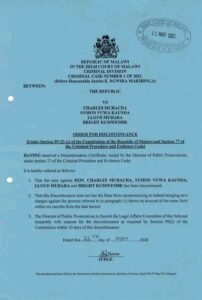
The recent decision by the Director of Public Prosecutions (DPP), Fostino Maele to drop the corruption case against former Cabinet ministers Charles Mchacha and Symon Vuwa Kaunda, along with other officials involved in the Lilongwe land acquisition scandal, has once again cast a shadow over the Democratic Progressive Party’s (DPP) much-touted commitment to fighting corruption.
Reported by the Daily Times, the discontinuance of these charges is not just a legal technicality—it is emblematic of a deeper malaise of selective justice that continues to plague Malawi’s political landscape.
At the heart of this controversy is the apparent double standard in how corruption cases are handled depending on who is involved.
When corruption allegations target ordinary citizens, the full weight of the law is brought to bear, often resulting in protracted legal battles, arrests, and harsh penalties.

However, when those accused belong to the ruling DPP, the narrative suddenly shifts—corruption becomes negotiable, cases get dropped on procedural grounds, and accountability is elusive.
The discontinuance of the Mchacha case, certified by Judge Edda Ngwira-Mwakibinga highlights procedural technicalities cited by the Anti-Corruption Bureau (ACB) and the DPP as justification for dropping the charges.
Yet, the timing and pattern of these decisions suggest a deeper political interference that undermines the principles of transparency and fairness. The ruling states that the ACB failed to obtain prior consent from the DPP within the required timeframe, thus rendering the prosecution invalid. While legal procedures must be respected, such technicalities should not be used as shields to protect the politically connected from due process.
This practice of shielding party elites from corruption charges is eerily reminiscent of the past, when the Malawi Congress Party (MCP) was accused of similar selective enforcement.
Back then, the MCP was criticized for protecting its own while punishing political opponents and common citizens. Today’s DPP, which has often branded itself as a beacon of integrity and good governance, appears to be repeating these mistakes, eroding public trust and fostering cynicism among Malawians.
The implications of this selective justice are far-reaching. Corruption thrives when those in power are immune from its consequences. This breeds a culture of impunity that stifles development, discourages foreign investment, and undermines democratic institutions. Moreover, it sends a dangerous message to the public: corruption is acceptable if you belong to the right party, but a crime if you are an ordinary citizen.
DPP’s failure to uphold its anti-corruption promises not only damages its credibility but also weakens the entire justice system. The fact that the DPP government is comfortable dropping cases involving its senior members while continuing to prosecute lesser-known individuals contributes to a polarized society where the rule of law is unevenly applied.
The DPP’s selective justice also contradicts the very principles enshrined in Malawi’s Constitution, which guarantees equality before the law. When citizens see political elites walk free despite credible allegations of corruption, it breeds disillusionment and apathy towards governance. This risks creating a vicious cycle where corruption becomes normalized and accountability becomes a foreign concept.
In analyzing the Daily Times report and the broader context, it is clear that the current leadership’s much-vaunted “proven leadership” is increasingly being exposed as a leadership failure.
The discontinuance of the Mchacha case is a stark reminder that political expediency often trumps justice in Malawi’s fight against corruption.
For Malawi to move forward, it is imperative that the DPP and all political actors commit genuinely to impartial justice. This requires strengthening the independence of institutions like the DPP office and the Anti-Corruption Bureau, ensuring that no one is above the law, regardless of party affiliation or political stature.
The dropping of the Mchacha land acquisition case is not an isolated incident but part of a disturbing trend of selective justice that undermines Malawi’s democratic values. Corruption should never be tolerated—be it by commoners or by those in the corridors of power.
The DPP must rise above political considerations and demonstrate true leadership by holding all individuals accountable equally. Until then, Malawi’s dream of a corruption-free society will remain just that—a dream.