


By Burnett Munthali
A campaign poster circulating online under the banner of the United Transformation Movement (UTM) has drawn ridicule and criticism after a glaring spelling error turned a political title into the name of a life-threatening disease.
Instead of presenting Goodluck Majamanda as a candidate for “Councilor,” the poster urged voters to support him “for Cancer,” a mistake that has quickly become a symbol of carelessness in political communication.
The blunder has prompted questions about the competence of both the designer who produced the material and the party officials who approved it for public release.
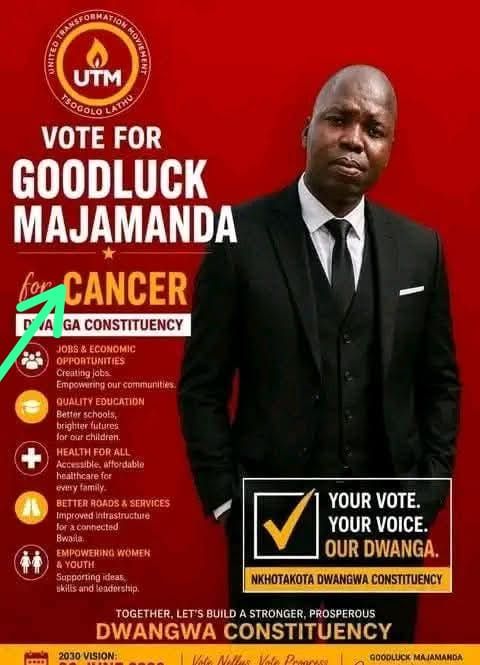
In modern politics, campaign posters are more than decorative items. They function as public statements that reflect a party’s discipline, seriousness, and preparedness.
The failure to distinguish between “Councilor” and “Cancer” is not a minor typo that can be dismissed as human error.
It is a fundamental mistake that alters the meaning of the message and exposes a lack of proofreading, professionalism, and attention to detail.
The error is more striking given that campaign materials are usually reviewed by multiple people before publication.
For such a visible mistake to pass through every stage of approval suggests either negligence or a culture of mediocrity within the campaign structure.
Political communication experts note that spelling errors in campaign materials can erode credibility, since voters often equate language accuracy with competence and leadership ability.
When a political team misspells the office its candidate is seeking, voters naturally question whether that team can manage public offices, budgets, and development programs effectively.
The incident has also renewed concerns about declining quality control across political parties in Malawi.
Instead of releasing polished and professionally reviewed materials, some actors appear focused on pushing content to social media without basic verification.
The mistake is particularly damaging because it involves a word associated with pain, suffering, and death.
Substituting “Cancer” for “Councilor” unintentionally creates an offensive message that many observers view as politically self-defeating.
Rather than building confidence, the poster has become a target of mockery and online satire.
Social media users have cited the error as evidence of incompetence, questioning whether qualified professionals were involved in the campaign.
Others have criticized the designer directly, arguing that anyone handling political branding should have basic spelling and editing skills.
Graphic design in politics is not only about colors, images, and logos. It is about conveying messages clearly, accurately, and professionally to voters.
A single spelling mistake can derail the intended message and shift public attention from policy to embarrassment.
In this case, the poster’s political objective has been overshadowed by one avoidable error.
Critics have also questioned the silence of party officials who allowed the material to circulate without an immediate correction or apology.
In serious political environments, a communication failure of this scale would typically lead to disciplinary action or the withdrawal of the material.
The incident illustrates how weak internal processes can damage a party’s image more effectively than opposition attacks.
Opposition parties often invest resources to embarrass rivals, but in this instance the damage appears self-inflicted.
The controversy may seem humorous on the surface, but it points to deeper issues of standards, competence, and professionalism in political operations.
Voters expect campaign teams to demonstrate accuracy, discipline, and respect for the electorate.
When basic communication fails at the poster level, public confidence in broader leadership capacity can erode.
For many observers, the incident is not just about a spelling mistake. It is about what that mistake reveals regarding oversight, preparedness, and regard for voters.
The poster was meant to market a candidate. Instead, it has marketed confusion, carelessness, and avoidable embarrassment on a national stage.